
🕑 6 min read
The man about to set interest rates for a $28 trillion economy owns Solana, Compound, and dYdX.
The average Bitcoin holder selling today? Losing money.
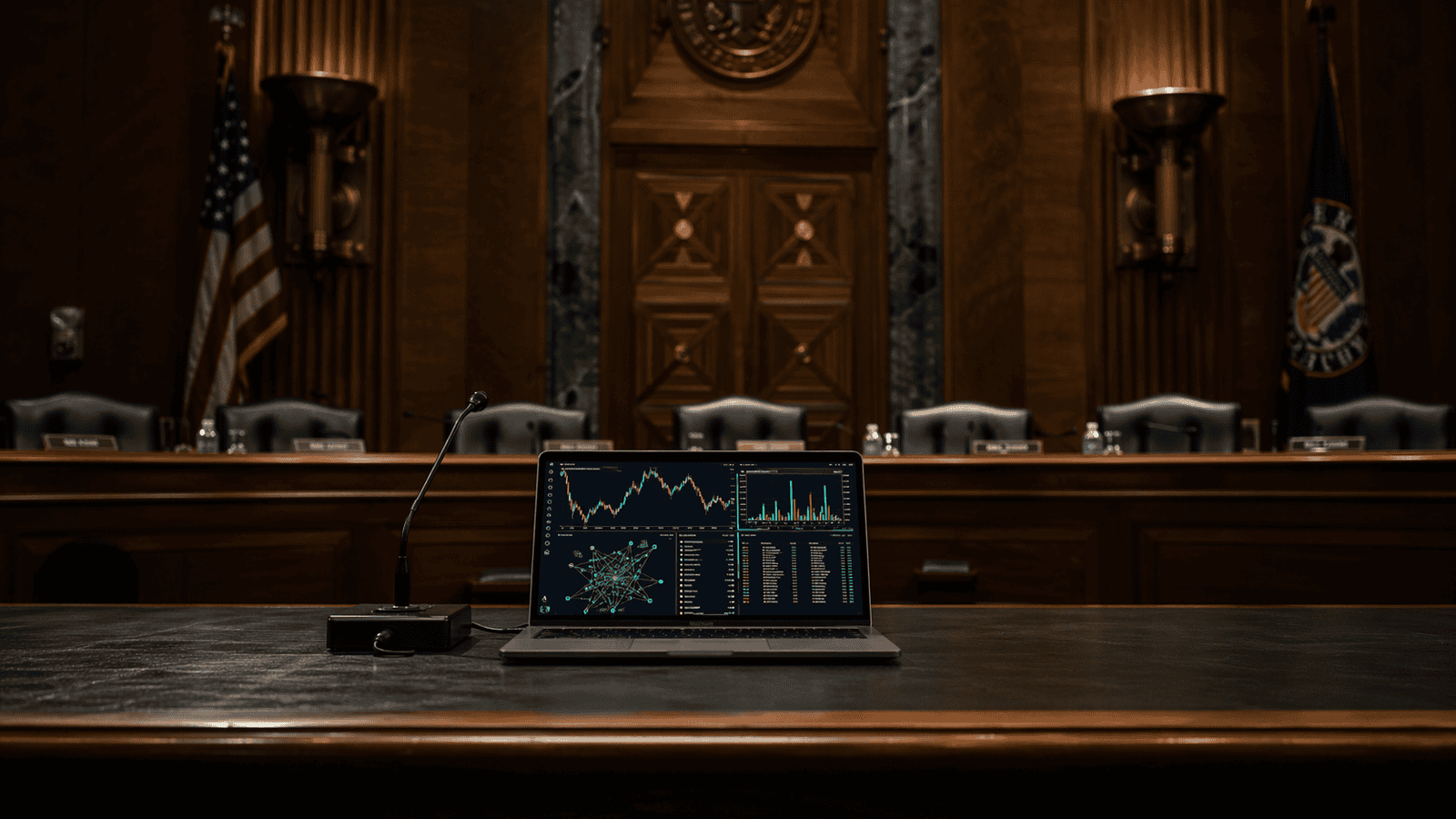
Kevin Warsh, Trump’s nominee for Federal Reserve chair, sat before the Senate Banking Committee on April 21 with more than $100 million in disclosed crypto and blockchain investments. No G7 central bank leader has ever held that much digital asset exposure.
He’s promised to divest everything. But the signal – that crypto is now woven into the financial establishment’s DNA – can’t be unsold.
Key Takeaways
- Kevin Warsh disclosed $100M+ in crypto holdings – including Solana, Compound, dYdX, Polymarket, and Optimism – making him the first Fed Chair nominee with documented digital asset exposure above $100 million.
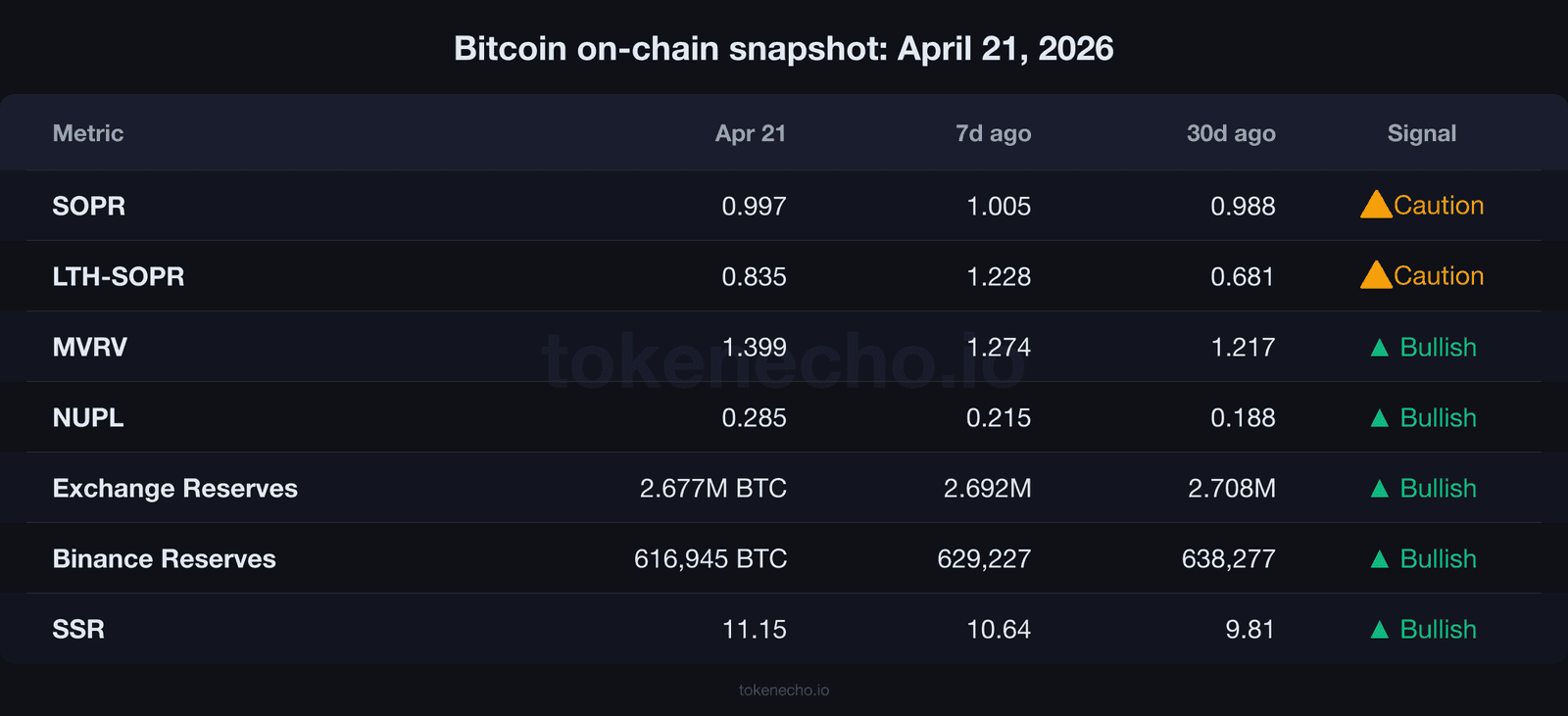
- Bitcoin’s SOPR has spent most of April below 1.0, meaning sellers lock in losses even as BTC rallied 15% from $66K to $75.3K. Long-term holders sell at a 16.5% loss (LTH-SOPR 0.835).
- Binance lost 21,332 BTC ($1.6 billion) in 13 days – 70% of all exchange outflows – while Strategy overtook BlackRock as the world’s largest institutional Bitcoin holder at 815,061 BTC.
A $100M crypto portfolio and the keys to interest rates
Warsh’s disclosure, filed with the U.S. Office of Government Ethics on April 14, reads like a crypto VC’s deal memo. Through fund vehicles DCM Investments 10 LLC and a series labeled AVF I through III, he holds equity in Solana, Optimism, Blast, Compound, dYdX, Polymarket, and Bitcoin infrastructure firms including Lightning Network operator Flashnet.
That’s not a dabble. That’s a thesis.
“Central bank independence is essential,” Warsh said during the hearing, pushing back against pressure to cut rates. But he also argued that AI-driven productivity gains could justify lower rates without reigniting inflation – a stance that, if enacted, would pump every risk asset in his portfolio.
He’ll have to sell it all if confirmed. A Fed Chair who genuinely understands Compound’s lending pools and dYdX’s order book mechanics won’t forget those insights just because he signed a divestiture agreement – and Senator Thom Tillis has vowed to block the nomination until the DOJ drops its inquiry into Jerome Powell, so the timeline stays unclear.
For crypto, the precedent matters more than the portfolio.
The last time a major institutional signal landed this loud was June 2023, when Larry Fink filed for the IBIT ETF. Bitcoin sat at $26,000 with an MVRV, the market-value-to-realized-value ratio comparing Bitcoin’s price to its aggregate cost basis, around 1.35. Nine months later: $73,000. A 192% rally.
Bitcoin rallied 15% – sellers still can’t break even
Why can’t Bitcoin holders make money even during a rally?
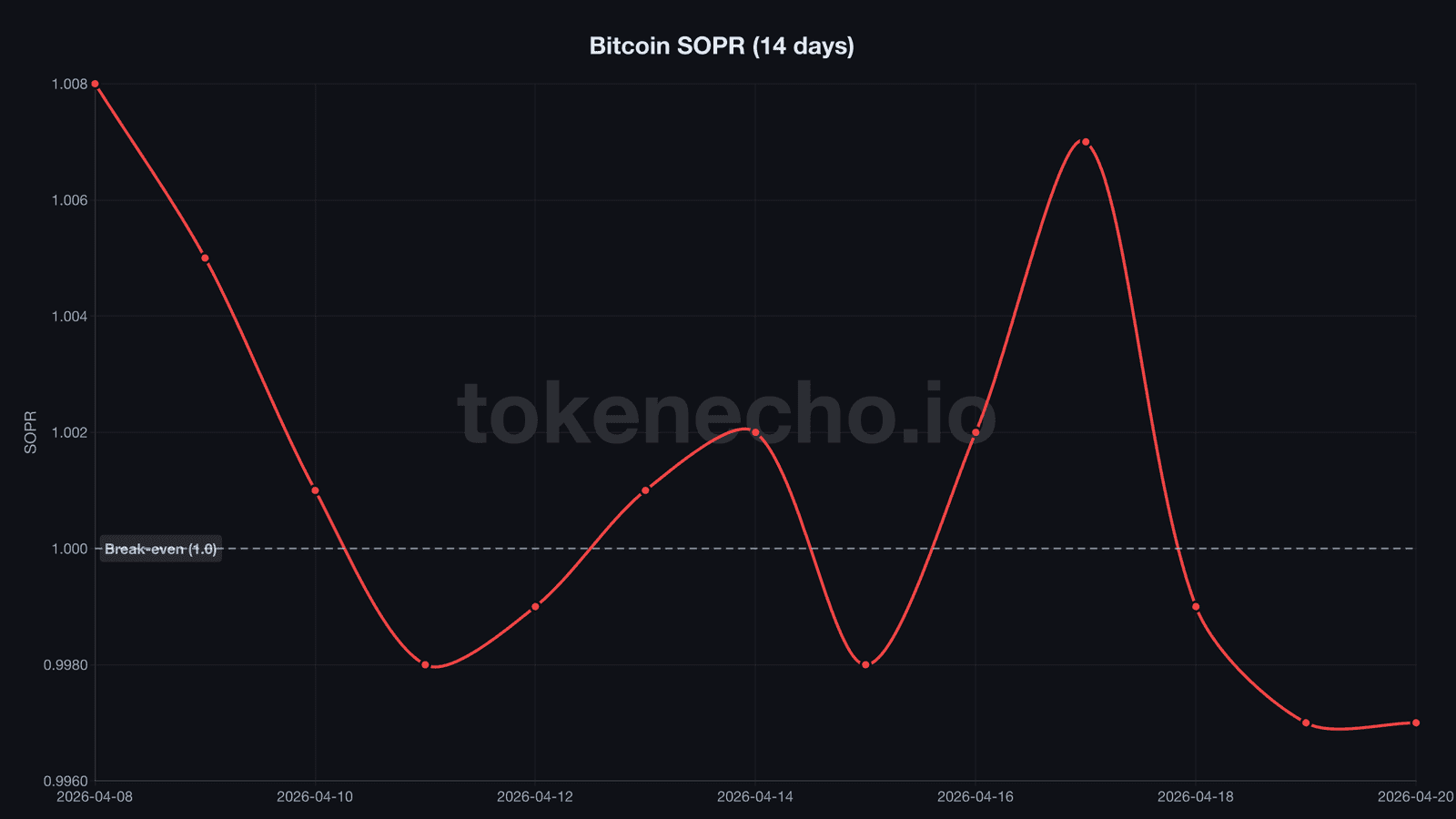
SOPR, the spent output profit ratio that tracks whether coins are sold at a gain or loss, printed 0.997 on April 20. Below 1.0 means the average seller is locking in a loss. And SOPR has been underwater for most of April – despite BTC climbing from $66,000 to $75,331, a 15% surge that still hasn’t turned sellers profitable.
Long-term holders are faring worse. LTH-SOPR, which isolates coins held longer than 155 days, crashed to 0.835.
These aren’t panic sellers. They’re veterans who bought above $90K during Q4 2025 euphoria – now eating a 16.5% loss on every coin they move. We saw the same pattern when Bitcoin’s longest panic since FTX ended and survivors immediately sold at a 20% loss.
We’ve tracked this divergence for weeks. It mirrors the FTX aftermath in late 2022: battle-tested holders capitulate into institutional buyers’ open arms while the market quietly heals from underneath.
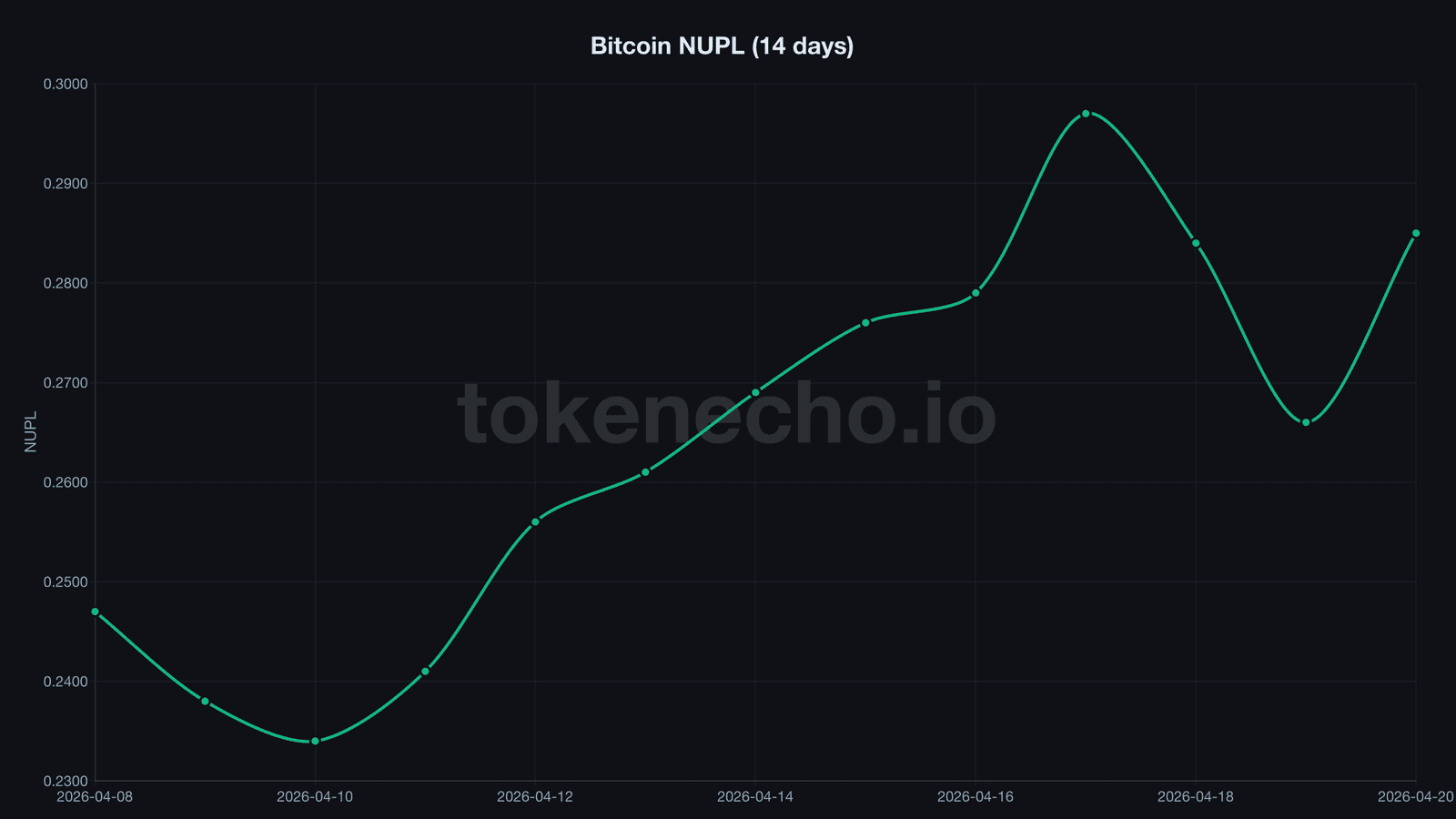
NUPL, the net unrealized profit/loss ratio measuring how much paper gain or pain sits across the network, recovered to 0.285 from the 0.188 capitulation zone touched in March. Fragile progress. One bad geopolitical headline – say, Iran’s ceasefire collapsing tomorrow – and NUPL slides right back toward the red zone.
It’s the crypto equivalent of selling your house at a loss during a recession while BlackRock quietly buys the entire neighborhood.
21,000 BTC left Binance in 13 days – someone’s buying every coin
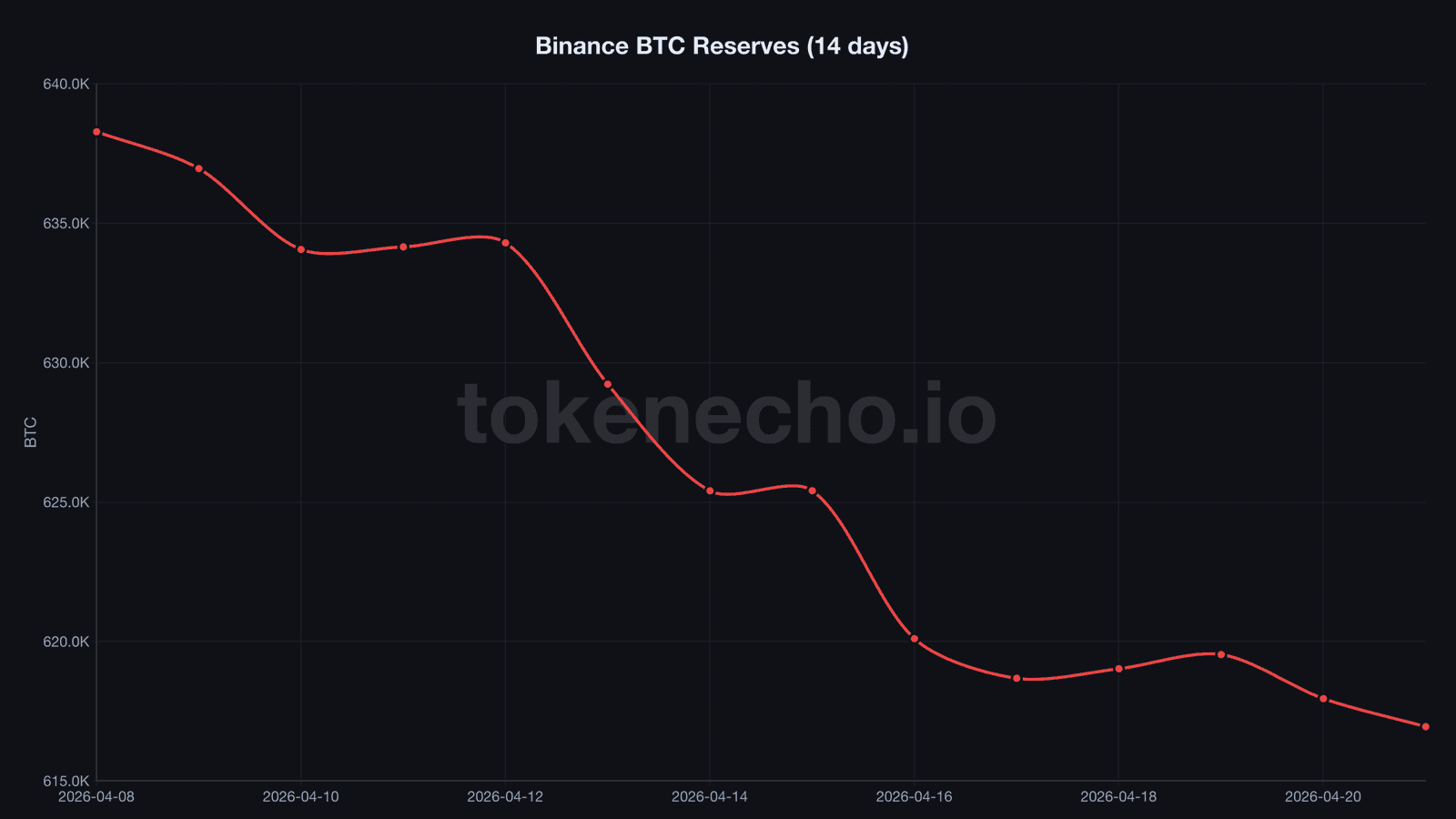
From April 8 to April 21, Binance’s BTC reserves dropped from 638,277 to 616,945. That’s 21,332 BTC gone – roughly $1.6 billion, accounting for 70% of all exchange outflows during the period.
On April 13, netflow hit -5,065 BTC. Three days later, -5,303 BTC. The drain hasn’t stopped.
So where did it all go?
Strategy just answered that. Michael Saylor’s firm bought 34,164 BTC for $2.54 billion between April 13 and 19, pushing total holdings to 815,061 BTC – surpassing BlackRock’s IBIT for the first time since Q2 2024. Strategy now controls nearly 4% of all Bitcoin in circulation.
“Old whales are selling to TradFi,” said Ki Young Ju, CEO of CryptoQuant.
All-exchange reserves fell to 2,677,642 BTC – a new cycle low. Goldman Sachs filed its first-ever Bitcoin ETF last week, and Morgan Stanley’s MSBT already launched at a record-low 0.14% fee.
Across the Pacific, Nomura’s latest survey found that 79% of Japanese institutional investors plan crypto allocations by 2029. The demand pipeline isn’t slowing. It’s accelerating.
The stablecoin supply ratio, SSR, which measures Bitcoin’s market cap relative to stablecoin purchasing power, climbed to 11.15. That puts roughly $148 billion in stablecoins on the sidelines – dry powder that hasn’t fired yet.
The last time institutional signals stacked this high
June 2023. Bitcoin at $26,000. BlackRock files for IBIT.
Nine months later, BTC hit $73,000. A 192% rally.
Today’s MVRV: 1.399. In June 2023, it was 1.35. Almost identical.
But the signal stack today dwarfs anything we saw three years ago – Goldman Sachs is filing its first Bitcoin ETF, Strategy swallowed $2.54 billion in BTC during a single week, Japan’s largest brokerage says four out of five institutional clients want crypto exposure by 2029, and the man nominated to lead the Federal Reserve has a personal portfolio that includes decentralized lending protocols and Layer 2 networks.
Current setup rhymes – but the macro cuts deeper. Bitcoin sits 40% below its October 2025 ATH of $126,080, Iran’s ceasefire expires April 22, and SOPR below 1.0 means the pain trade hasn’t fully resolved. If the 2023 template repeats from these levels, $75K reaches $145K by early 2027. That’s not a prediction. That’s arithmetic from the last cycle.
Whether the same math holds depends on one variable: can the institutional bid absorb everything retail keeps dumping?
On-chain scorecard (3 of 6 bullish)
✅ Exchange reserves: 2.677M BTC, cycle low – supply squeeze intensifying
✅ Binance drain: -21,332 BTC/$1.6B in 13 days – accelerating institutional accumulation
✅ NUPL: 0.285, recovering from 0.188 capitulation – momentum building
⚠️ SOPR: 0.997, sellers still underwater – break-even hasn’t arrived
⚠️ LTH-SOPR: 0.835, veterans selling at 16.5% loss – late-cycle distribution ongoing
❌ Puell Multiple: 0.696, miner revenue down 30% vs yearly average – miners under stress
TokenEcho Verdict
Direction: Cautiously bullish
Key level: $78,240 – April high and the wall where the rally stalled. A breakout with volume confirms the institutional accumulation thesis.
Risk factor: Iran ceasefire expires April 22; Warsh confirmation blocked by Sen. Tillis. Either catalyst could reverse the rally within 48 hours.
This is an analytical assessment, not financial advice.
What to watch in the next 48-72 hours
- $78,240 breakout with daily volume above $45B → bullish confirmation, opens the path toward $80K psychological resistance
- Iran ceasefire deadline April 22 – collapse triggers oil spike and risk-off rotation; BTC support sits at $72K
- Senate Banking Committee scheduling for Warsh confirmation vote – Tillis blockade introduces policy uncertainty that derivatives markets haven’t priced in
This analysis builds on our daily Bitcoin price tracking. For a full data-driven BTC outlook through 2030, see our Bitcoin price prediction.
The on-chain signals say accumulation. The geopolitical calendar says chaos. Which force breaks first?
This is not financial advice. DYOR. Data as of April 21, 2026.
Sources:
CryptoQuant – SOPR, LTH-SOPR, MVRV, NUPL, exchange reserves, Puell Multiple, SSR
CoinGecko – BTC price, market cap, supply data
U.S. Office of Government Ethics – Warsh financial disclosure (April 14, 2026)
Nomura Holdings – 2026 Institutional Investor Survey (April 16, 2026)
Strategy Form 8-K – April 20, 2026
Leave a Reply