

🕑 5 min read
Ethereum trades at $2,044. Down 59% from its all-time high. ETH/BTC just printed a five-year low at 0.0305, and dominance has faded to roughly 10%.
Almost nobody’s paying attention.
That might be the most bullish signal on the entire blockchain.
1.2 Million ETH Left Exchanges in 30 Days – Where Did It Go?
On March 6, exchanges held 16.02 million ETH. By April 4, that figure dropped to 14.83 million.
Nearly 1.2 million tokens – $2.4 billion at today’s prices – moved off platforms and into cold storage, staking contracts, or DeFi protocols. And the pace didn’t taper off. It accelerated.
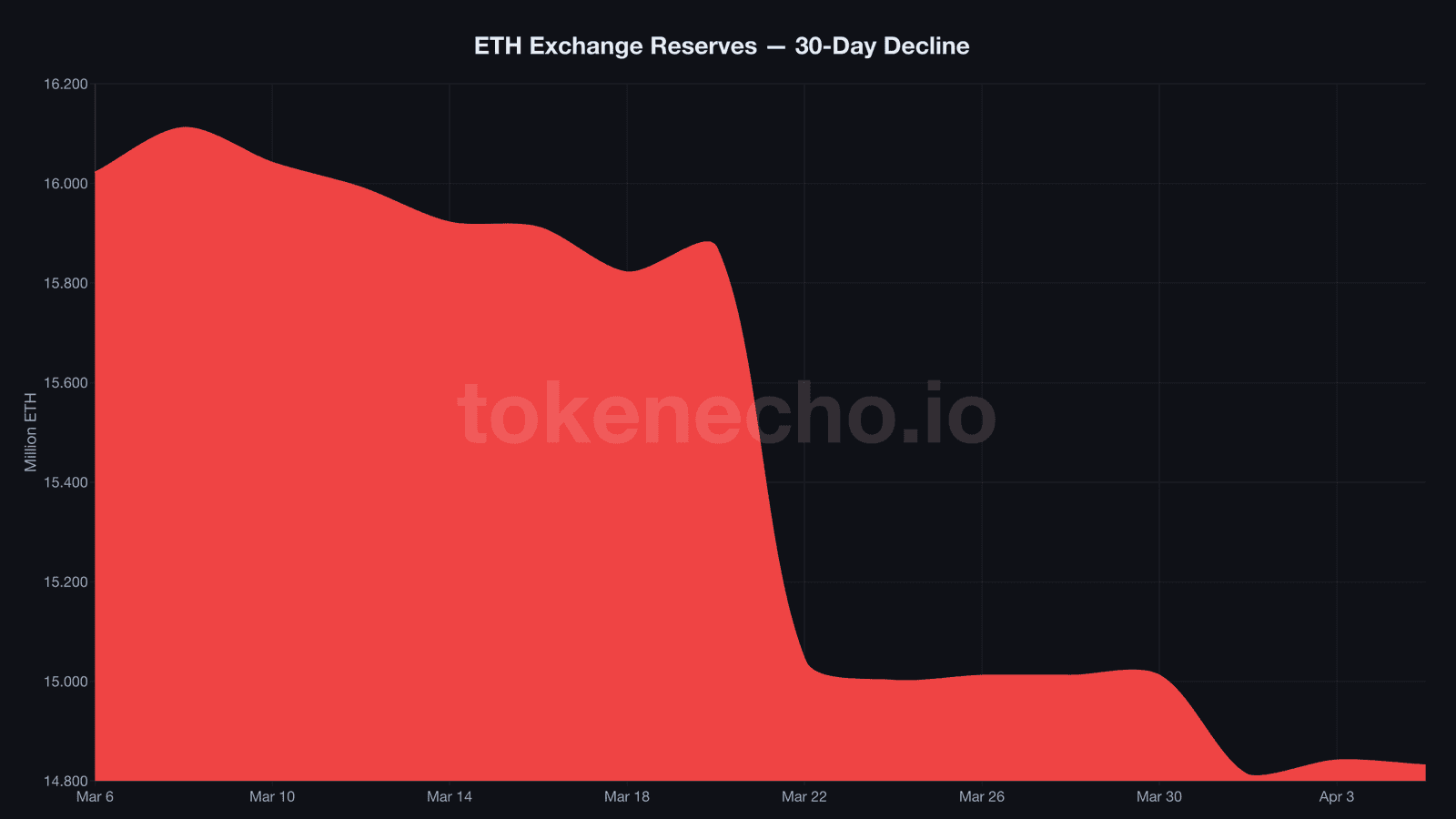
On March 22 alone, 827,364 ETH left exchanges in a single 24-hour window. That’s $1.7 billion worth of Ethereum disappearing on a random Friday during a bear market – the kind of outflow usually triggered by an institutional custody migration, not apathy.
But the outflows aren’t the loudest signal. The inflows are.
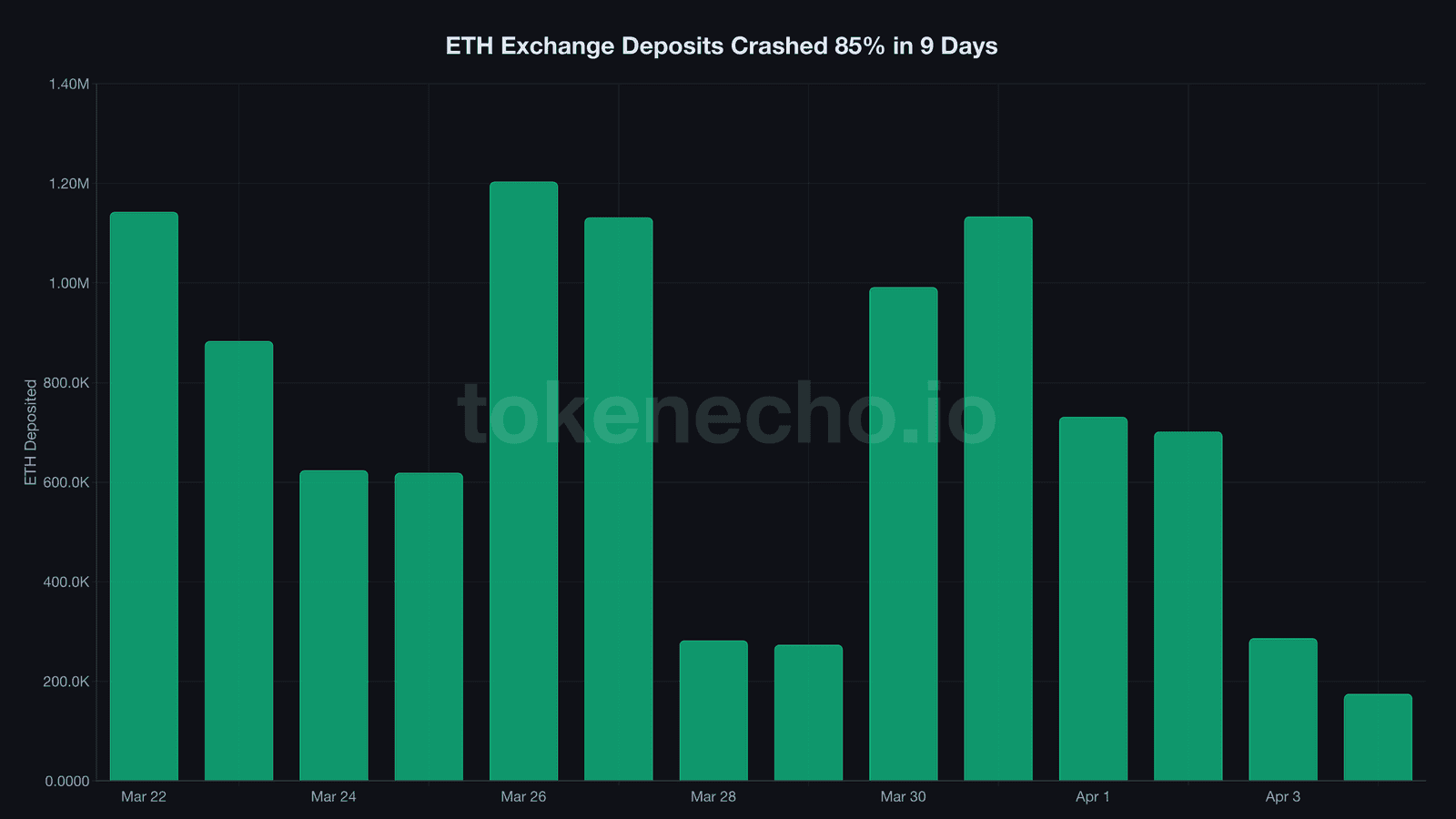
Exchange deposits – ETH sent to platforms before being sold – collapsed from 1.2 million on March 26 to just 174,672 by April 4. An 85% crash in nine days.
Sellers didn’t slow down. They evaporated.
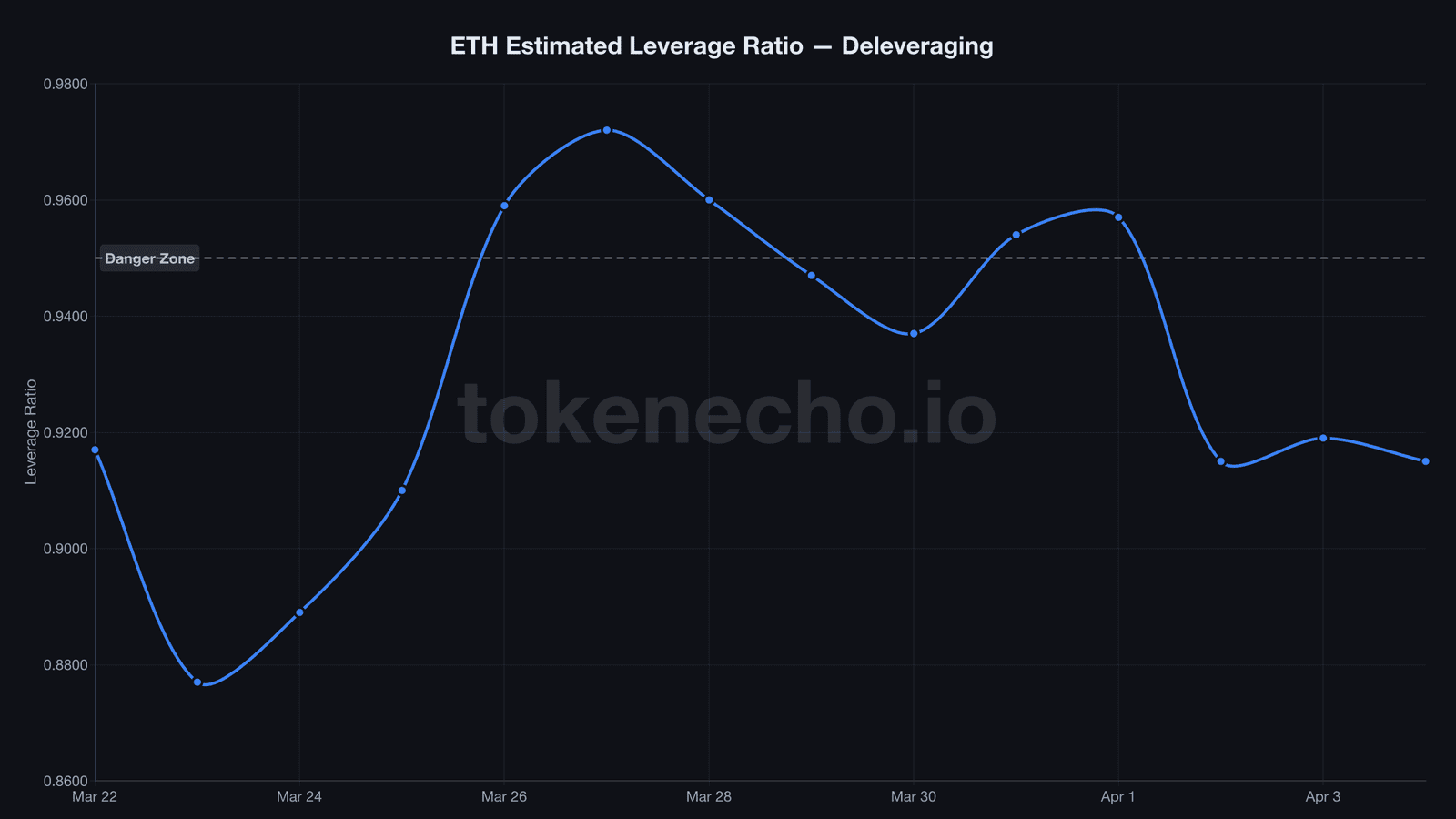
The estimated leverage ratio, a metric comparing derivative open interest to actual exchange reserves, declined steadily from 0.972 in late March to 0.915 by April 4. Traders aren’t building new bets. They’re unwinding old ones.
If a move comes, it’ll be spot-driven. Not liquidation-fueled.
It’s the crypto equivalent of a department store where shelves are emptying and nobody’s restocking. Except the people grabbing inventory aren’t planning to return it.
Ethereum’s Most Notorious Seller Just Staked $143 Million
For years, the Ethereum Foundation funded operations by doing the one thing that drove every ETH holder mad: selling tokens into the open market.
On April 3, that era ended.
The Foundation staked 45,034 ETH in a single day – $93 million – pushing its total staked position to nearly 70,000 ETH. At today’s prices, that’s $143 million locked into Ethereum’s own consensus layer, arriving in precise batches of 2,047 ETH each. Expected annual yield: between $3.9 million and $5.4 million.
Why stake at $2,044 when they could’ve waited for a recovery? That question answers itself.
And they aren’t alone. BlackRock’s staked ETH fund, ETHB, attracted $155 million on its first day in late March – beating BlackRock’s own Bitcoin ETF debut by 40%. Traditional ETH ETFs bled $2.76 billion over four months. But staked ETH products? Fresh money flowing in.
“Ethereum has entered a generational ‘Buy Zone,’” said Ali Martinez, a widely followed crypto analyst, pointing to ETH’s MVRV ratio – a metric that compares market price to the average investor’s cost basis. “Historically, this ‘fair value’ reset has been the precursor to massive structural bull rallies.”
Three selling pressures – the Foundation, exchange holders, and leveraged traders – all reversed direction within the same month. That kind of alignment doesn’t make headlines. It shows up in supply curves, quietly, while everyone argues about whether ETH is dead.
ETH Looked This Dead in 2018 – Then It Rallied 5,932%
Sound familiar?
December 2018. Ethereum at $82. Down 94% from its January peak. Dominance below 10%. The “Ethereum killer” narrative was everywhere – EOS, Tron, and NEO were supposed to bury it. Nobody built DeFi on Ethereum because the word didn’t exist yet.
From that $82 floor, ETH climbed to $4,946 by August 2025. A 5,932% rally stretched over six and a half years.
The current drawdown is shallower – 59%, not 94%. But the sentiment fingerprint looks almost identical: dominance cratering to 10%, a half-decade low against Bitcoin, institutional apathy measured in billions of ETF outflows, and retail capitulation that’s ground on for months without a single relief rally worth remembering.
What separates 2026 from 2018 is the infrastructure beneath the price.
Back then, Ethereum had no staking, no DeFi, no Layer 2 networks, no institutional products. Today it anchors $97.6 billion in DeFi TVL, processes transactions across over 900 Layer 2 operations per second alongside mainnet, and hosts BlackRock’s first-ever staking ETF.
The bear market stripped the price. It didn’t strip the foundation underneath.
Two Risks That Could Stall the Squeeze
None of this guarantees a rally. Two headwinds deserve honest attention.
ETH ETF outflows haven’t stopped. Traditional Ethereum funds hemorrhaged $2.76 billion in four months, and BlackRock’s staked product – while successful – has mostly cannibalized existing ETH ETF holders rather than attracting fresh institutional capital from the sidelines. Until net flows across all Ethereum products flip positive, demand stays fractured.
Then there’s the Layer 2 problem. L2 networks now handle 42 times more operations than mainnet. Great for users, brutal for ETH’s fee burn. The “ultrasound money” thesis needs activity on Layer 1, and that activity keeps migrating to Arbitrum, Base, and Optimism. Less burn means less deflationary pressure on the supply everyone’s watching drain from exchanges.
Both risks are real. But neither undoes supply mechanics. The 1.19 million ETH that left exchanges over 30 days won’t magically reappear on Binance because Arbitrum processed a few more swaps.
This analysis is part of our daily Ethereum price tracking. For our long-term outlook, see the Ethereum price prediction for 2026-2030.
Exchange reserves keep draining, the Foundation flipped from seller to staker, and the MVRV ratio signals historic undervaluation – yet the price sits flat at $2,044. If ETF outflows reverse while exchange deposits stay suppressed, the setup rhymes with late 2018. Until that happens, the spring keeps coiling.
This is not financial advice. Do your own research. Data as of April 5, 2026.
Sources
- CryptoQuant ETH exchange flow data: cryptoquant.com
- CoinGecko ETH market data: coingecko.com
- CoinDesk: Ethereum Foundation Stakes $93 Million Ether
- Ali Martinez analysis via U.Today
Leave a Reply