
🕑 6 min read
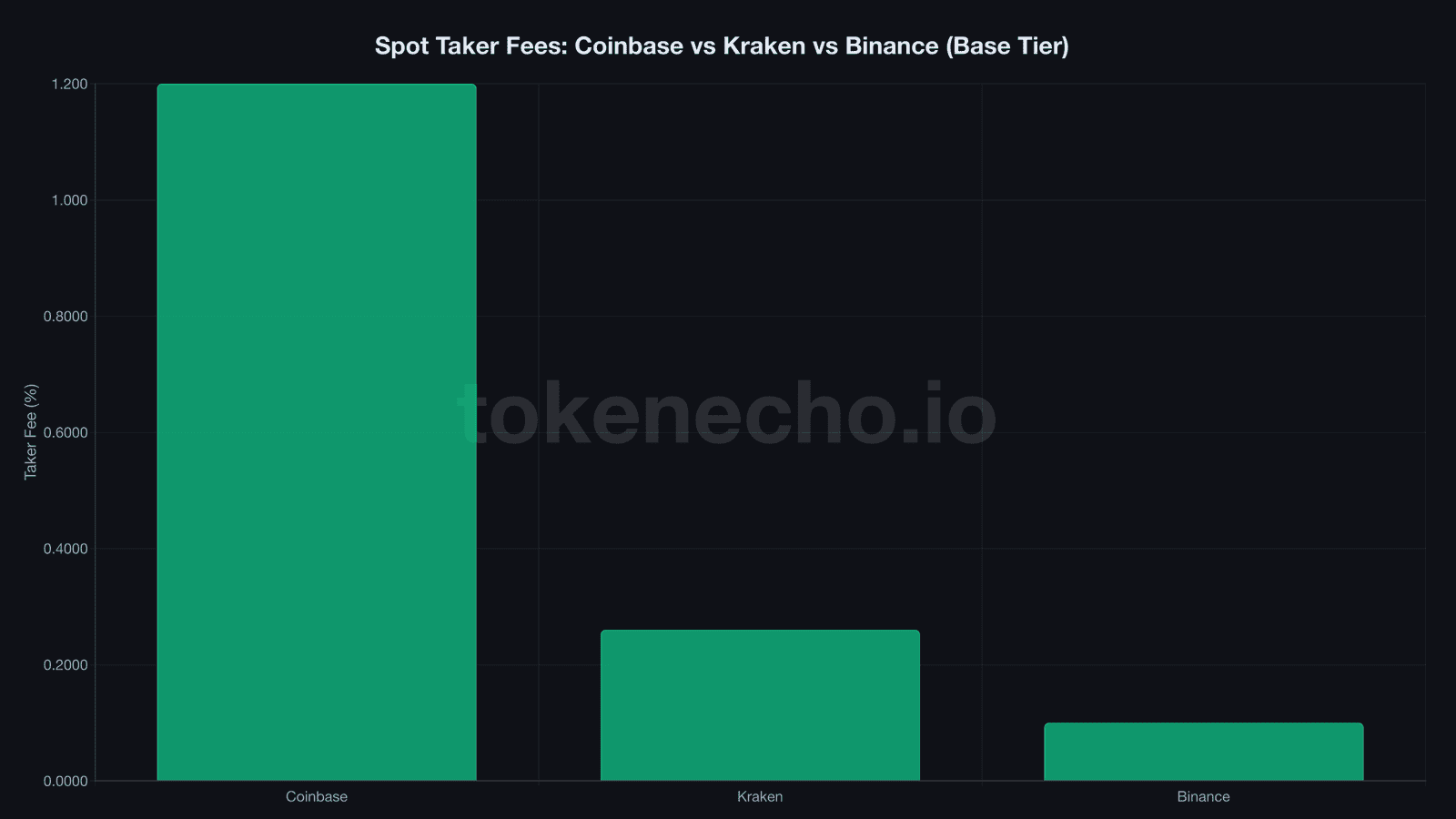
A $10,000 Bitcoin purchase costs $120 on Coinbase, $26 on Kraken, and $10 on Binance.
That’s not a rounding error. Coinbase charges 12 times more than Binance for the exact same BTC – and somehow keeps 60 million active users coming back. We pulled live fee schedules, security track records, and CoinGecko exchange data to figure out which platform actually earns your money in 2026. The answer isn’t as obvious as the fee table suggests.
Coinbase charges 12x more than Binance – and millions don’t seem to care
Everyone says they care about fees. The data says otherwise – Coinbase collects 59% of its revenue from transaction fees, according to S&P Global, at rates that make competitors look like a charity.
What each exchange charges at base tier for spot trading:
| Fee Type | Coinbase Advanced | Kraken Pro | Binance |
|---|---|---|---|
| Maker | 0.60% | 0.16% | 0.10% |
| Taker | 1.20% | 0.26% | 0.10% |
| $10K trade cost (taker) | $120 | $26 | $10 |
| Wire deposit | $25 | $5 | N/A |
| Staking commission | 35% | 0-15% | Varies |
But spot fees are just the cover charge.
Coinbase stacks on a 0.5% to 2% conversion spread for simple trades – the kind beginners default to. Debit card purchases run 3.99%. And staking through Coinbase means surrendering 35% of your rewards. Park $10,000 in ETH at 3.5% APY, and Coinbase pockets $122 of your $350 annual yield.
Kraken runs leaner. Wires cost $5. Staking commissions stay between 0% and 15% depending on the asset, and there’s no hidden conversion spread on Kraken Pro orders.
Binance is the cheapest by a mile – 0.10% flat, with 25% discounts for BNB holders. But there’s a catch we’ll get to.
“Coinbase’s fee structure is outrageous compared to what competitors charge for the same service,” said Alex Svanevik, CEO of blockchain analytics firm Nansen. He’s not wrong. For a trader doing $50,000 a month, the annual cost difference between Coinbase and Binance exceeds $6,600. That’s not pocket change – that’s a vacation fund.
Fees matter. Obviously. But the cheapest exchange in the world doesn’t help much if your funds disappear overnight. Ask anyone who kept money on FTX.
A $4.3B settlement, a data breach, and 14 years without a scratch
The last exchange to promise bulletproof security while cutting corners was FTX – it had celebrity endorsements, a $32 billion valuation, and zero customer funds remaining when the music stopped in November 2022. Security records matter more than marketing budgets, and these three exchanges carry very different histories.
Binance wrote the biggest check in crypto regulatory history. The $4.3 billion DOJ settlement in November 2023 addressed money laundering violations and sanctions evasion. CEO Changpeng Zhao pleaded guilty and served four months. President Trump pardoned him in October 2025.
The aftermath actually improved things. Richard Teng – a former Abu Dhabi FSRA and Singapore MAS regulator with decades of financial oversight experience – now runs operations, and the company has secured over 20 licenses globally including Abu Dhabi’s ADGM in January 2026. The SAFU emergency fund holds $1 billion in BTC (15,000 coins), and proof-of-reserves audits cover $215 billion in client assets.
One concern that hasn’t gone away: multiple senior compliance officers departed in March 2026. Compliance departures at a company still on probation are worth watching.
Coinbase has never lost customer funds to a hack. They store 98% of assets in air-gapped cold storage, carry FDIC insurance up to $250,000 on USD balances, and hold SOC 2 Type II certification. Being NASDAQ-listed since April 2021 means quarterly SEC financial audits – a level of forced transparency that no other crypto exchange can match.
The blemish: a May 2025 data breach exposed customer information. No funds were stolen, but it cracked the “fortress” reputation.
Kraken might have the cleanest record of all. Fourteen years of continuous operation since 2011 without a major security breach – that’s practically ancient in crypto terms. Regular proof-of-reserves reports. No DOJ settlements. No data breaches. It’s the Toyota Camry of crypto exchanges: nobody brags about owning one, but it doesn’t break down.
So you’ve got the reformed bad boy, the publicly traded institution, and the quiet veteran. All three earn CoinGecko’s maximum trust score of 10/10. The differences are in what keeps you up at night.
1,423 pairs vs 382 coins – what each platform actually lets you do
Binance lists 1,423 trading pairs. That number alone dwarfs everything else.
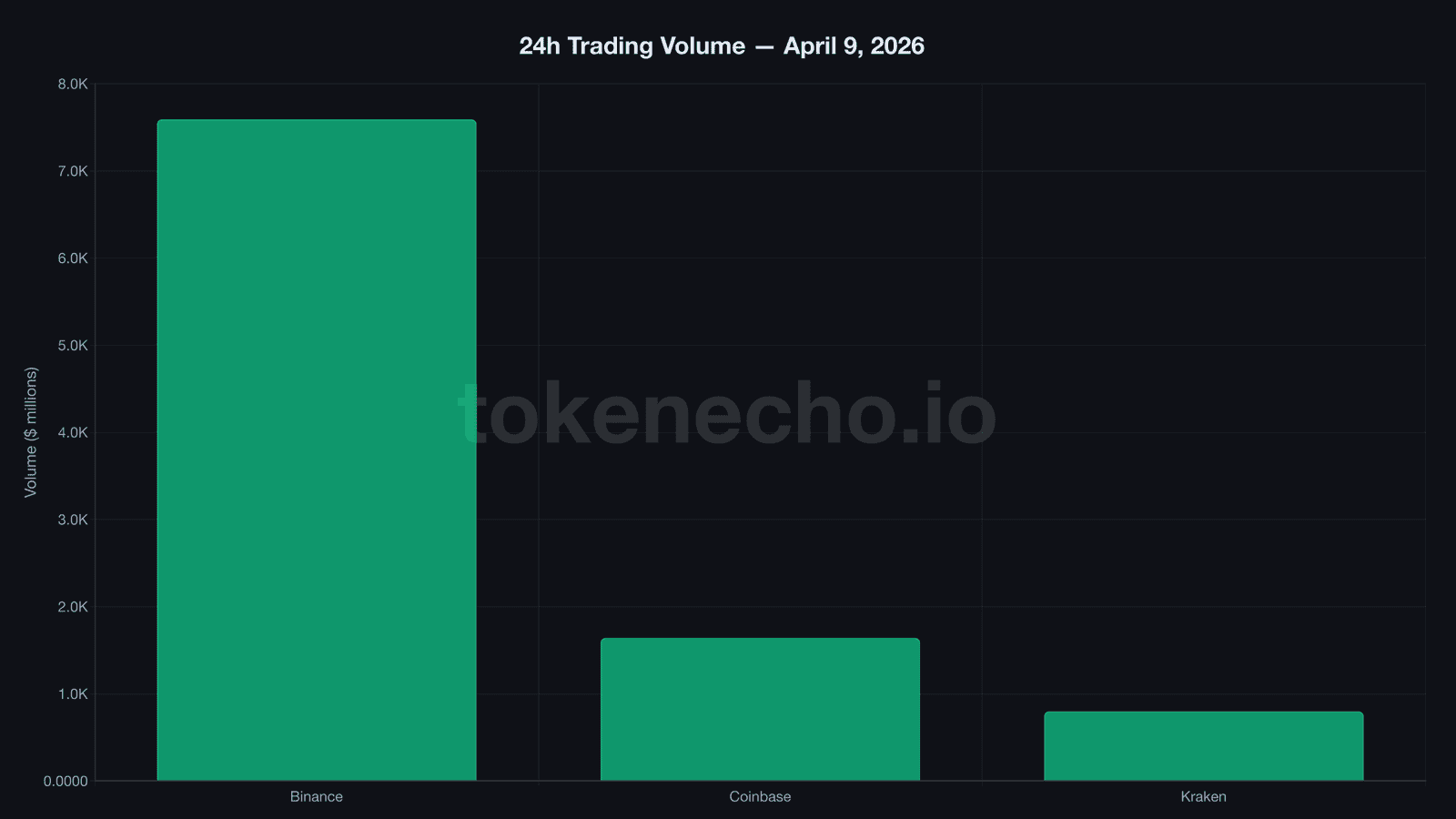
They’ve been adding products aggressively in 2026 – equity futures that let you trade Meta, Nvidia, and Google stock as perpetual contracts, plus crude oil futures with up to 100x leverage. Binance also dominates raw volume at $7.6 billion daily, roughly 39% of the entire global crypto market. If a financial instrument exists, Binance probably lists it.
Coinbase offers 382 coins and 132 staking assets with yields reaching 14% APY. Their real edge is the ecosystem. Base, Coinbase’s own Layer 2 network, has quietly become one of the top three L2s by total value locked – a bridge between centralized and decentralized worlds that neither competitor matches. Coinbase Wallet connects directly to DeFi protocols, making it a genuine earn-and-build platform, not just a trading venue.
Kraken splits the difference with 300+ coins, solid staking options, margin trading, and futures. The interface leans toward power users. Think Bloomberg Terminal energy, not Robinhood vibes.
The catch most comparison articles skip – Binance blocks Americans
Why do so many “best exchange” lists crown Binance when 330 million Americans can’t use it?
Binance doesn’t serve U.S. customers. Period. Binance.US exists as a separate entity, but it operates with a fraction of the liquidity, limited coin selection, and its own legal headaches – the SEC sued it in 2023.
For Americans, this three-way comparison is really a two-horse race: Coinbase vs Kraken. Binance is also restricted in the UK, Japan, and parts of the EU. The cheapest fees on earth don’t matter if you can’t access the platform.
Who wins – the answer changes depending on who you are
There’s no single winner. Anyone claiming otherwise is selling something.
Best for U.S. beginners: Coinbase. Yes, the fees sting. But the interface takes maybe ten minutes to learn, FDIC insurance covers your USD, and a NASDAQ listing means this company files quarterly with the SEC – it can’t vanish like FTX. You’re paying what amounts to the Apple tax of crypto: a premium for the brand, the ecosystem, and the peace of mind that comes with regulatory transparency. Start with Simple, then migrate to Advanced to cut your taker fee from roughly 1.5% to 0.60%.
Best for cost-conscious U.S. traders: Kraken. At 0.26% taker fees backed by a 14-year security record, Kraken delivers the best fee-to-trust ratio available to Americans. No DOJ baggage. No data breaches. No drama. A trader doing $50,000 monthly saves $5,640 a year versus Coinbase. That math gets hard to ignore once you’re past the beginner stage.
Best for global high-volume traders: Binance. Nothing competes on fees (0.10%), liquidity ($7.6 billion daily), or product depth (1,423 pairs). The $4.3 billion DOJ settlement paradoxically made Binance more compliant than it’s ever been – they simply had no alternative. If you’re outside the U.S. and trading serious volume, the numbers aren’t close.
| Category | Winner | Why |
|---|---|---|
| Lowest fees | Binance | 0.10% flat – 12x cheaper than Coinbase |
| Best security record | Kraken | 14 years, zero breaches |
| Best for U.S. beginners | Coinbase | FDIC insurance, NASDAQ listed, simple UI |
| Largest selection | Binance | 1,423 pairs, equity + oil futures |
| Best staking | Coinbase | 132 assets, up to 14% APY |
| Best DeFi integration | Coinbase | Base L2 + Coinbase Wallet |
| Best fee-to-trust ratio | Kraken | Low fees + zero incidents |
For detailed platform breakdowns, read our full Coinbase review, Kraken review, and Binance review. If Coinbase’s hidden costs caught you off guard, our deep dive on Coinbase Advanced Trade fees covers what most users miss.
Traditional brokerages are circling. Morgan Stanley just launched a BTC ETF that undercuts BlackRock by 44%, and Schwab has spot crypto trading in development. If $6 trillion in brokerage assets gets direct access to crypto, the entire exchange fee structure gets rewritten – and the winner of this comparison might look very different by 2027.
This is not financial advice. DYOR. Data as of April 9, 2026.
Sources
- CoinGecko Exchange API – trust scores, 24h volumes, exchange rankings (accessed April 9, 2026)
- S&P Global – Coinbase revenue breakdown (transaction fees as % of total revenue)
- U.S. Department of Justice – United States v. Binance Holdings Limited, settlement agreement (November 2023)
- Alex Svanevik, CEO of Nansen – public commentary on exchange fee structures
Leave a Reply