
🕑 5 min read
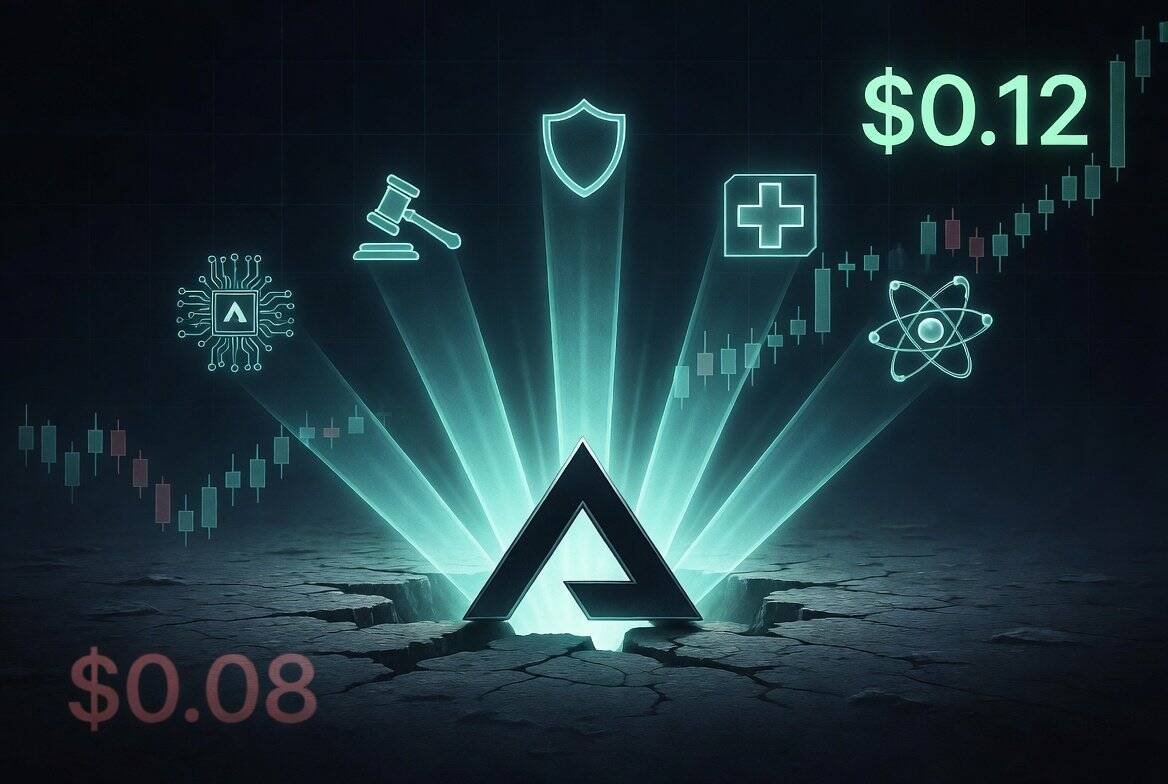
Algorand rallied 50% from near-record lows as a Google quantum paper, regulatory clarity, and institutional adoption converged in one explosive week.
Nobody wanted Algorand at $0.08.
ALGO, the native token of the Layer 1 blockchain built by MIT cryptographer Silvio Micali, spent most of Q1 2026 in freefall. It touched $0.08 in late March – within pennies of its all-time low set in February – while trading volume dried up and crypto media moved on to louder stories. At 96.5% below its 2019 all-time high of $3.56, Algorand looked like a relic.
Then five things happened at once. And ALGO became the biggest gainer in the top 100, surging 50% in a week to $0.1226 with $142 million in daily volume.
$0.08 and Falling – Then Five Things Happened at Once
The numbers paint a brutal picture of where ALGO was just days ago. On March 28, the token traded near $0.082 – a level that priced Algorand’s entire ecosystem, its 8.89 billion circulating tokens, and six years of development at roughly $730 million.
That’s less than what some DeFi protocols hold in a single liquidity pool.
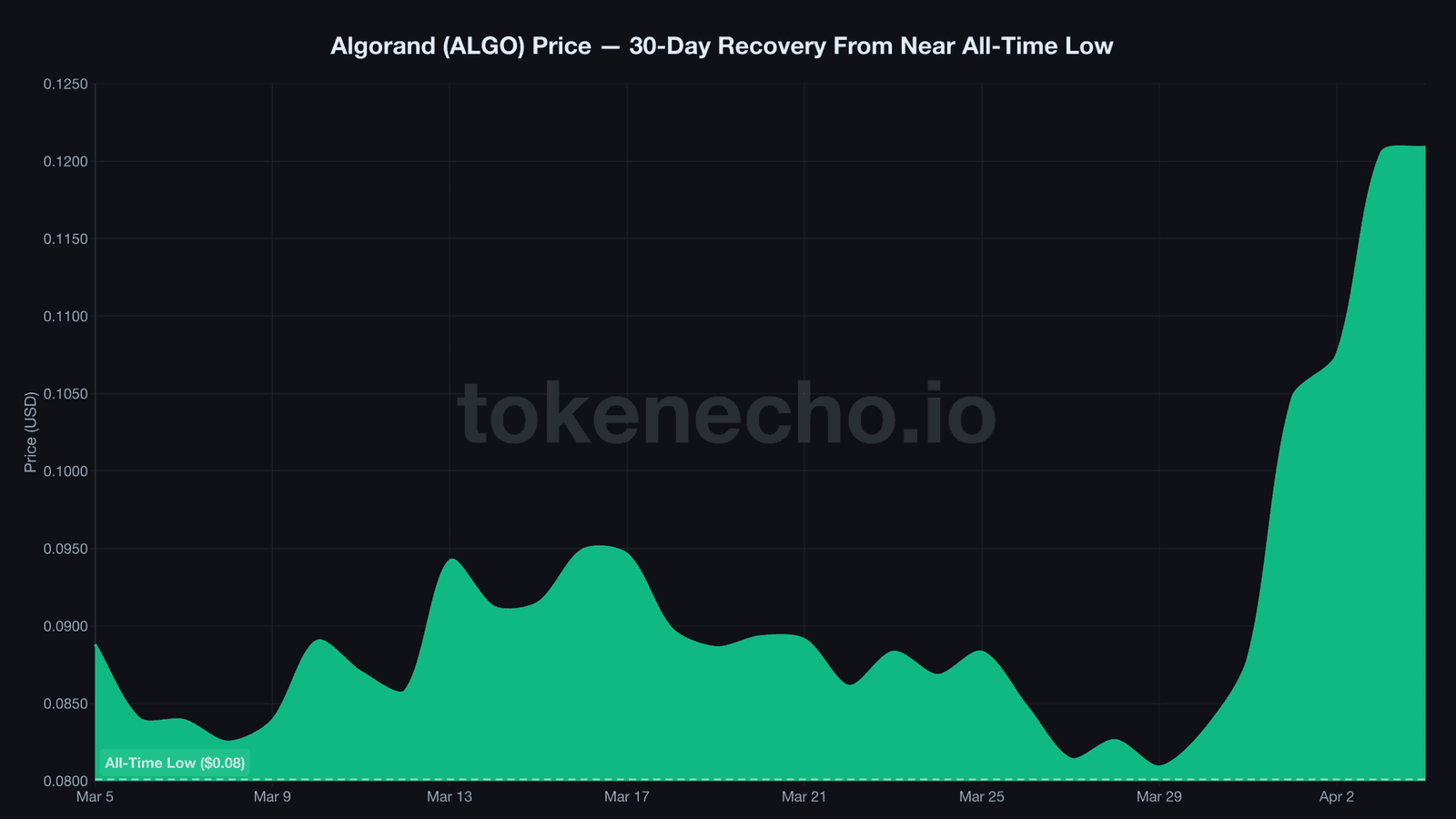
The 30-day chart was a flatline. The 200-day return sat at -48%. Even Algorand’s DeFi TVL, a measure of total capital locked in its smart contracts, had shriveled to $33 million. For a blockchain that once ranked in the top 20 by market cap, this was hospice care.
Google Didn’t Just Mention Algorand – It Featured It
On March 31, Google Quantum AI published a paper titled “Securing Elliptic Curve Cryptocurrencies against Quantum Vulnerabilities” – co-authored with Stanford and the Ethereum Foundation. We wrote about how that paper exposed $458 billion worth of Bitcoin to quantum attack. But buried in the same document was something else entirely.
Algorand was cited 32 times. More than any blockchain except Bitcoin and Ethereum.
What caught our attention isn’t the citation count – it’s what Google actually wrote. From page 32 of the paper:
“Algorand provides an example of real-world deployment of PQC on an otherwise quantum-vulnerable blockchain,” the researchers said. They highlighted that Algorand “has recently deployed post-quantum Falcon digital signatures for smart transactions and state proofs” – and made Falcon verification available as a native smart contract primitive.
In plain English: while Bitcoin and Ethereum are still debating how to protect against quantum computers, Algorand already shipped the fix. The price jumped 20-25% within 24 hours of the paper’s release.
It’s the crypto equivalent of a small pharma company getting name-dropped in an FDA breakthrough report. Except the FDA here is Google’s quantum computing division.
A Neobank, a Swiss State Bank, and the SEC Walk Into the Same Month
What happened next reads like someone scripted it.
On the same weekend the Google paper dropped, Revolut launched ALGO staking for its 70+ million users. That’s direct exposure to a token most neobank customers had never heard of – now available with one tap inside an app that serves more people than the population of France.
“The recent Algorand rally appears closely linked to the release of this Google Quantum AI paper,” said Illia Otychenko, Lead Analyst at CEX.IO. “The paper highlights Algorand’s real-world implementation and leadership in post-quantum cryptography.”
But the Google paper wasn’t the only catalyst.
PostFinance, a Swiss state-owned bank with 2.5 million customers, had already added ALGO to its platform in February – making it one of the first systemically important banks in Europe to offer direct Algorand trading. “Our customers want to trade cryptocurrencies with their trusted primary bank,” said Dr. Alexander Thoma, PostFinance’s Head of Digital Assets.
And then there’s the SEC and CFTC joint commodity framework from March 17. While ALGO wasn’t among the 16 primary assets named, it was specifically referenced as meeting digital commodity criteria – removing much of the securities-law uncertainty that had hung over the token for years.
The Algorand Foundation, meanwhile, completed its own restructuring. It relocated from Singapore to Delaware in January, unified all operations under one entity in March with a $15 million commitment to protocol development, and brought on a new board chaired by Bill Barhydt, the Abra founder. Silvio Micali himself endorsed the move: “I believe that having unified operations under Algorand Foundation leadership will greatly help Algorand to deliver on the promise of blockchain,” he said.
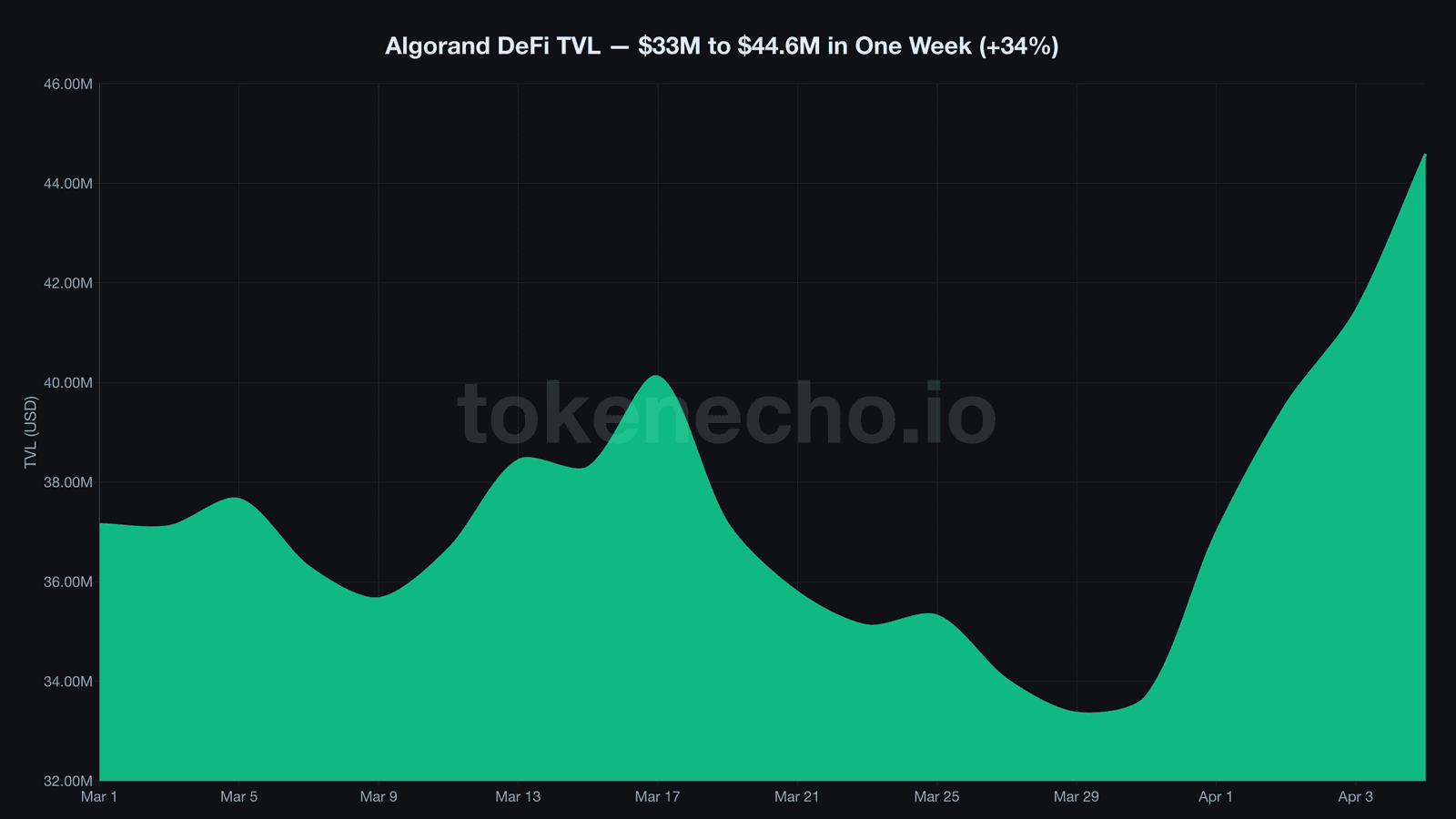
The DeFi side responded too. Algorand’s TVL surged to $44.6 million – up 34% in seven days – as protocols like Folks Finance and Tinyman attracted fresh capital.
Still 96% Below ATH – And the Foundation Just Cut Its Team
So is ALGO’s comeback real, or a dead cat bounce dressed in quantum clothes?
We’ve tracked enough L1 rallies to know the risks.
Start with the math. Even after a 50% pump, ALGO trades at $0.12 – still 96.5% below its $3.56 all-time high from 2019. Getting back to even $1 would require an 8x from here. The fully diluted valuation sits at $1.09 billion – meaningful, but nowhere near the heavyweights.
And the Foundation’s restructuring came with a cost: a 25% workforce reduction. Consolidating operations sounds clean. Laying off a quarter of your team during a rally sounds like a company watching its runway.
TVL tells a similar story. At $44.6 million, Algorand’s DeFi ecosystem is a rounding error compared to Ethereum’s $60+ billion or Solana’s $8+ billion. The 34% weekly growth is encouraging, but it started from a very small base.
The rally also carried on thin volume relative to top chains. And short-term profit-taking after a 50% surge in five days is virtually guaranteed.
If the Google quantum narrative holds while institutional products from Revolut and PostFinance drive sustained demand, ALGO could establish a new trading range above $0.10. But if this week’s momentum fades – and the quantum paper’s novelty wears off – the token has a very long way to fall back toward $0.08.
Until Algorand proves its quantum-proof technology can attract developers and real DeFi volume, not just paper citations and price pumps, the comeback story remains exactly that: a story.
The quantum argument sells the rally. The on-chain fundamentals – $44.6M in TVL and a 25% headcount cut – argue something different. Which side the market believes will define whether ALGO holds $0.10 or revisits $0.08.
This is not financial advice. DYOR. Data as of April 4, 2026.
Leave a Reply