

🕑 5 min read
Everyone left privacy coins for dead after the 2022 exchange delistings. Binance dropped ZEC. Bittrex followed. The narrative was straightforward: privacy is a regulatory liability, not a feature.
Zcash didn’t get the memo. ZEC tore through $376 this week in a rally that delivered 56% gains in seven days – outpacing Bitcoin’s 8.8% weekly move by a factor of six. And the forces behind this aren’t just technical. They’re structural.
Key takeaways
- ZEC surged 56% in 7 days after $28M in short positions were liquidated – open interest exploded 61% to $400M, with funding rates turning negative.
- Grayscale filed the first-ever privacy coin spot ETF (ZCSH) in November 2025 – a Q2 2026 SEC decision could unlock $500M-$2B in institutional capital for a $6.2B market cap asset.
- A record 31% of ZEC’s circulating supply ($5.18B) now sits in fully shielded pools – the highest ever recorded, signaling organic demand for financial privacy.
$28M in ZEC shorts liquidated – open interest tells the rest
$28 million. That’s how much bears lost betting against Zcash in four days.
The trigger was geopolitical. Trump’s two-week Iran ceasefire announcement on April 8 – the same event that pushed Bitcoin past $72K – flipped the entire crypto market risk-on. But ZEC didn’t just ride the wave. It front-ran the pack.
Open interest in ZEC futures exploded 61%. That’s a jump from $248 million to nearly $400 million in just four days, while funding rates cratered to -0.05% – a level where shorts are literally paying longs to keep their positions open. The kind of squeeze that feeds on itself.
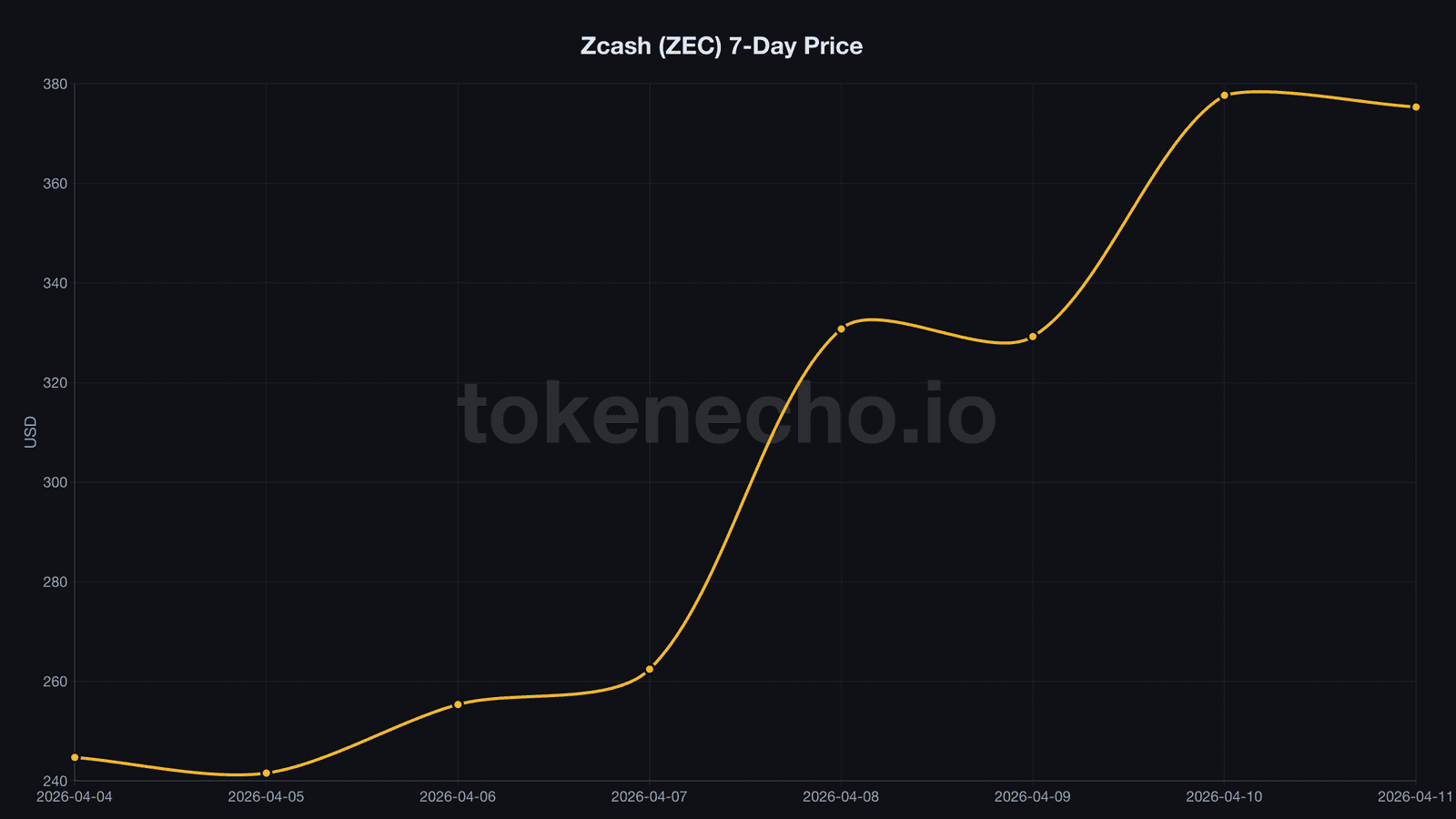
Volume told the same story. Daily ZEC trading tripled from $200 million on April 5 to $843 million by April 8.
For a coin ranked #19 by market cap, that ratio is borderline absurd.
And it wasn’t just Zcash. Dash surged 59% on the week with similar volume dynamics, confirming this wasn’t a single-asset anomaly but a sector-wide rotation into privacy assets.
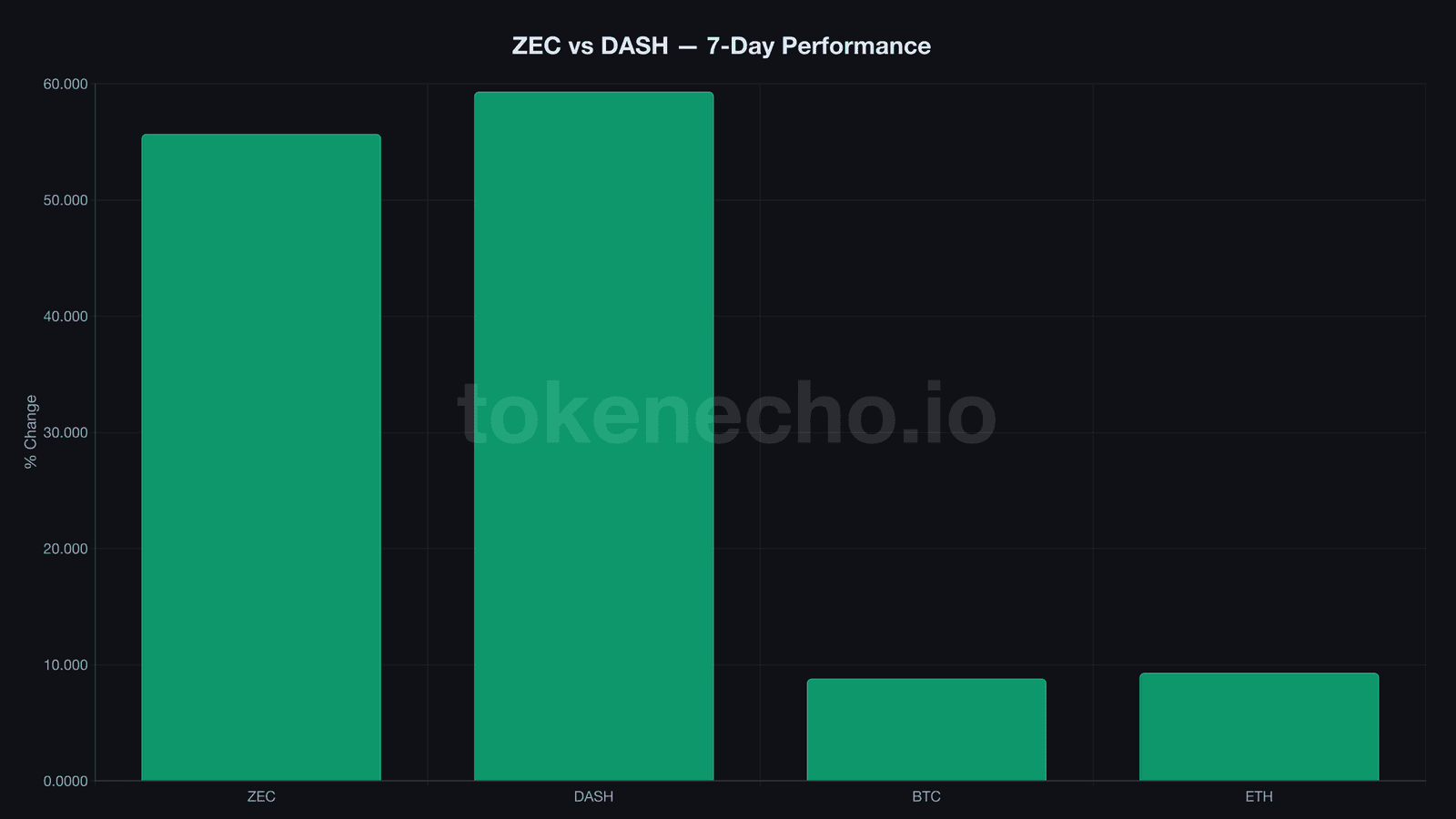
Privacy coins were the crypto sector everyone was ready to eulogize. The pallbearers just got rekt.
The first privacy coin ETF, and SEC already said yes
A privacy coin getting an ETF sounds like an oxymoron – the financial equivalent of a speakeasy applying for a liquor license. Counterintuitive, sure. But potentially brilliant.
Grayscale filed to convert its $137 million Zcash Trust into a spot ETF (ticker: ZCSH) on NYSE Arca in November 2025. That trust already holds roughly 5% of all circulating ZEC. A Q2 2026 SEC decision looms.
The regulatory path had already cleared. On January 15, the SEC formally closed its multi-year investigation into the Zcash Foundation – no enforcement action, no charges.
That probe had hung over the project since August 2023, when the Foundation received a subpoena as part of the SEC’s broader crypto asset classification effort. Gone now.
“Privacy coins are outperforming because transparency became overused as a control layer,” said Mati Greenspan, founder of Quantum Economics. “When everything is traceable, privacy shifts from philosophy to utility.”
And the infrastructure is following the money. Foundry Digital – operator of the world’s largest Bitcoin mining pool – launched an institutional-grade ZEC mining pool in April 2026 with full KYC/AML compliance and SOC 2 auditing. Three years ago, most exchanges delisted this coin. Now institutions are building mining operations around it. What changed?
Analysts project $500 million to $2 billion in ETF inflows if ZCSH wins approval. For a $6.2 billion market cap asset, that kind of capital injection doesn’t just move the needle – it redefines the entire supply-demand equation in ways that Bitcoin, at $1.4 trillion when its own ETF launched, never had to contend with.
31% of supply locked in shielded pools – a squeeze building
The last time Grayscale’s ETF ambitions aligned with a regulatory green light for a specific crypto asset, it was Bitcoin – Grayscale won its landmark court case against the SEC on August 29, 2023, when BTC sat at $26,000, and five months later the spot ETF launched at $73,000 for a 180% rally.
ZEC’s setup rhymes. SEC clearance? Check. ETF filing? Check. Institutional mining infrastructure? Check.
But ZEC has one variable Bitcoin never did.
Shielded pools, the protocol’s fully encrypted transaction layer, now hold 31% of total circulating supply. That’s $5.18 billion worth of ZEC sitting in the network’s most private layer – an all-time record. It functions as a de facto supply squeeze that most traders haven’t priced in yet.
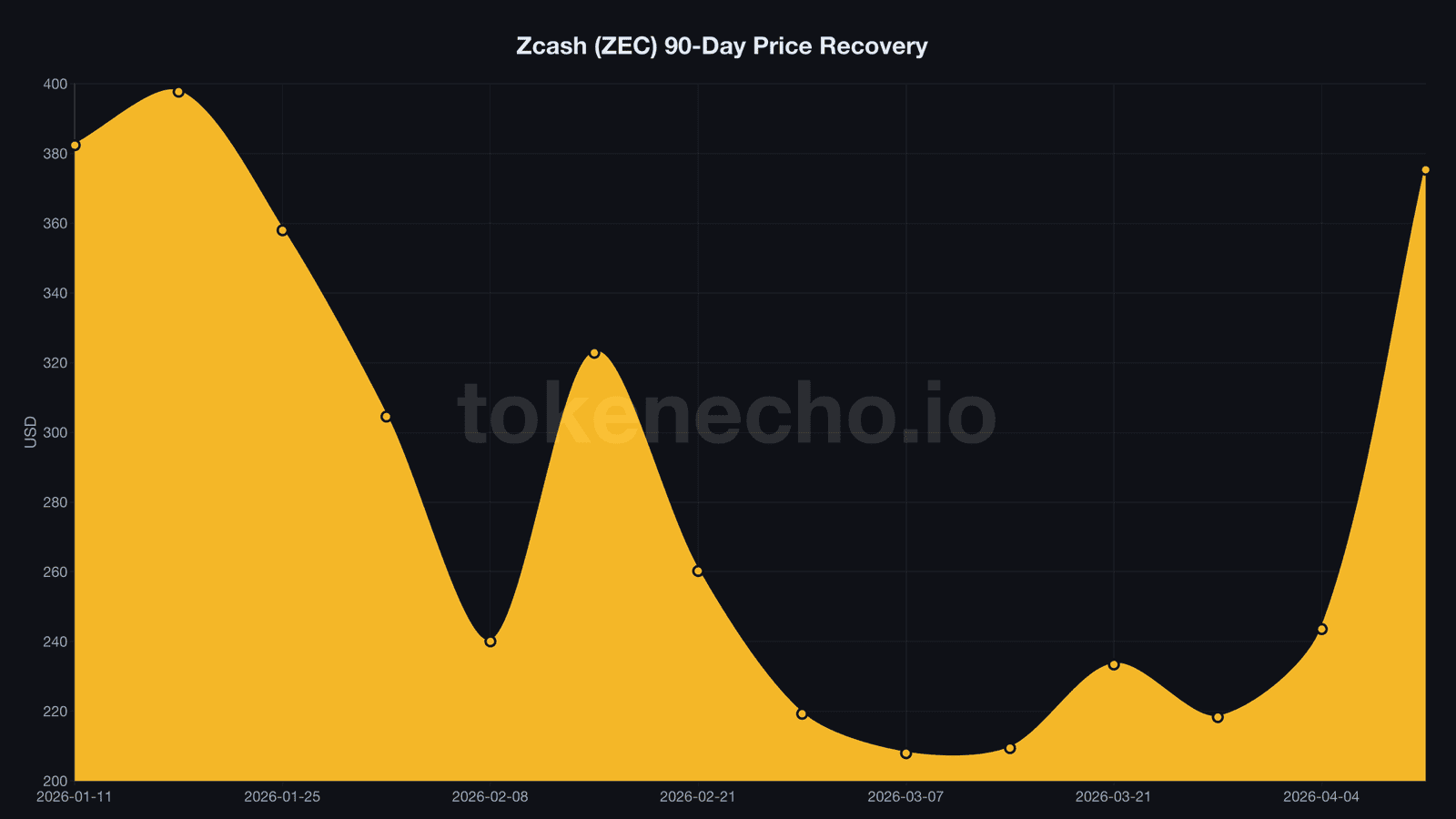
We’ve tracked similar supply dynamics with Bitcoin when exchange reserves dropped to seven-year lows – less liquid supply plus rising institutional demand has a predictable trajectory.
But the risk is real. ZEC’s $6.2 billion market cap is roughly 200 times smaller than Bitcoin’s was at ETF approval. Smaller assets accelerate faster in both directions. An ETF rejection or a MiCA-driven European delisting wave could erase this rally in days, not weeks. The broader privacy sector still trades on a knife’s edge between regulatory clarity and regulatory crackdown.
What to watch in the next 48-72 hours
- $400 resistance – a sustained daily close above $400 with volume exceeding $500M would confirm continuation beyond the short squeeze
- Grayscale ZCSH timeline – any SEC staff comment or amended filing could accelerate or delay the Q2 decision window
- DASH and XMR as confirmation – if the broader privacy sector holds these gains, ZEC’s rally has structural legs; if Dash fades while ZEC holds, it points to institutional accumulation rather than sector hype
ZEC sits between two gravitational forces: institutional capital building infrastructure around privacy coins, and regulators who haven’t decided whether to let it scale. Which side prevails defines whether this is a week-long squeeze or the start of a secular rerating.
This is not financial advice. DYOR. Data as of April 11, 2026.
Sources: CoinGecko – Zcash Market Data · Zcash Foundation – SEC Investigation Notice · CoinDesk – Privacy Tokens 2026 · Grayscale Zcash Trust
Leave a Reply