




Bitmine Lost $7.8 Billion on Ethereum and Just Bought $108 Million More
🕑 4 min read
One company controls 3.86% of all Ethereum in existence – and it refuses to stop buying.
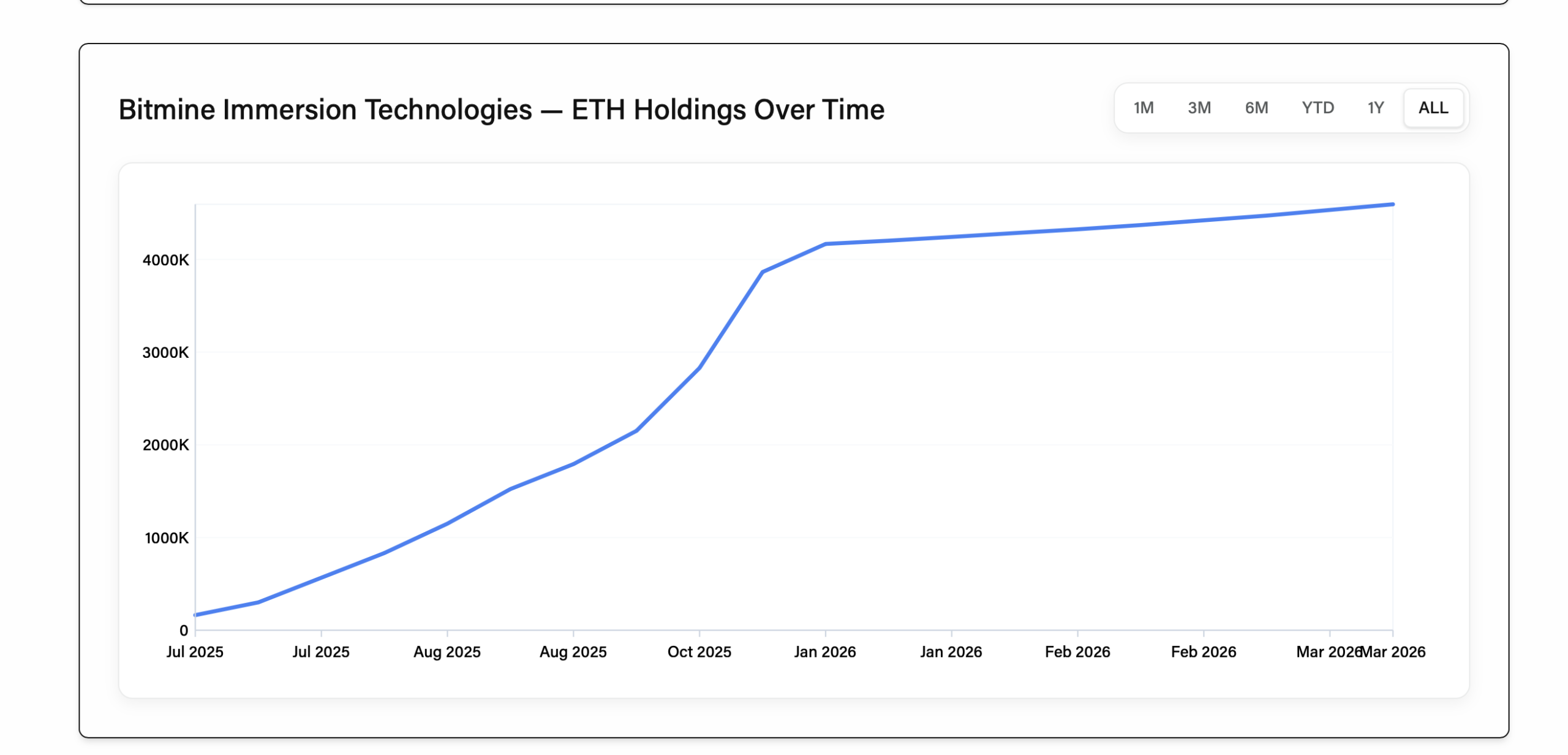
Bitmine Immersion Technologies dropped another $108 million on 50,000 ETH this week while sitting on roughly $7.8 billion in unrealized losses. ETH slipped below $2,000 on March 27 for the first time since early March. Bitmine’s response? Buy more.
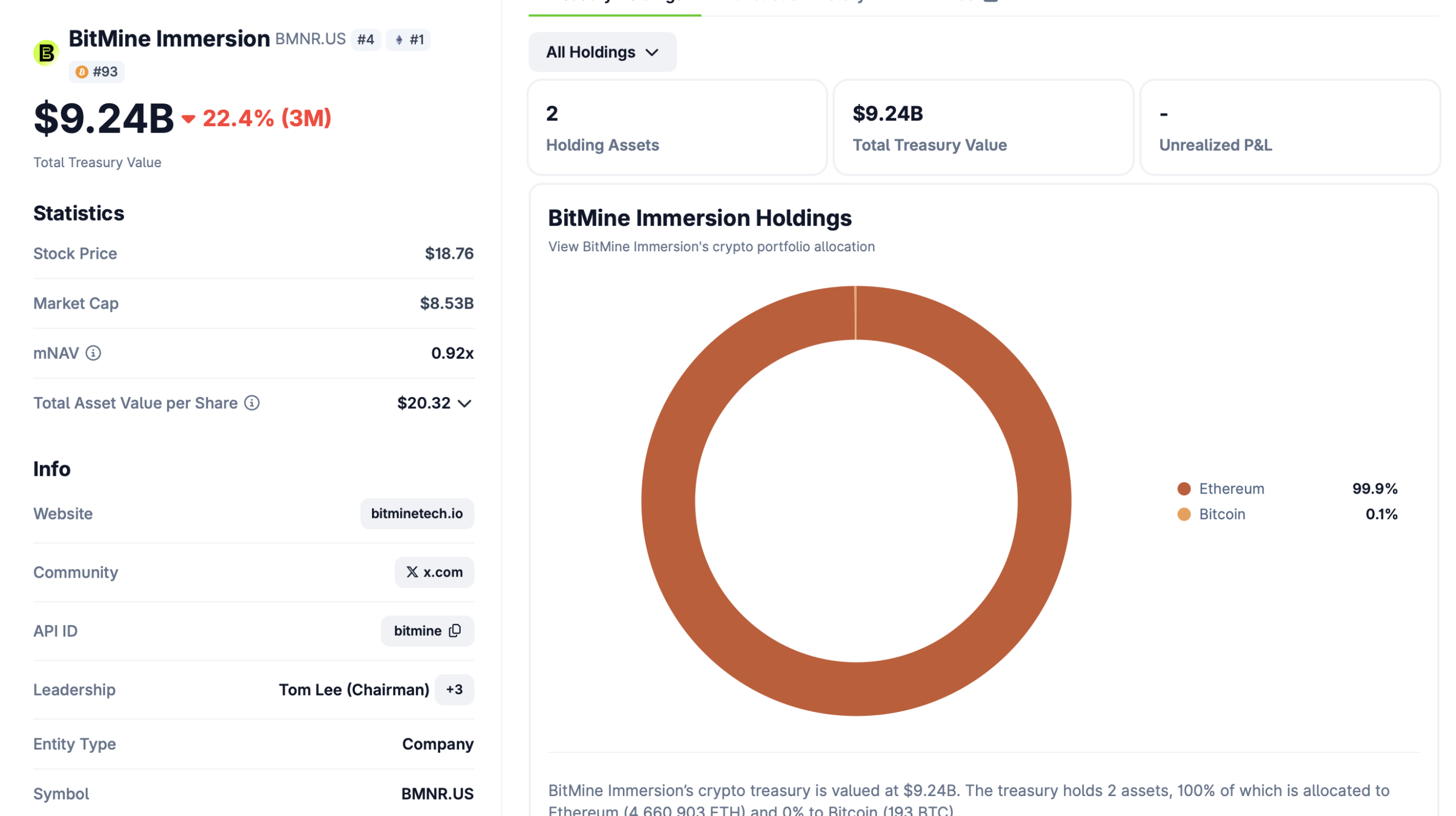
That’s not a typo. The world’s largest Ethereum treasury – 4.66 million tokens, accumulated at an average cost basis around $3,850 – just increased its position while the asset trades 48% below what they paid for it.
The “Alchemy of 5%” Playbook
Tom Lee, Bitmine’s chairman and the perma-bull who built a Wall Street career on contrarian calls, has a target: own 5% of Ethereum’s entire circulating supply. At 3.86%, they’re 77% of the way there.
“Our base case is ETH is in the final stages of the ‘mini-crypto winter,'” Lee said during a March 9 update as Bitmine ramped up its weekly buying pace from 45,000-50,000 ETH to over 65,000.
The firm has accelerated purchases for three consecutive weeks. Think about that rhythm. Every seven days, Bitmine absorbs more ETH than most DeFi protocols hold in their entire treasuries.
$15 Billion In, $9.3 Billion Left
The math isn’t kind. Bitmine has invested approximately $15 billion into Ethereum across its accumulation campaign. At today’s prices near $1,988, those 4.66 million tokens carry a market value of roughly $9.3 billion. The gap – call it $5.7 to $7.8 billion depending on which accounting window you use – represents one of the largest unrealized losses in corporate crypto history.
And BMNR shareholders feel the pain. The stock dropped to $18.87 on March 27, trading at just 0.80x book value. That’s a 20% discount to what the company’s assets are actually worth on paper. Imagine walking into a store and finding a $100 bill on sale for $80. That’s either a screaming bargain or a signal that something is deeply broken.
When critics flagged the treasury losses as a structural ceiling on ETH prices, Lee pushed back. “A feature, not a bug,” he said.
Strategy’s Mirror – But With a Yield Engine
If this playbook sounds familiar, it should. Strategy absorbed 45,000 BTC in 30 days earlier this month while every other corporate buyer quit. Bitmine runs the Ethereum version of that exact trade – except with one critical difference.
Bitmine generates yield. Strategy sits on Bitcoin and waits.
Through its MAVAN staking platform, launched in Q1 2026, Bitmine has staked 3.14 million ETH – roughly $6.8 billion worth – and projects annual staking income near $300 million once fully scaled. Current annualized rewards sit around $184 million at a 2.84% network yield.
For context, that staking revenue exceeds what most mid-cap crypto companies generate in total revenue. Bitmine essentially built a $184 million-per-year income stream while everyone focused on its paper losses.
And last week, Bitmine outspent Strategy. The firm deployed $140.74 million on ETH purchases versus Strategy’s $76.6 million on Bitcoin. The student is outpacing the teacher.
3.86% of Supply – The Concentration Risk Nobody Wants to Discuss
Bitmine owns 3.86% of Ethereum’s 120.7 million circulating tokens. MAVAN instantly became the world’s largest Ethereum staking operation at launch, creating an $8 billion backlog on the Ethereum staking queue in January.
One entity controlling nearly 4% of a $233 billion network raises questions that go beyond price speculation. If Bitmine ever needs to unwind – whether from a margin call, debt covenant breach, or shareholder revolt – the selling pressure would dwarf anything ETH markets have absorbed before.
But Lee isn’t worried about exit scenarios. He’s planning to open MAVAN to institutional clients, transforming Bitmine from a treasury company into a staking infrastructure provider. The pivot mirrors what happened with Ethereum’s broader DeFi ecosystem, which held $97.6 billion in TVL even as prices crashed.
The Contrarian Math
Strip away the narrative and look at what Bitmine actually owns. Nearly 4% of a proof-of-stake network generating protocol-level yield, held by a publicly traded company with $1.1 billion in cash reserves, buying at prices 48% below their cost basis.
The 10-year Treasury yield just hit 4.5% – a one-year high – and it’s crushing every risk asset on the board. BTC fell below $67,000. ETH broke $2,000. The options market just expelled $14 billion in contracts. None of that stopped Bitmine from writing another nine-figure check.
Either Tom Lee is running the most expensive conviction trade in Ethereum’s history, or he’s positioned Bitmine to own a permanent slice of the network that underpins $95 billion in DeFi applications, processes trillions in annual stablecoin volume, and just received commodity classification from both the SEC and CFTC.
The market thinks he’s wrong. BMNR at 0.80x book value says so clearly. But the last time a corporate treasury bet this aggressively against consensus – Strategy at $16,000 BTC in 2022 – the skeptics needed about 18 months to admit they’d miscalculated.
ETH closed March 27 at $1,988. Bitmine’s buying desk was still open.
This is not financial advice. DYOR. Data as of March 27, 2026.
Sources
- Bitmine ETH Holdings – PR Newswire (March 23, 2026)
- Tom Lee “mini crypto winter” – CoinDesk (March 9, 2026)
- Bitmine $138M ETH purchase – CoinDesk (March 23, 2026)
- $108M mystery wallet – The Coin Republic (March 27, 2026)
- Bitmine unrealized losses – U.Today
- MAVAN staking launch – Decrypt
- Tom Lee “feature not a bug” – The Block
- BTC below $67K, Treasury yield 4.5% – CoinDesk (March 27, 2026)