



Strategy Absorbed 45,000 BTC in 30 Days While Every Other Corporate Buyer Quit
🕑 5 min read
Forty-five thousand Bitcoin. That’s what one company – just one – bought over the past 30 days while the rest of corporate America slammed the door shut on crypto.
Strategy, the firm formerly known as MicroStrategy, has been on its largest buying spree since April 2025, scooping up roughly $3.1 billion worth of BTC at an average price near $69,000. And the kicker? Every other corporate treasury buyer combined picked up about 1,000 coins during the same period. Down 99% from the 69,000 BTC they collectively purchased at the peak of the treasury trade last August.
One buyer. Ninety-eight percent of all corporate demand. That’s not a trend. That’s a single point of failure.
The Market Everyone Left
The numbers tell a brutal story.
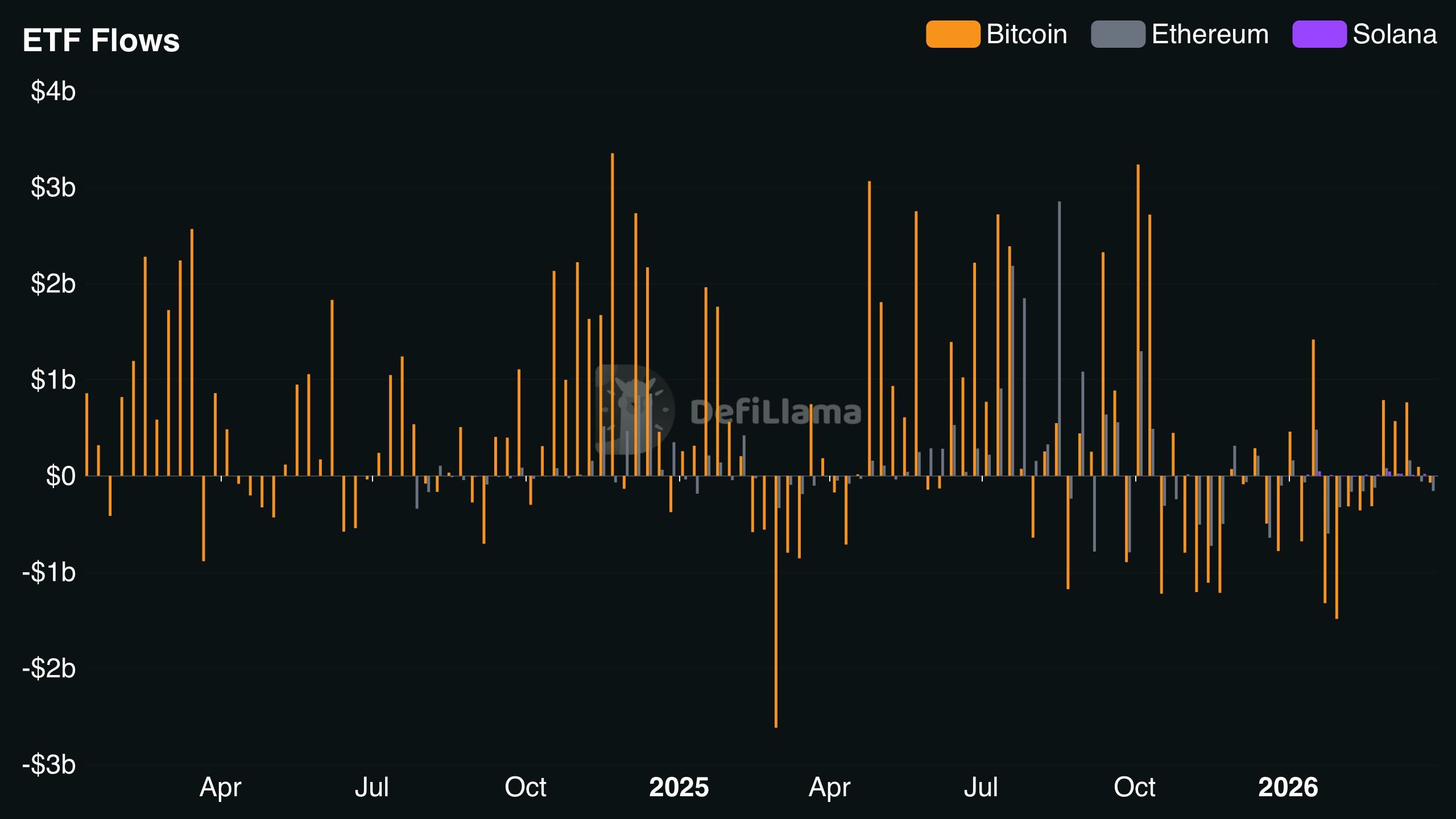
U.S. spot Bitcoin ETFs hemorrhaged $1.8 billion in net outflows over the past three weeks, according to Farside Investors data. On March 26 alone, redemptions hit somewhere between $171 million and $350 million – depending on which funds you count – with IBIT, FBTC, BITB, and ARKB all bleeding simultaneously.
But one name kept buying.
BlackRock’s IBIT averaged $85 million per week in net inflows through March, even as every other major ETF product turned negative. Think about that for a second. The world’s largest asset manager is effectively the only institutional fund still adding Bitcoin exposure through traditional channels.
So you’ve got Strategy on one side, BlackRock on the other, and a $2.41 trillion market resting on two sets of shoulders. That’s not diversified demand. That’s a trust exercise.
The Ghost Buyer Problem
What makes this weird – genuinely weird – is what’s happening on-chain.
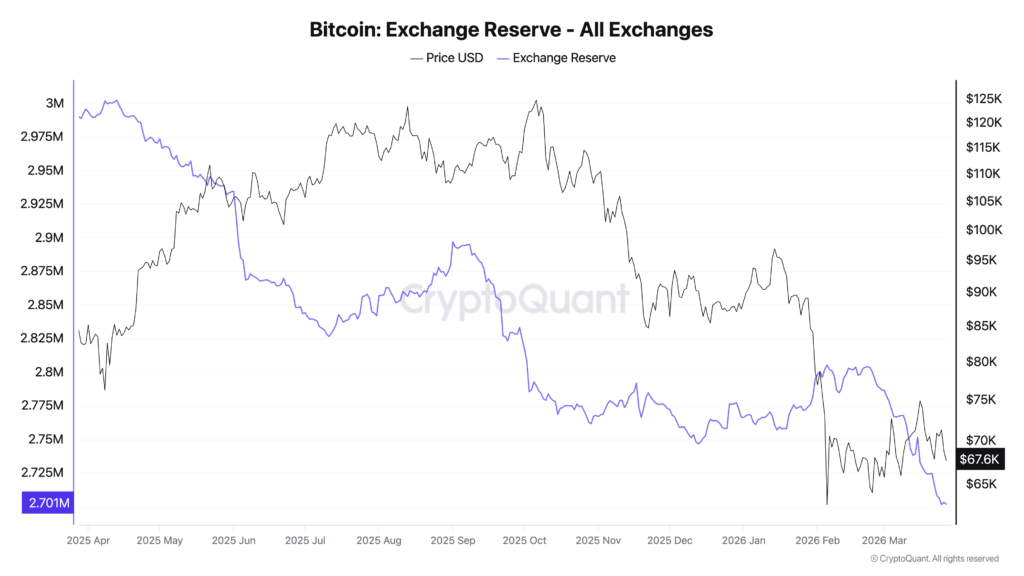
Exchange reserves just hit an all-time low: 2.43 million BTC, barely 5.88% of circulating supply. That number was above 3.2 million less than three years ago. Nearly a million coins have vanished from trading platforms, and the pace is accelerating. On one day in mid-March, 32,000 BTC left exchanges in a single sweep.
But wait. If ETFs are bleeding $1.8 billion and corporate buyers (minus Strategy) have essentially quit, who’s pulling all this Bitcoin off exchanges?
The SOPR ratio sits at 0.97 to 0.99 – which means the average seller is taking a loss. The Fear and Greed Index cratered to 8 on March 24, marking 46 consecutive days below 25. That’s the longest sustained fear reading since the FTX collapse in late 2022.
People are selling at a loss, in extreme fear, into the worst sentiment since Sam Bankman-Fried’s mugshot hit the news cycle. And yet supply on exchanges has never been tighter.
Someone is vacuuming up every coin that hits the market. They’re doing it quietly, probably through OTC desks, and they aren’t showing up in the headline flow data.
Strategy’s Lonely Bet
Strategy now holds 762,099 BTC – roughly $52.6 billion at current prices. CEO Phong Le confirmed the company raised $25.3 billion in capital during 2025 alone, making it the largest equity issuer among U.S. public companies for two straight years.
And they’re not done. Saylor’s target: one million Bitcoin by end of 2026. That requires another 239,000 coins at an estimated cost of $22.2 billion.
For context, that’s more than the entire market cap of Ford Motor Company. Spent on an asset that’s down 37% from its all-time high, in the middle of a war, with oil above $100 and the Fed refusing to cut rates.
You can call it conviction. You can call it reckless. The line between the two has always been drawn in hindsight.
What’s undeniable is the concentration risk. If Strategy pauses its purchases – say, because equity markets seize up or Saylor faces a margin event on his leveraged positions – corporate Bitcoin demand doesn’t drop by half. It drops by 98%. The entire buyer base collapses to whatever scraps remain.
BlackRock: The Quiet Anchor
On the institutional side, BlackRock’s IBIT has become the market’s emotional support ETF.
While Grayscale’s GBTC keeps leaking (another $25 million on March 26), IBIT absorbs capital like nothing happened. Eighty-five million a week isn’t spectacular – it’s a fraction of the $400 million daily inflows from early March – but it’s positive. In a market where everything else is negative, “still buying” is the new “wildly bullish.”
The divergence between BlackRock and every other issuer mirrors the Strategy-vs-everyone split in corporate treasuries. Two names. Two conviction bets. Everyone else is either frozen or exiting.
The Expiry Wildcard
Tomorrow adds another layer of volatility. Roughly $14.16 billion in Bitcoin options expire on Deribit at 08:00 UTC on March 28 – about 40% of all open interest on the platform.
Max pain sits at $75,000. Spot price: $69,036. That $6,000 gap creates what traders call a gravitational pull – market makers delta-hedging their positions can push price toward the strike where the most contracts expire worthless. Whether that pull actually drags BTC higher into the weekend or gets overwhelmed by macro fear (Iran Day 28, oil above $100, no ceasefire in sight) is anyone’s guess.
But the options expiry does one thing for certain: it clears the board. Roughly $14 billion in open interest vanishes overnight, and whatever positioning emerges afterward will reveal the market’s true directional conviction – or lack of it.
So What Happens If One of Them Stops?
That’s the question nobody wants to ask.
Strategy’s buying program depends on continued access to equity and debt markets. If MSTR shares drop below Saylor’s implied cost basis – which, at 762,000 BTC and $57.69 billion invested, sits around $75,700 per coin – the “buy the dip” machine doesn’t just slow down. It faces existential questions about margin and solvency.
BlackRock’s IBIT depends on retail and institutional flows continuing. So far, the brand name alone seems to be enough. But brand loyalty in a bear market is a wasting asset.
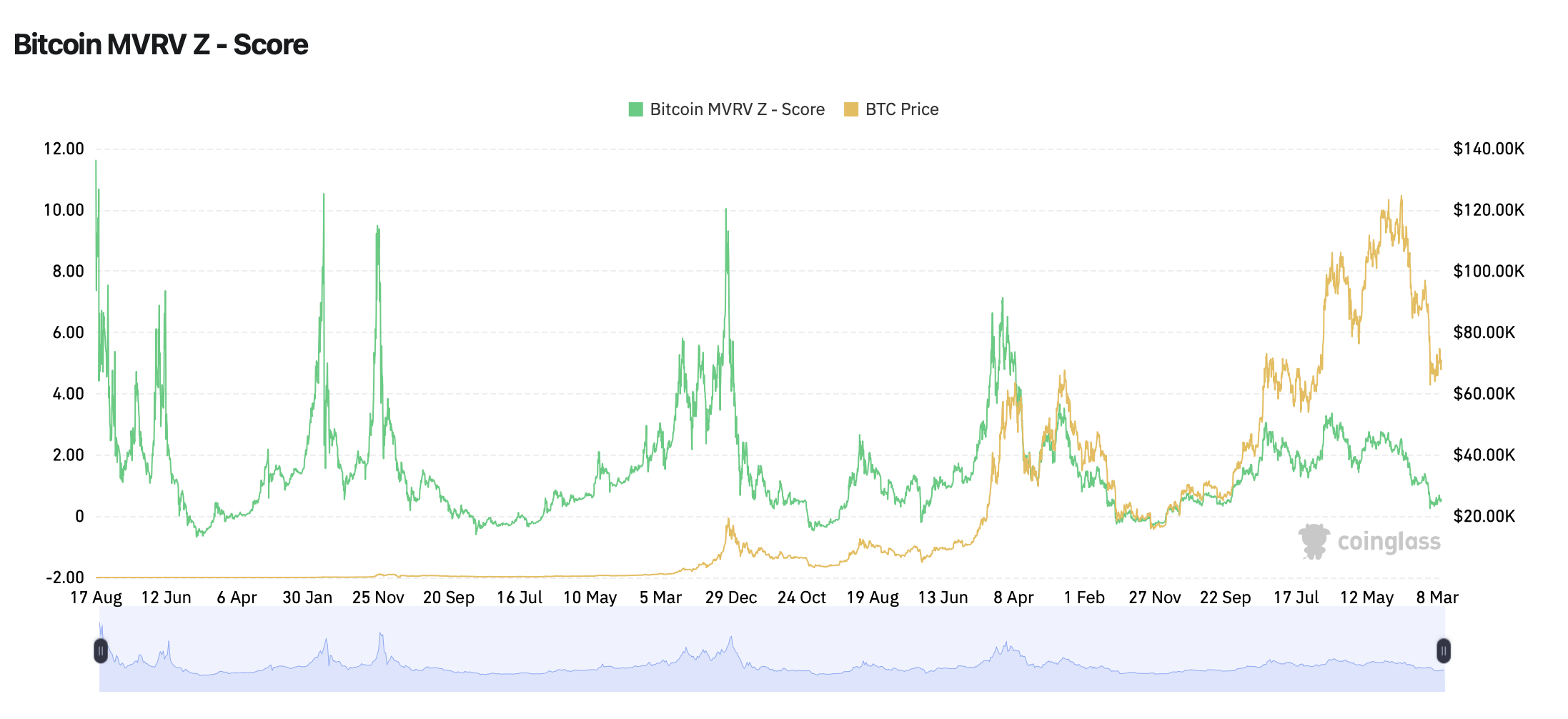
Five out of seven Glassnode on-chain bottom indicators are flashing right now. MVRV Z-Score compressed to 1.2. Whale wallets holding 1,000+ BTC have grown by 753 over the past three months, reaching 2,140 total. The structural setup looks like a coiled spring – but springs need a catalyst, and right now the only catalysts on the calendar are an options expiry and an Iran situation that keeps getting worse.
The Bitcoin market in late March 2026 doesn’t have a demand problem. It has a concentration problem. Two buyers are doing what dozens used to do. And the on-chain data keeps screaming accumulation while the price chart whispers capitulation.
Either Strategy and BlackRock know something everyone else doesn’t. Or they’re the last ones holding the rope.
This is not financial advice. Do your own research. Data as of March 27, 2026.
Sources
- CryptoSlate – Strategy is the only Bitcoin Treasury firm still buying
- Farside Investors – Bitcoin ETF Flow Data
- CryptoQuant – Bitcoin Exchange Reserve
- CoinGlass – Bitcoin MVRV Z-Score
- DefiLlama – ETF Flows Tracker
- SpotedCrypto – Bitcoin On-Chain Bottom Signals
- Phemex – Bitcoin Exchange Reserves Record Low