
🕑 6 min read
Binance dominates 39% of global crypto trading volume. We ran the numbers on whether that dominance comes at a cost.
A $100 spot trade on Coinbase costs you $1.20 in fees. The same trade on Binance? Ten cents.
That gap – a 12x difference – explains why 300 million users still park their crypto on the exchange that paid $4.3 billion to the US Department of Justice barely two years ago, choosing rock-bottom fees over what some might call a spotty regulatory track record. This Binance review breaks down everything that’s changed since that settlement, what hasn’t, and whether the world’s largest crypto exchange deserves your trust in 2026.
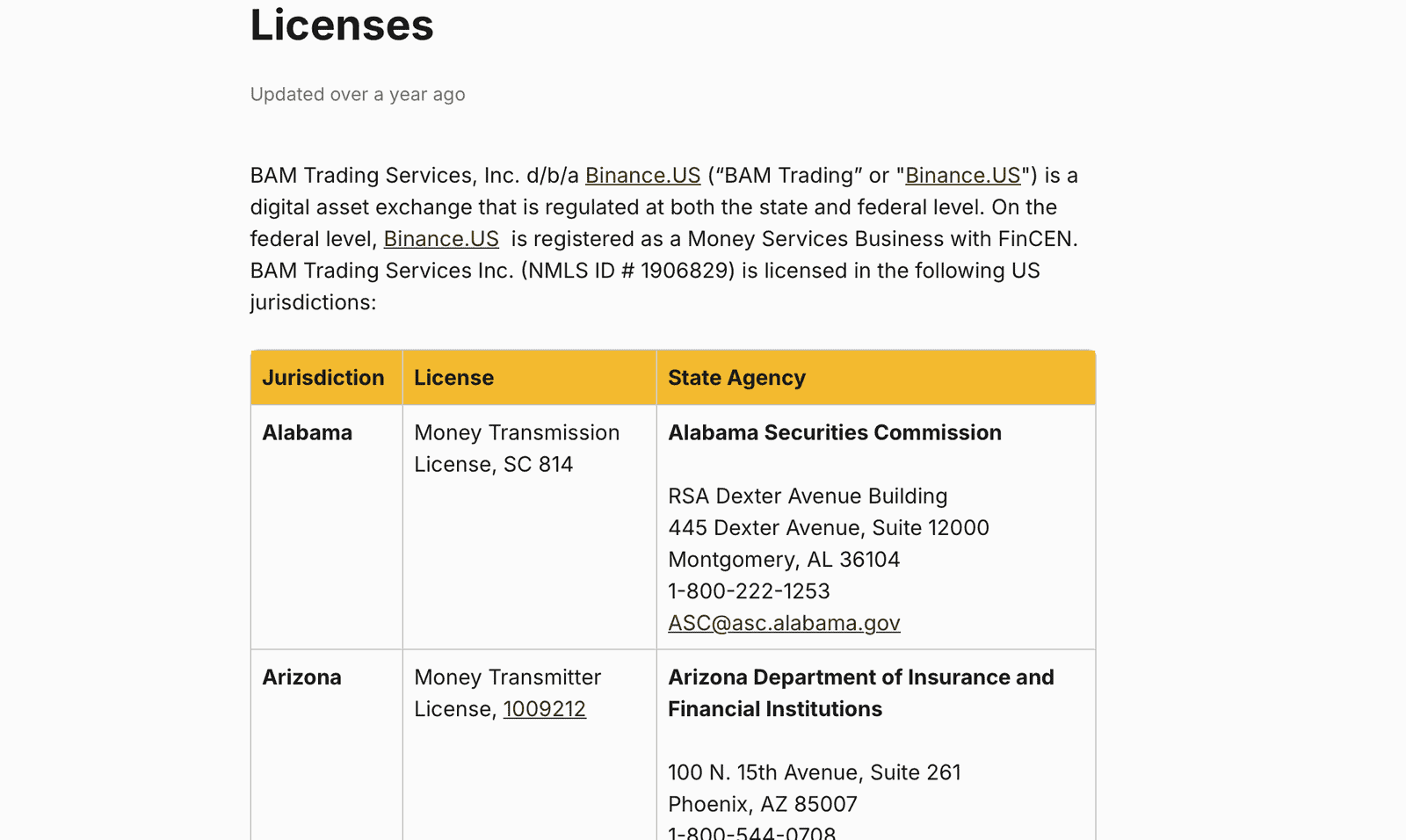
$4.3B in fines to 20 licenses – Binance’s regulatory U-turn
The exchange that once operated from a Telegram channel with no headquarters now holds regulatory licenses in over 20 jurisdictions. That transformation didn’t happen voluntarily.
In November 2023, Binance pleaded guilty to violating US anti-money laundering laws. Founder Changpeng Zhao stepped down as CEO and served four months in federal prison. The $4.3 billion fine was the largest penalty in crypto history – and it wasn’t close.
What followed was a corporate overhaul that most analysts didn’t expect. Richard Teng, a former regulator at Abu Dhabi’s FSRA and Singapore’s MAS, took the wheel. By January 2026, Binance secured three licenses from the Abu Dhabi Global Market – becoming the first crypto exchange licensed under the ADGM framework.
“Scale and trust need not be in tension: the more people trust the system, the more it grows,” said Richard Teng in a January 2026 interview after crossing 300 million registered users.
And then Trump pardoned CZ in October 2025. The founder now sells his memoir Freedom of Money (it went on sale April 8, 2026) and runs an education nonprofit called Giggle Academy. He’s officially out of Binance operations.
But – and this matters – two senior compliance leaders quietly left in March 2026. Peter Van Logtenstein, head of global investigations, and Inga Petrauskaite, financial crime investigations lead, both departed. For an exchange still under a five-year federal monitorship, that’s an odd signal.
Paying a $4.3 billion fine and emerging stronger is the corporate equivalent of totaling your car and buying a Lamborghini with the insurance check. It’s impressive. It’s also a little unsettling.
Binance fees vs Coinbase vs Kraken – the math isn’t close
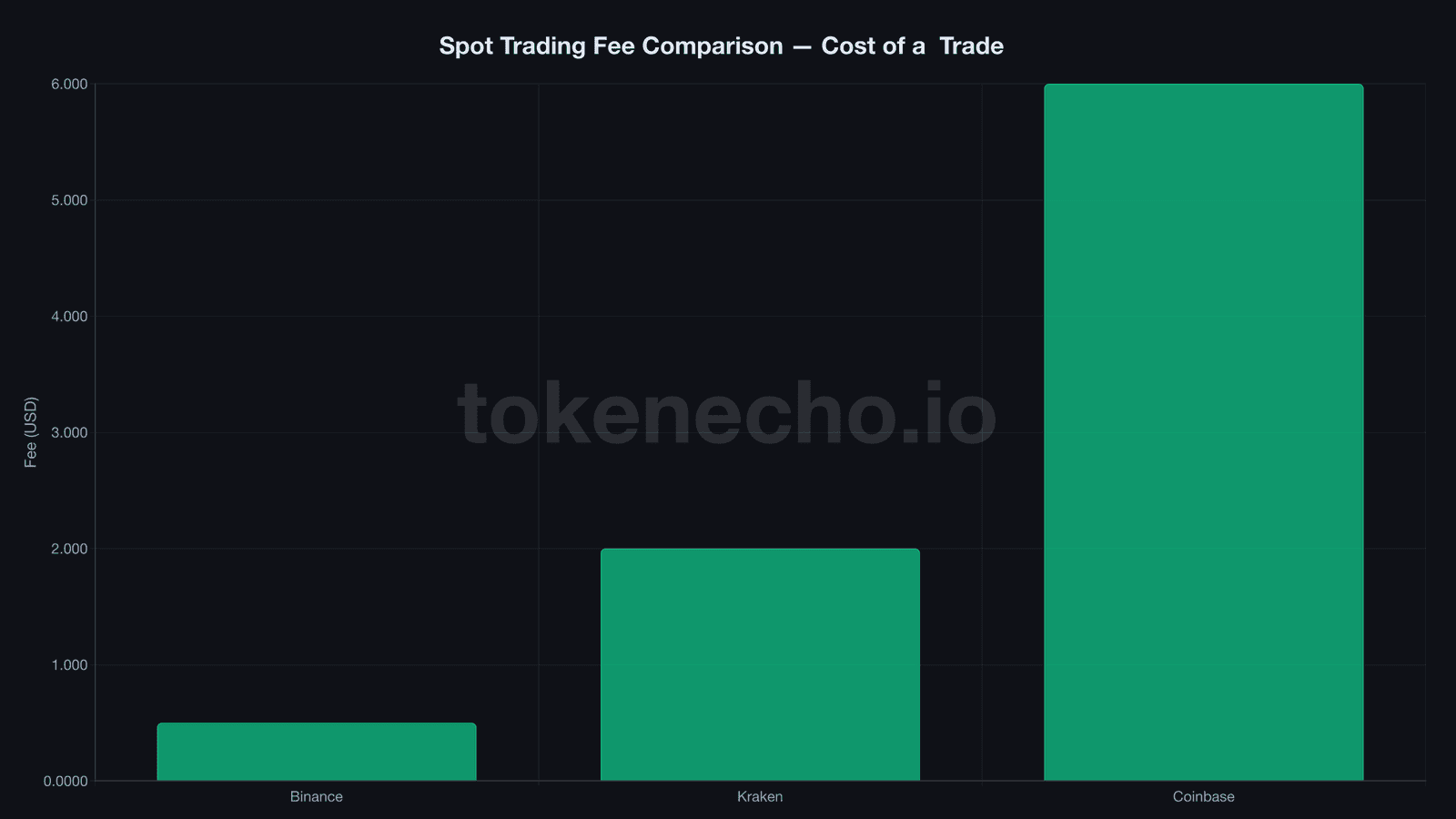
Run a $500 buy order on three exchanges and the fee difference becomes impossible to ignore.
| Exchange | Maker Fee | Taker Fee | Cost on $500 Trade | Best Available Rate |
|---|---|---|---|---|
| Binance | 0.10% | 0.10% | $0.50 | 0.075% with BNB |
| Kraken | 0.25% | 0.40% | $2.00 | Pro rates lower |
| Coinbase | 0.60% | 1.20% | $6.00 | Advanced: ~0.60% |
That’s a 12x spread between Binance and Coinbase’s standard tier. Even against Kraken’s Pro pricing, Binance undercuts by roughly 60%.
Hold BNB in your account and fees drop another 25% – down to 0.075%. That discount alone makes Binance cheaper than Kraken’s professional tier.
High-volume traders on VIP 9 ($2 billion monthly) pay just 0.02% maker. For context, that’s essentially free compared to what a Robinhood user pays in hidden spread.
Crypto deposits are free across the board. Fiat deposits via bank transfer usually cost nothing. Credit card purchases carry a 1.8-2% surcharge – annoying, but standard industry-wide.
Where Binance quietly bleeds you: ERC-20 withdrawals. Pulling USDT on Ethereum can cost $10-25 during congestion. The TRC-20 network runs about $1. Seasoned traders already know this. New users often don’t.
Experienced users watching their margin will note that Binance’s fee structure rewards loyalty aggressively – the gap between VIP 0 and VIP 9 is a 5x cost reduction, something neither Coinbase nor Kraken matches at scale.
1,423 trading pairs and oil futures – because why not
Binance isn’t just an exchange anymore. It’s closer to a financial operating system with a crypto accent.
The core platform lists 441 coins across 1,423 trading pairs. Futures traders get 530+ perpetual contracts with up to 125x leverage on BTC, ETH, and BNB. That’s enough rope to make serious money or hang yourself spectacularly – depending on your risk management.
And then there’s the 2026 product blitz. In March, Binance launched equity futures on META, NVDA, and GOOGL with 10x leverage. By April 1, they’d added WTI crude oil and natural gas futures at 100x leverage.
Oil futures on a crypto exchange. Three years ago that sentence would’ve been satire.
Binance Earn offers flexible and locked savings, staking, dual investment, and liquidity farming. Launchpad runs token sales that routinely sell out in minutes.
The Web3 wallet handles DeFi without leaving the app. Copy trading mirrors lead traders’ positions. There’s even a P2P marketplace for fiat-to-crypto in countries where banks won’t touch digital assets.
Why does any of this matter? Because Coinbase lists 382 coins and no derivatives for US users. Kraken offers 300+ coins with futures – but nothing close to Binance’s product breadth. If you want a one-stop platform, nobody competes.
Traditional brokerages spent decades assembling product suites this wide. Binance did it in seven years – though regulators would argue they skipped a few safety inspections along the way.
$1B insurance fund in Bitcoin – and the cracks beneath
So should you actually trust them with your money?
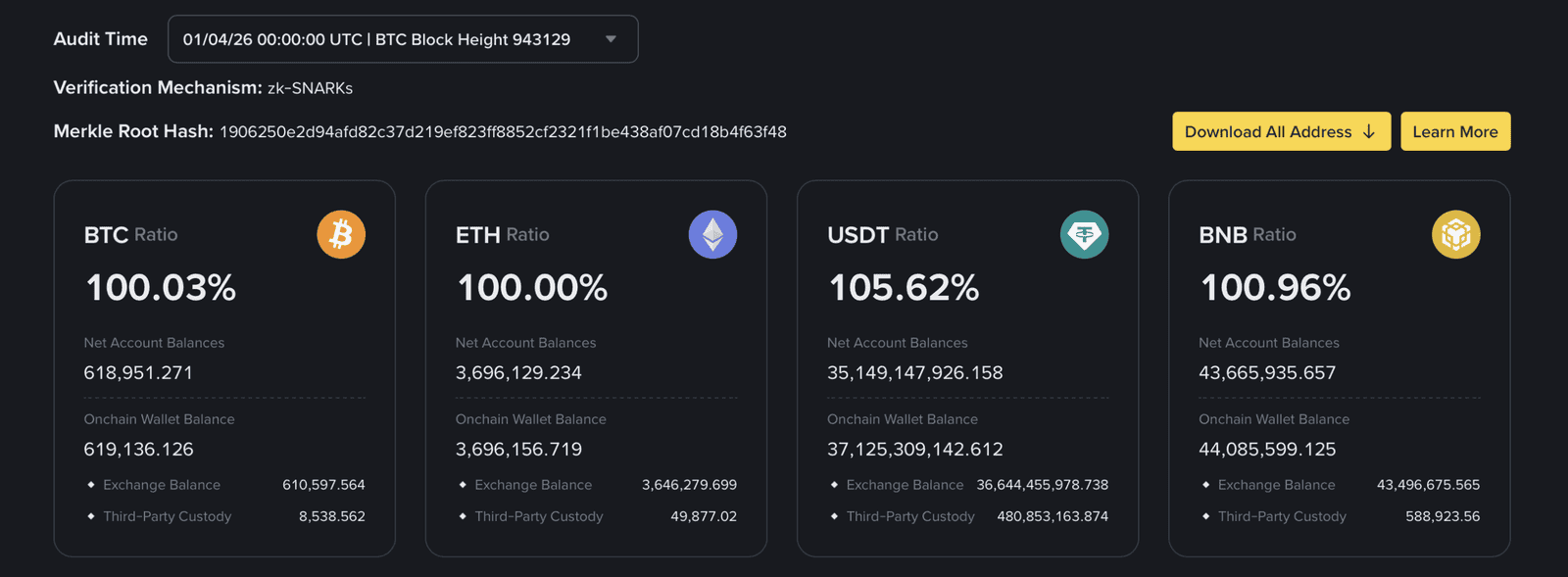
The headline numbers look solid. Binance maintains SAFU, a $1 billion emergency fund that was originally held in stablecoins but converted entirely to Bitcoin – roughly 15,000 BTC – in the first two months of 2026, with an automatic top-up mechanism that refills the fund whenever its value drops below $800 million.
Proof of Reserves, a Merkle-tree verification system covering 45+ asset categories, shows $215 billion in client assets as of March 2026 – backed at 1:1 or above. That’s not an independent audit. But it’s more transparency than most exchanges offer.
The 2019 hack, when 7,000 BTC vanished overnight, proved SAFU works in practice. Binance covered every user’s losses without blinking. No other exchange has actually battle-tested their insurance fund like that.
But cracks exist.
In early 2026, roughly 420,000 user credentials surfaced online – not from a platform breach, according to Binance, but from infostealer malware on user devices. True or not, it shook confidence.
And those compliance departures in March? When your global investigations lead walks out of an exchange that’s still under federal monitoring, the timing raises questions nobody at Binance has publicly answered.
KYC requires government ID and facial recognition from day one. Daily limits start at $50,000 fiat and 100 BTC for basic verification.
Want higher limits? Level 2 adds proof of residence and bumps you to $2 million daily fiat with unlimited crypto withdrawals.
Who should skip Binance entirely
Americans. Full stop.
Binance Global blocks US IP addresses. Binance.US exists as a separate, stripped-down entity – but it lacks futures, most altcoins, and the fee advantages that make the global platform compelling. Several states (New York, Texas, Hawaii, Vermont) block even Binance.US.
Canadians are also locked out of the global platform.
If you’re anywhere else – and particularly in the UAE, Southeast Asia, Europe, or Latin America – Binance offers the lowest fees, deepest liquidity, and widest product selection available today. The app scores 4.7 on iOS and 4.4+ on Android across millions of reviews. And the 24/7 live chat actually connects to humans after the bot triage.
For a deeper look at the competition, see our Coinbase review and Kraken review.
Binance’s fee advantage remains undeniable. Whether its compliance transformation runs deep enough to outlast the federal monitorship – or just deep enough to last until the monitors leave – is the question that $215 billion in client assets rides on.
This is not financial advice. DYOR. Data as of April 9, 2026.
Leave a Reply