

🕑 7 min read
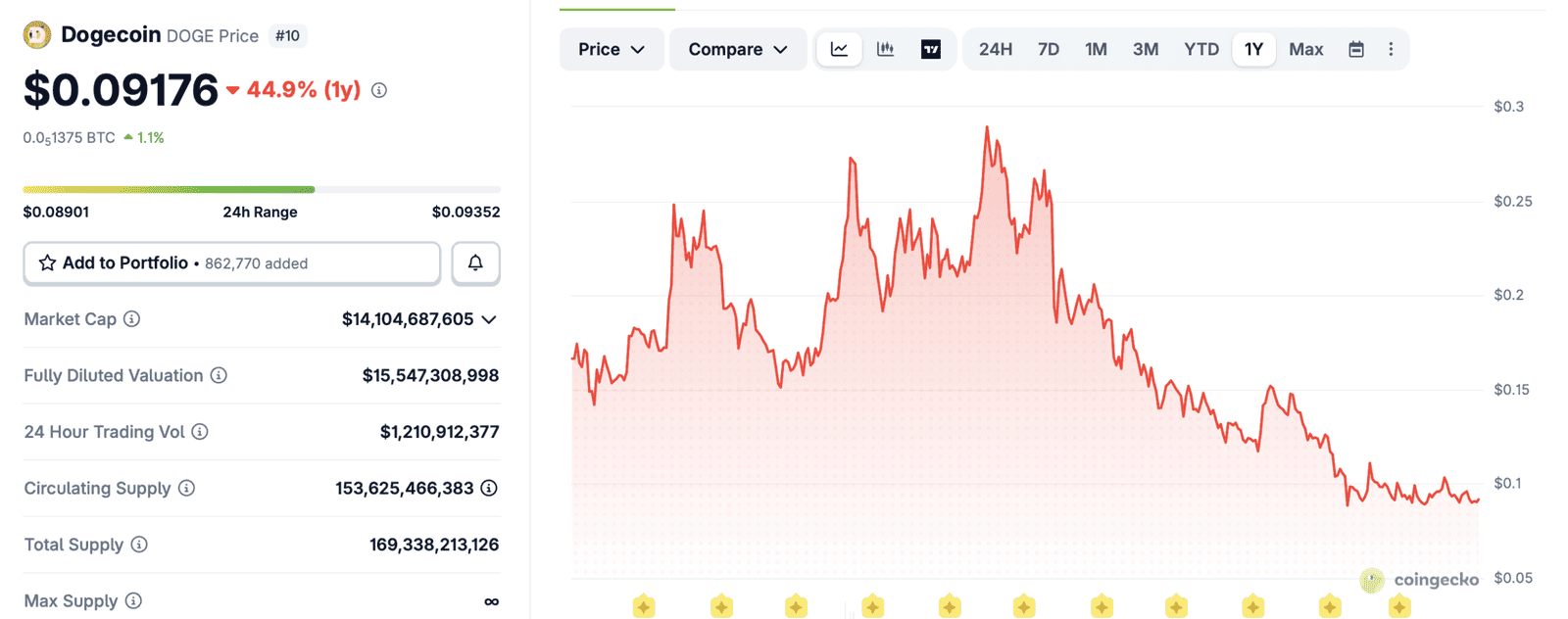
DOGE sits at $0.092 – 87% below its all-time high. Buying it takes five minutes. Knowing where and how to do it without overpaying takes this guide.
Dogecoin doesn’t need an introduction. The Shiba Inu meme coin that started as a joke in December 2013 now commands a $14.1 billion market cap and ranks 10th among all cryptocurrencies. But figuring out how to buy Dogecoin in 2026 isn’t the hard part – it’s avoiding the fees, scams, and wallet mistakes that drain new buyers before they even start.
At $0.092, DOGE trades 87% below its May 2021 all-time high of $0.73. That’s either a screaming discount or a warning sign, depending on who you ask. Either way, roughly $1.2 billion in DOGE changes hands every 24 hours. People are still buying.
So should you? And more importantly – where?
The 30-Second Version for People Who Won’t Read the Whole Thing
Open a Coinbase or Kraken account. Complete identity verification (10 minutes, sometimes less). Deposit via bank transfer to dodge the card surcharge. Buy DOGE. Move it to a self-custody wallet if you’re holding more than you’d be comfortable losing. Done.
Now, if you want to actually understand what you’re paying and why some exchanges cost four times more than others – keep reading.
Where to Buy Dogecoin – And What You’ll Actually Pay
Not all exchanges treat DOGE the same. Fees vary wildly, and the “headline” fee rarely tells the full story.
Coinbase charges 0.60% maker / 1.20% taker on its Advanced platform. That sounds manageable – until you realize the simple buy/sell interface tacks on a spread plus a flat fee that can push effective costs past 3% on small orders. “We’ve always been transparent about our fee structure,” Coinbase CEO Brian Armstrong said during a 2025 earnings call. Transparent, sure. Cheap? Not exactly. But Coinbase is publicly traded on NASDAQ, carries FDIC insurance on USD balances up to $250,000, and stores 98% of assets in cold storage. For a first-time buyer who values sleep over saving $2 on fees – it’s the default for a reason. If you’ve already used it to buy Bitcoin, the process is identical.
Kraken takes a different approach. Maker fees start at 0.25%, taker at 0.40% – roughly a third of what Coinbase charges on the advanced tier. Kraken added DOGE in 2021 after holding out longer than most major exchanges, and the liquidity has grown steadily since. No FDIC insurance here, but Kraken publishes quarterly Proof of Reserves audits. You can verify your assets are backed 1:1. Bank transfers (ACH in the US) land fee-free; debit cards cost 3.75%.
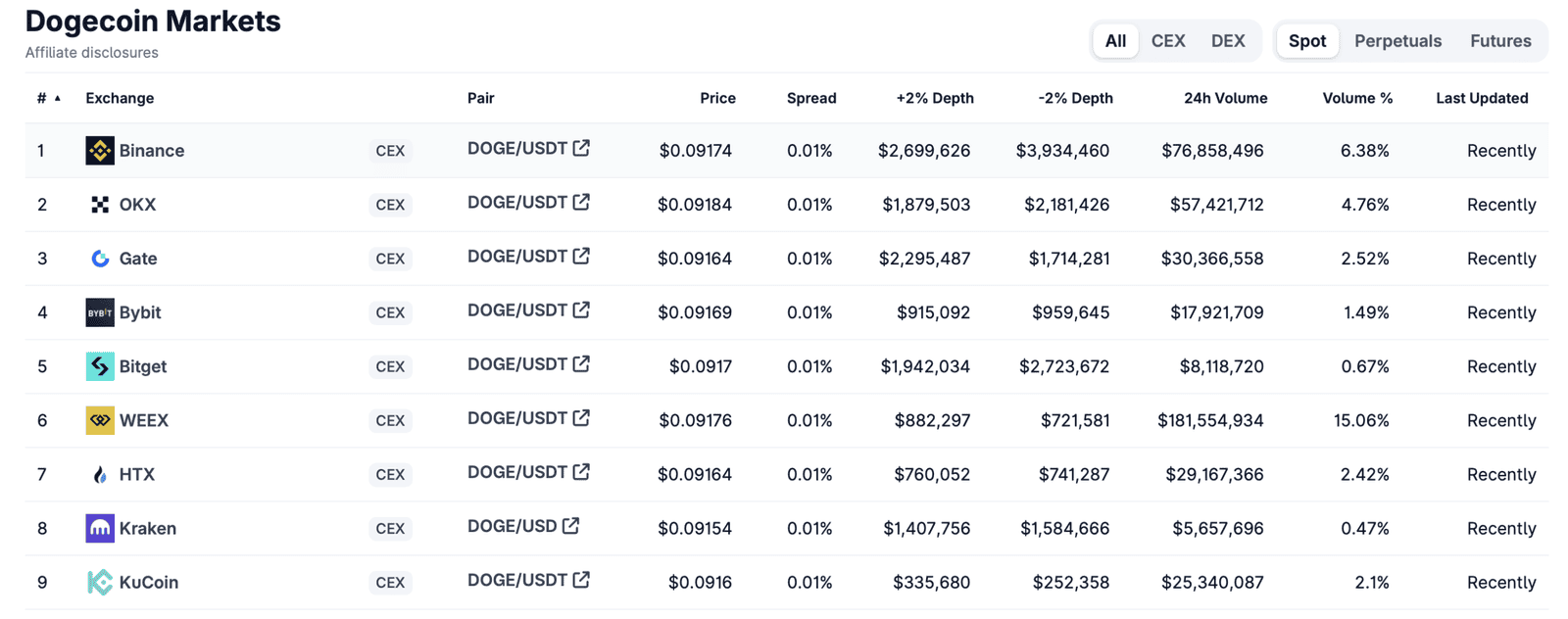
Binance dominates globally with 0.10% spot fees – the cheapest of any major platform. But US residents get shunted to Binance.US, a separate entity with a rockier regulatory history. The SEC sued Binance.US in 2023; it settled in 2024 and resumed normal operations, but some states still restrict access. If you’re outside the US, Binance offers the tightest spreads and deepest DOGE order book on the planet. If you’re in the US, check your state’s availability first.
And then there’s Robinhood. Zero-commission DOGE trading – sounds perfect until you realize Robinhood didn’t even allow crypto withdrawals until late 2022, after two full years of user complaints. You can now withdraw DOGE to an external wallet, but the spread markup effectively replaces the commission. For casual buyers who already have a Robinhood brokerage account? Convenient. For anyone who wants actual ownership and self-custody? Look elsewhere.
The Fastest Way to Buy DOGE Right Now
Forget the numbered step-by-step. You’ll spend the first five minutes on KYC – uploading a selfie, confirming your address, the standard identity dance that every regulated exchange requires post-2024 Travel Rule enforcement. Some exchanges verify in under a minute (Coinbase, usually). Others take hours (Binance.US on a bad day).
Then fund the account. Bank transfer is free on most platforms but takes 1-3 business days. Card deposit is instant but costs 2.49% on Coinbase, 3.75% on Kraken, 1.8% on Binance. For a $500 DOGE purchase, that card surcharge ranges from $9 to $18.75. Worth the speed? Your call.
Once funded, search for DOGE in the trading interface. Place a market order for instant execution or a limit order to set your price. At $0.092 per coin, $100 buys you roughly 1,087 DOGE – and no, that’s not a typo. Dogecoin’s unlimited supply means individual coins stay cheap. The circulating supply already exceeds 153.6 billion DOGE with approximately 5 billion new coins minted annually through mining rewards.
One thing nobody tells beginners: don’t buy DOGE on a Friday afternoon if you funded via bank transfer. ACH settlements don’t process over weekends, and some exchanges restrict withdrawals until the deposit fully clears. Tuesday morning? Perfect timing.
A Coin Born From a Tweet (and a Bad Day at Work)
Quick detour. Billy Markus, an IBM software engineer, and Jackson Palmer, an Adobe product manager in Sydney, created Dogecoin in roughly three hours on December 6, 2013. Palmer registered dogecoin.com as a joke. Markus forked Luckycoin’s code (itself a fork of Litecoin) and swapped the branding. Neither expected anyone to actually use it.
Twelve years later, Elon Musk’s Tesla briefly accepted DOGE for merchandise, a DOGE-funded NASCAR car raced at Talladega, and the coin peaked at $0.73 during the 2021 meme frenzy. Palmer left crypto entirely in 2021, calling the industry “controlled by a powerful cartel of wealthy figures.” Markus still posts on X, occasionally bewildered by what his joke became.
Why does this matter for buying? Because DOGE has no roadmap committee, no foundation with a treasury, no staking mechanism, and no burn schedule. You’re buying pure network effect and cultural momentum. Understand that before you commit real money.
Wallets – Where DOGE Actually Lives After You Buy It
Leaving DOGE on an exchange works for small amounts. But exchange hacks haven’t stopped – Bybit lost $1.4 billion in February 2025, the largest crypto theft ever. If your DOGE is on an exchange that gets breached, you’re in line with every other creditor.
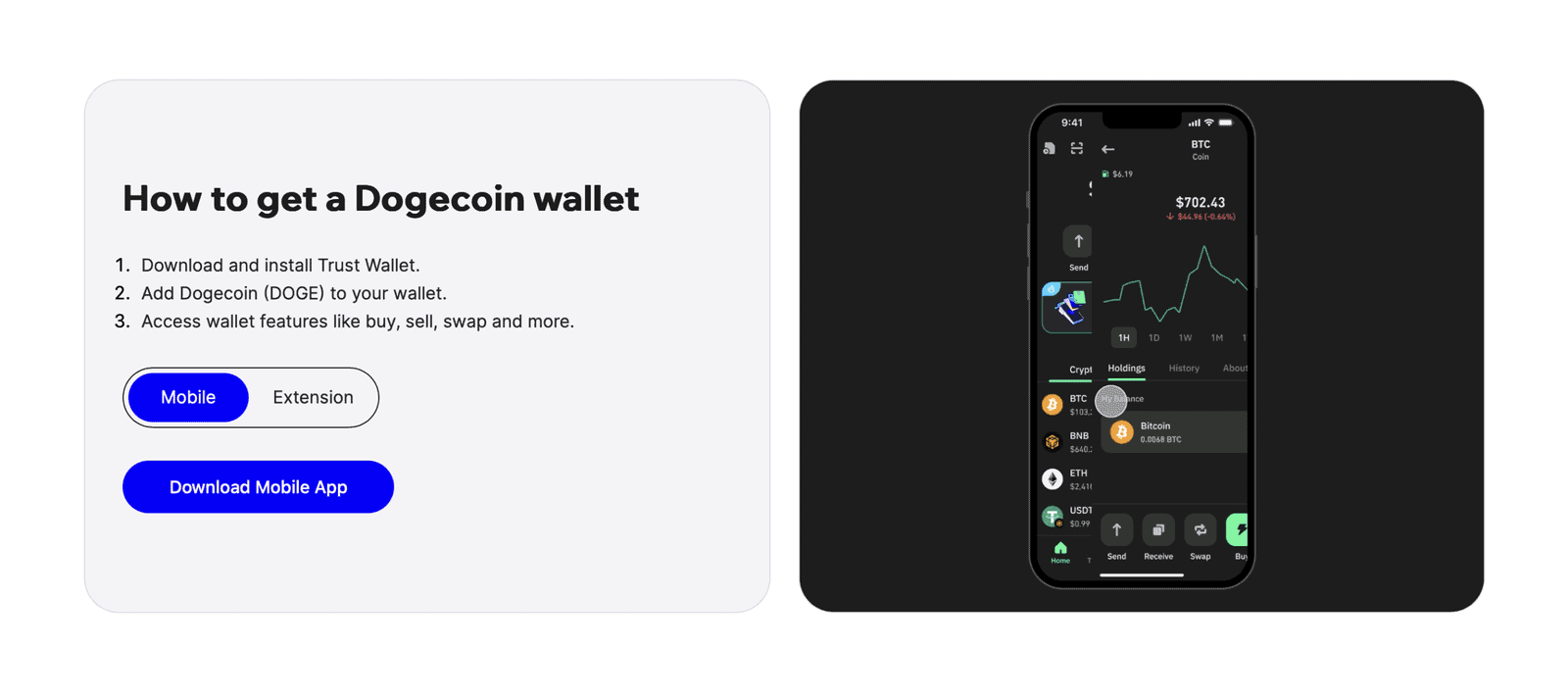
Trust Wallet (mobile, free) supports DOGE natively and gives you full control of your private keys. It’s Binance-affiliated but open-source. Clean interface, built-in swap feature, no KYC for the wallet itself. Good default for most buyers holding under $5,000.
Ledger Nano S Plus ($79) stores DOGE offline on a hardware device. Overkill for 1,000 DOGE? Absolutely. Essential if you’re holding five or six figures? Without question. Ledger suffered a customer database leak in 2020 (email addresses and phone numbers, not private keys), which led to targeted phishing campaigns. The devices themselves remain uncompromised. Connect it to Ledger Live, install the Dogecoin app, and your keys never touch the internet.
Exodus (desktop + mobile, free) bundles a slick portfolio tracker with a built-in exchange. Fees on the built-in swap run higher than dedicated exchanges – around 2-4% depending on the pair – but the convenience factor is real. If you want one app for holding DOGE, BTC, and ETH without juggling three interfaces, Exodus handles it.
One rule regardless of wallet choice: write your seed phrase on paper, not in a screenshot. Every year, thousands of wallets get drained because someone saved their 12 words in Notes or Google Drive. A $3 notebook is the most effective security tool in crypto.
Taxes, DCA, and the Stuff Everyone Skips
The IRS classifies DOGE as property. Every sale, swap, or purchase of goods triggers a taxable event. Buy $500 in DOGE, watch it climb to $800, sell it – you owe capital gains tax on the $300 profit. Hold longer than a year and you qualify for long-term rates (0-20%). Sell within a year and it’s taxed as ordinary income.
Dollar-cost averaging crushes the timing problem. Set a $25 weekly recurring buy on Coinbase or Kraken. At current prices, that’s roughly 272 DOGE per week, 14,130 per year. You won’t catch the exact bottom – nobody does – but you won’t buy the top either. Recurring buys also remove the emotional component. DOGE dropped 25% in February? Your auto-buy grabbed more coins at a discount while everyone else panicked on Reddit.
Track everything. Koinly, CoinTracker, and TaxBit all integrate with major exchanges and generate IRS-ready forms. The $49-99 annual subscription pays for itself the moment you need to file Schedule D.
What Could Go Wrong (Seriously, Read This)
DOGE has no supply cap. Five billion new coins enter circulation every year through mining – roughly 3.2% annual inflation at current supply. That inflation rate decreases over time as the fixed issuance becomes a smaller percentage of total supply, but it never hits zero. Bitcoin maxis call this a feature bug. DOGE supporters argue predictable issuance keeps transaction fees low and encourages spending over hoarding.
The Musk factor cuts both ways. A single tweet sent DOGE from $0.05 to $0.73 in 2021. Musk’s departure from DOGE, the government efficiency department he briefly led (yes, it was named after Dogecoin), removed a narrative catalyst. DOGE hasn’t recaptured its highs since. Our Dogecoin price prediction covers the scenarios in detail – but the short version: without a new demand catalyst, the 87% drawdown from ATH could persist.
Liquidity risk on smaller exchanges is real too. Stick with platforms processing $100M+ in daily DOGE volume. At $1.2 billion in 24-hour volume globally, DOGE liquidity is healthy on major exchanges – but thin books on smaller platforms mean you’ll get slipped on large orders.
This is not financial advice. DYOR. Data as of March 30, 2026.
Sources:
- CoinGecko API – DOGE price, market cap, supply data (accessed March 30, 2026)
- Coinbase fee schedule: coinbase.com/advanced-fees
- Kraken fee schedule: kraken.com/features/fee-schedule
- Binance fee schedule: binance.com/en/fee/schedule
Leave a Reply