

🕑 4 min read
A private key breach took down crypto poker’s most celebrity-backed platform – but player wallets walked away untouched.
$94,267. That’s all it took to shut down the self-proclaimed “world’s first player-owned online poker platform.”
Phenom Poker, the crypto-native poker DAO running on Base with Viktor “Isildur1” Blom and Daniel “Jungleman” Cates on its roster, went dark on April 1 after hackers drained site funds through a compromised team member’s laptop. Not a rug pull. Not a smart contract exploit. A stolen private key – the kind of attack that doesn’t require a single line of malicious code.
A Compromised Laptop, Not a Smart Contract Exploit
CEO Matt Valeo confirmed the breach in Discord hours after the site went offline.
“Today we got attacked by a sophisticated group who was able to compromise a team member’s machine. Unfortunately, a private key was compromised and the hacker was able to move some site funds before we were able to act,” Valeo said.
The attack vector was almost embarrassingly simple. Someone got access to a team member’s computer, extracted a private key, and drained the treasury wallet. No flash loans. No reentrancy exploits. No oracle manipulation. Just malware – or social engineering – and patience.
Phenom pulled the site offline as a precaution. Cash games are set to resume April 4. Tournaments got frozen mid-play, with affected multi-table events paying out based on ICM calculations.
It’s the crypto equivalent of robbing a poker tournament’s cashier office. You got the petty cash. The players’ chips stayed on the table.
The Proxy Contract Warning Nobody Read
Did anyone actually check the fine print on PHNM before aping in?
We pulled up the token on CoinGecko, and GoPlus Security had flagged it with a warning that should’ve made anyone pause: “This is a proxy contract. The contract owner can make code changes to the token contract including but not limited to disabling sells, changing fees, minting, transferring tokens.”
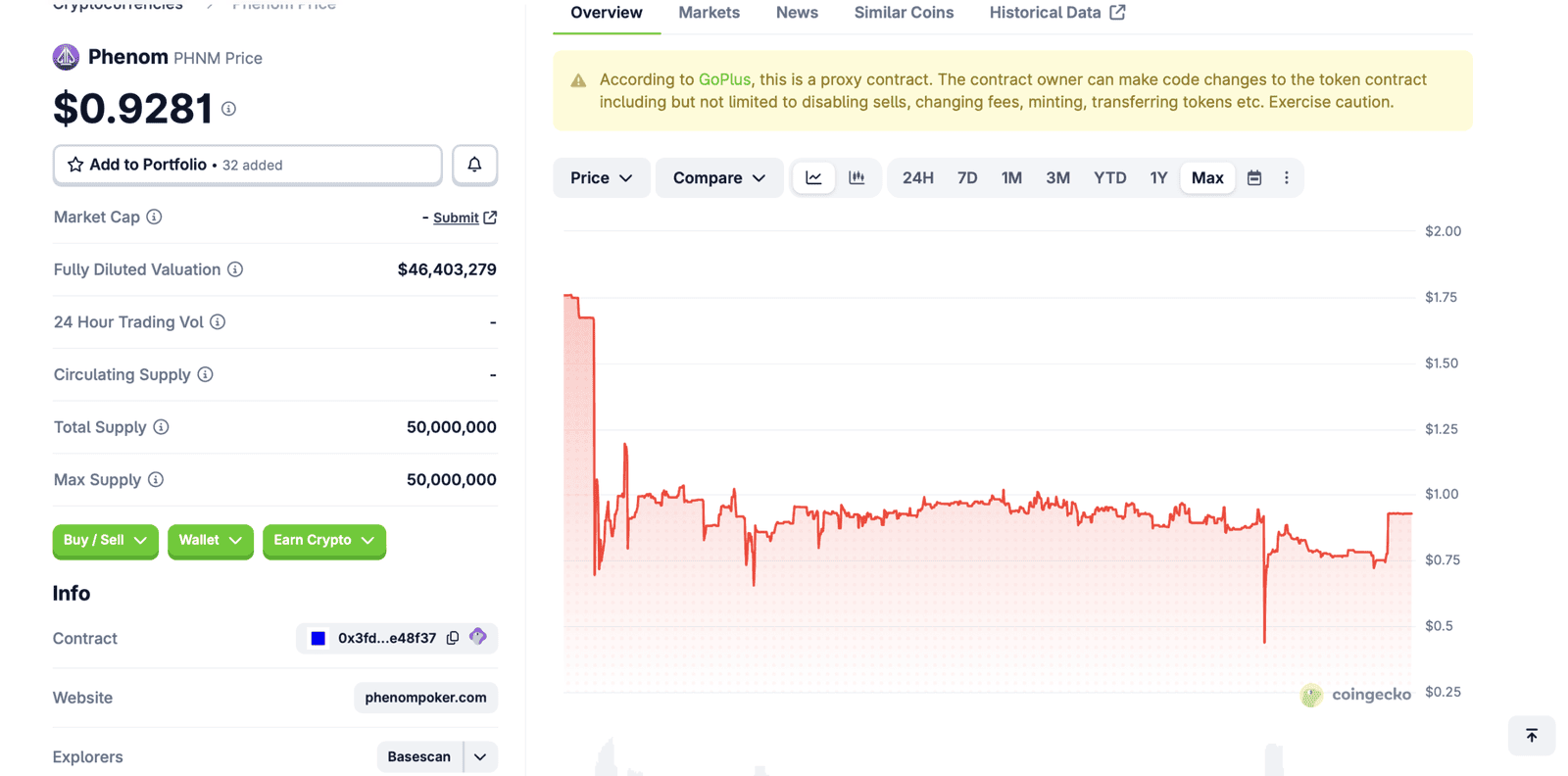
That doesn’t mean the hack exploited the proxy mechanism. It didn’t – this was a private key theft, not a contract exploit. But a proxy contract on a poker platform with $46.4 million fully diluted valuation and $42 in daily trading volume? That’s a structural risk investors chose to ignore.
PHNM trades at $0.93 today, down 47.3% from its February all-time high of $1.76. The token migrated from Polygon to Base in early 2026 after the original fixed-price model – where the Phenom treasury was the sole buyer – burned through reserves as players mass-redeemed PHNM for USDT. That treasury drain forced a pivot to open-market DEX trading on Aerodrome.
And then the treasury that replaced it got hacked.
Isildur1 and Jungleman Couldn’t Save This One
Phenom’s roster reads like a poker Hall of Fame shortlist. Isildur1, Jungleman, Phil Laak, Brian Rast, Huck Seed, Ben Heath, Sergio Aido, Joseph Cheong, Chris “Big Huni” Hunichen. These are names that move needles in the poker world.
But celebrity endorsements don’t audit smart contracts. And they definitely don’t secure private keys.
The one genuinely good piece of engineering? Player funds weren’t touched. By design, Phenom doesn’t custody user wallets – balances live in external Web3 wallets that even the platform can’t access. Players could withdraw during the outage. Valeo emphasized this point repeatedly: “Phenom, and therefore even a hacker, DOES NOT have access to your player wallets.”
That’s a meaningful architectural choice. It’s also the bare minimum for any Web3 application in 2026.
What Comes Next – And What It Tells Us
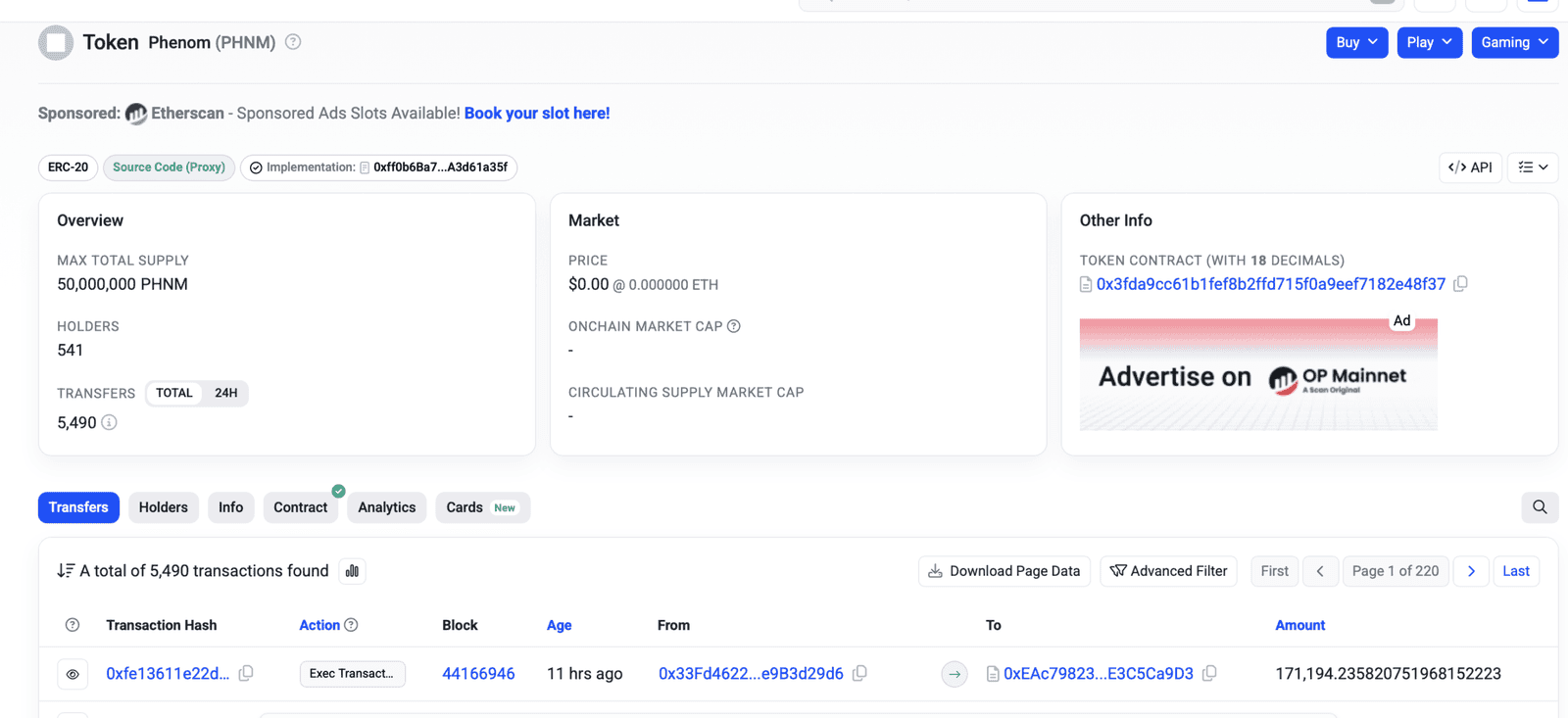
Phenom plans to transition away from PHNM entirely, replacing it with an in-game currency called CHIP. The stolen liquidity will reportedly be restored. No timeline yet on either.
The $94K loss is pocket change compared to the $285 million Drift Protocol exploit that hit Solana the same week, where Elliptic pointed to North Korea’s Lazarus Group. Phenom’s hack won’t make the Rekt leaderboard.
But the pattern is identical. Private key compromise – the same attack vector behind Ronin ($625M), Harmony Horizon ($100M), and the Bybit breach. No amount of smart contract auditing protects against a team member clicking the wrong link.
Phenom holds a gambling license from the Autonomous Island of Anjouan (Union of Comoros) and uses iTech Labs-certified RNG. Whether those credentials mean anything to a hacker with root access to a team laptop is a question worth asking.
If Phenom restores liquidity and ships the CHIP migration without further incidents, this becomes a $94K lesson. If the proxy contract gets exploited next – or if the “sophisticated group” comes back for a bigger target – it becomes something else entirely.
Phenom Poker’s 50 million token supply is fixed and non-inflationary, with 50% of net rake distributed weekly to PHNM stakers via USDC. The platform remains licensed and operational, with cash games resuming April 4, 2026.
A $94K hack didn’t kill crypto poker. But it exposed how thin the security layer really is – even when the biggest names in the game are backing the table.
This is not financial advice. DYOR. Data as of April 2, 2026.
Sources:
Leave a Reply