

🕑 4 min read
World Liberty Financial’s token hit rock bottom on Friday — and the on-chain trail behind the collapse reads like a conflict-of-interest case study.
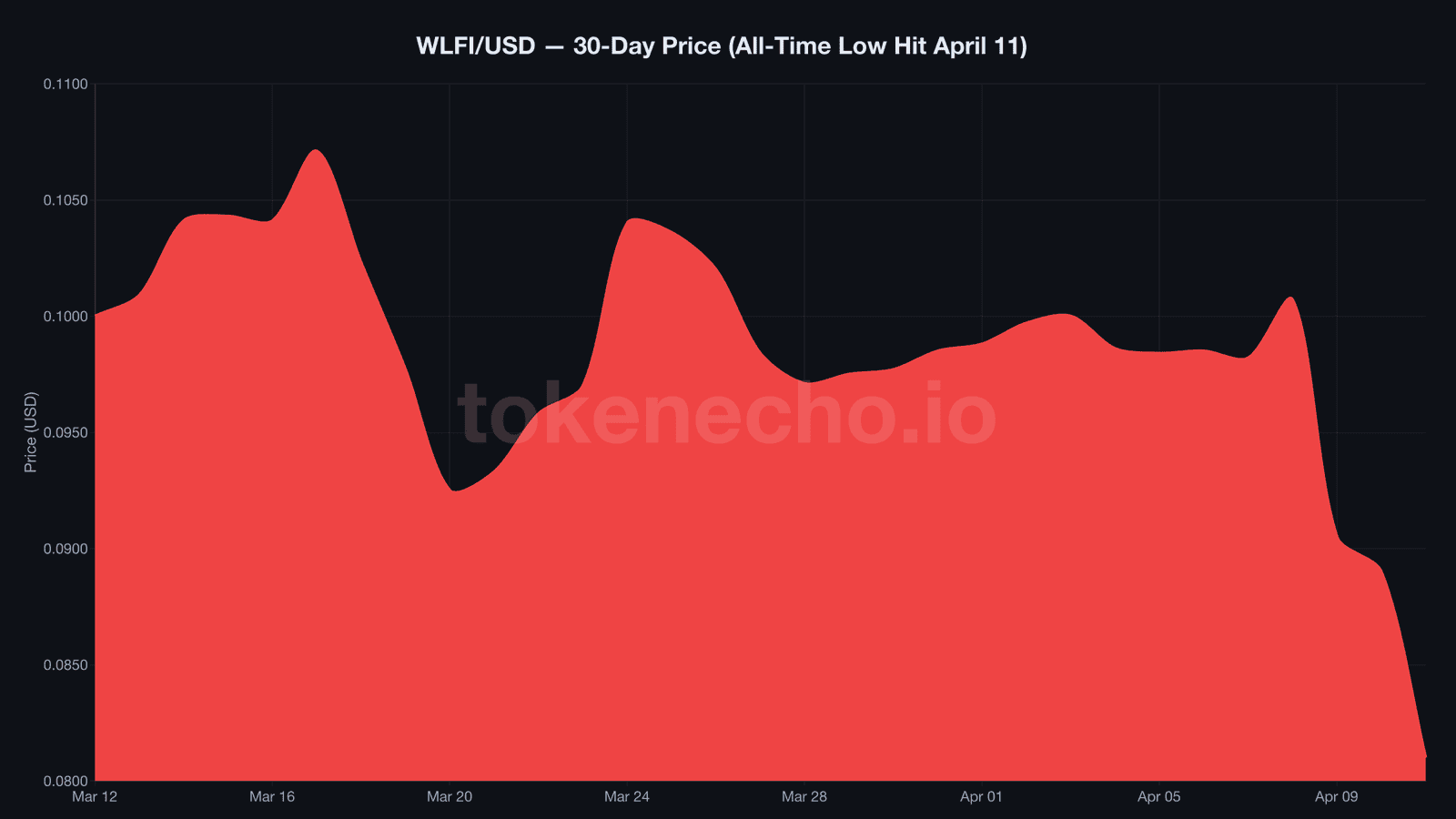
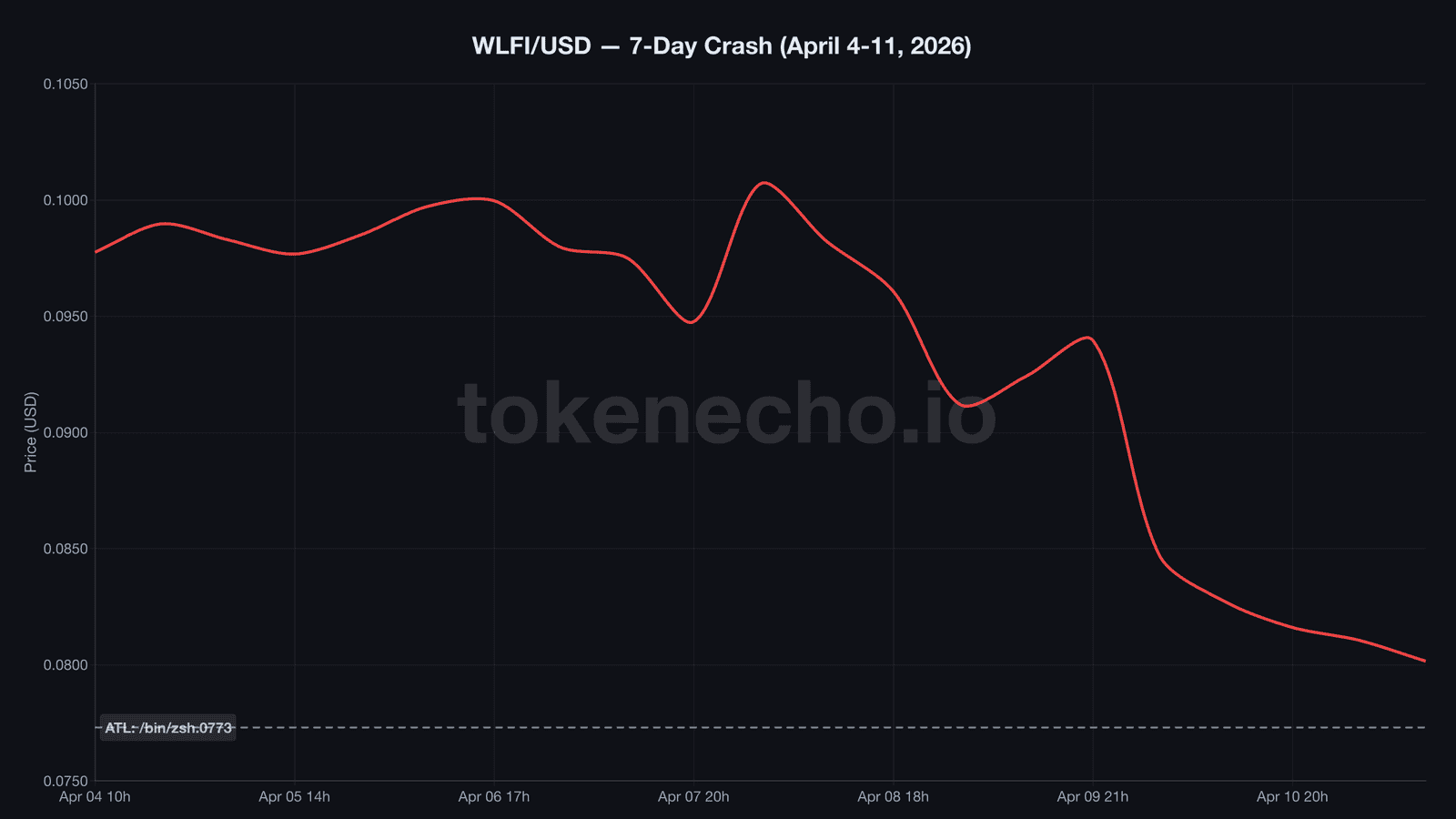
WLFI, the governance token of Trump-backed World Liberty Financial, crashed to an all-time low of $0.077 on April 11. That’s a 76% decline from its September 2025 peak of $0.33 – and the bleeding accelerated after reports surfaced that the project borrowed roughly $150 million in stablecoins against its own token on Dolomite, a DeFi lending protocol co-founded by one of World Liberty’s own advisers.
The token shed 20% in seven days. Market cap crumbled from roughly $2.9 billion to $2.5 billion, erasing over $400 million in 48 hours while the broader crypto market rallied 1.3%.
That divergence alone should raise eyebrows.
$150M borrowed against its own token – on an adviser’s platform
World Liberty Financial says it’s “generating yield” for everyone. The on-chain data paints a messier picture.
Two wallets linked to the project deposited 5 billion WLFI tokens into Dolomite and borrowed a combined $150 million in stablecoins. Most of it was USD1 – World Liberty’s own stablecoin – with another $10.3 million in USDC.
More than $40 million of those proceeds moved directly to Coinbase Prime, according to CoinDesk’s on-chain analysis. That’s a lot of stablecoins heading toward fiat rails for a project claiming to “generate yield.”
What caught our attention isn’t just the size. It’s who runs the platform.
Corey Caplan co-founded Dolomite. He’s also a listed adviser to World Liberty Financial. In traditional finance, a related-party transaction of this scale would require disclosure, independent board approval, and probably a few uncomfortable conference calls with regulators. In DeFi, it just takes a wallet and an Ethereum transaction.
WLFI’s collateral now accounts for roughly 55% of Dolomite’s entire $836 million in total value locked. The project’s USD1 pool sits at 93% utilization – a technical way of saying depositors can’t withdraw their money until the borrower pays it back.
“We are one of the largest suppliers and borrowers on WLFI Markets,” the team posted on X on April 10. “Even if markets moved dramatically against us, we’d simply supply more collateral,” they said.
The team called it FUD.
Depositors trapped, Justin Sun’s $70M frozen and bleeding
But the scariest part isn’t the loan itself.
It’s what happens if WLFI keeps falling. DeFi analyst Nicolas Vaiman warned that significant further price declines could trigger collateral liquidation, “forcing additional token sales in a death spiral.” The token trades with limited market depth relative to the 5 billion tokens pledged. A forced sale wouldn’t just crash WLFI – it could leave Dolomite holding bad debt that depositors eat.
And then there’s Justin Sun.
The Tron founder dropped $30 million on 544 million WLFI tokens in late 2024. Those tokens peaked at roughly $119 million last September. Today they’re worth about $43 million – a paper loss north of $70 million. But Sun can’t cut his losses even if he wanted to. World Liberty blacklisted his wallet in September 2025, freezing every token in place.
Sun can’t sell. Can’t transfer. Can only watch the number shrink.
“I am innocent,” Sun said at the time. “No buying or selling was involved.” He’s been demanding World Liberty unlock his tokens ever since. Friday’s drop alone cost his frozen position another $11 million.
Meanwhile, World Liberty repaid $25 million of the Dolomite debt on April 11 – a partial unwind, but the outstanding balance still sits around $125 million. And a governance vote on unlocking up to 16 billion additional WLFI tokens looms in the coming weeks. If that supply hits the market, it represents a potential $1.28 billion shock at current prices.
Is anyone really surprised the token can’t find a floor?
For more on Trump’s crypto ventures, see our analysis of Trump’s crypto empire and the $3.3B stablecoin. For context on DeFi resilience during market stress, read how DeFi held $97.6B in TVL while Bitcoin bled 20%.
A DeFi project borrowing against its own token on a platform run by its own adviser – and calling critics “FUD” – is either supreme confidence or a ticking clock. The on-chain data doesn’t pick sides.
This is not financial advice. DYOR. Data as of April 11, 2026.
Leave a Reply