


XRP Price Prediction 2026, 2027-2030: Data-Driven Forecast
🕑 7 min read
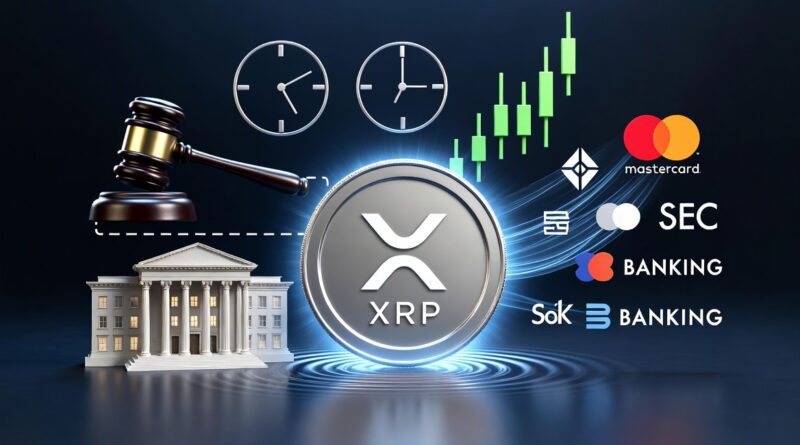
In two days, the SEC reaches its final deadline for the last batch of spot XRP ETF applications. Grayscale, WisdomTree, Franklin Templeton – they’re all waiting. And the approval odds sit above 90%.
But that’s not the number that caught our attention. This one did: 16%.
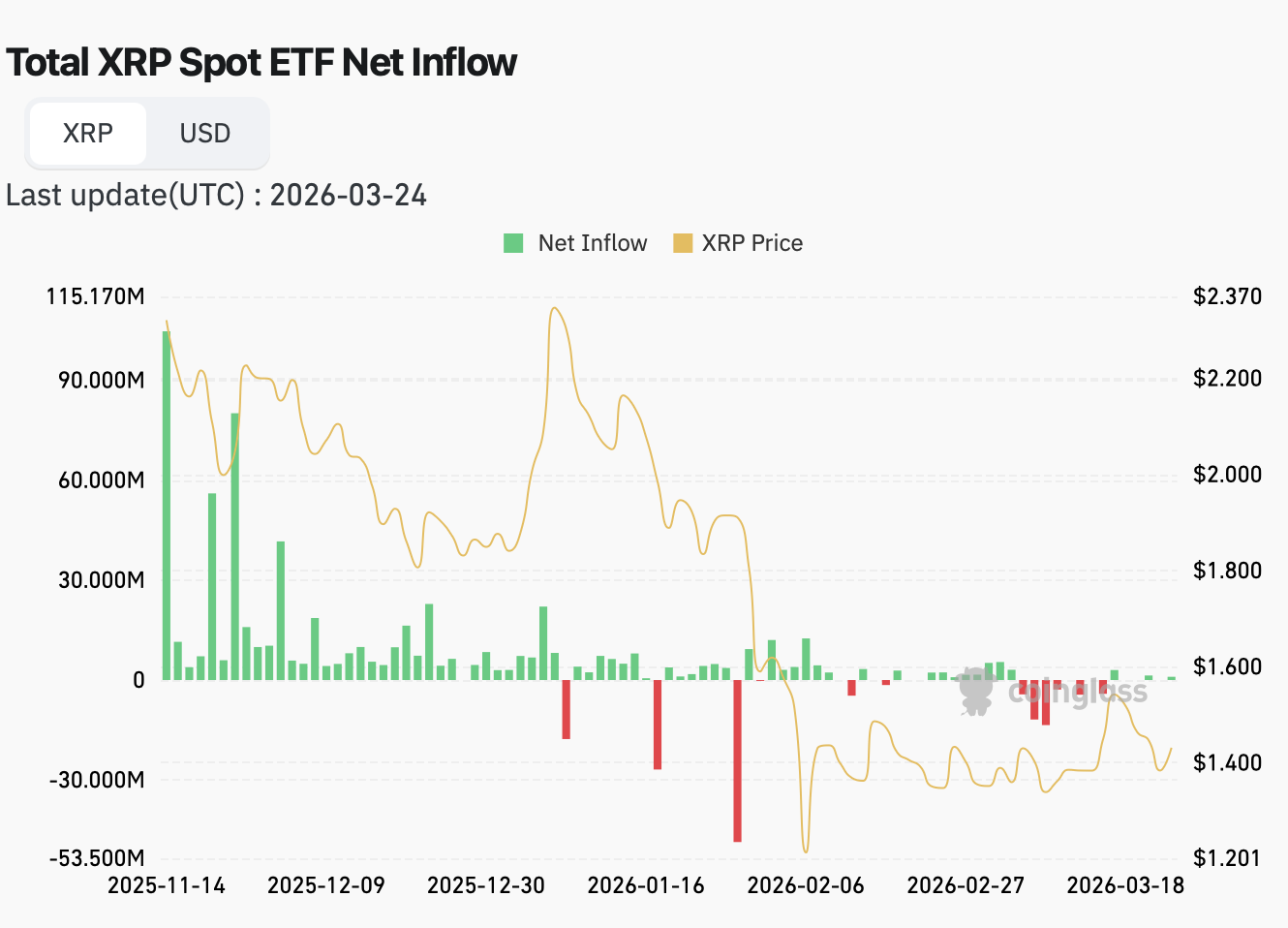
That’s the institutional participation rate in XRP ETFs after four months of trading. Sixteen percent. Bitcoin ETFs hit 40% institutional within six months. Ethereum is trending toward similar numbers thanks to BlackRock’s staking product. XRP? The institutions that everyone assumed would rush in after the commodity classification… haven’t showed up yet.
Which means one of two things. Either XRP is fundamentally less interesting to institutional capital than BTC and ETH – or the wave is still building, and $1.42 is the price you get before it arrives.
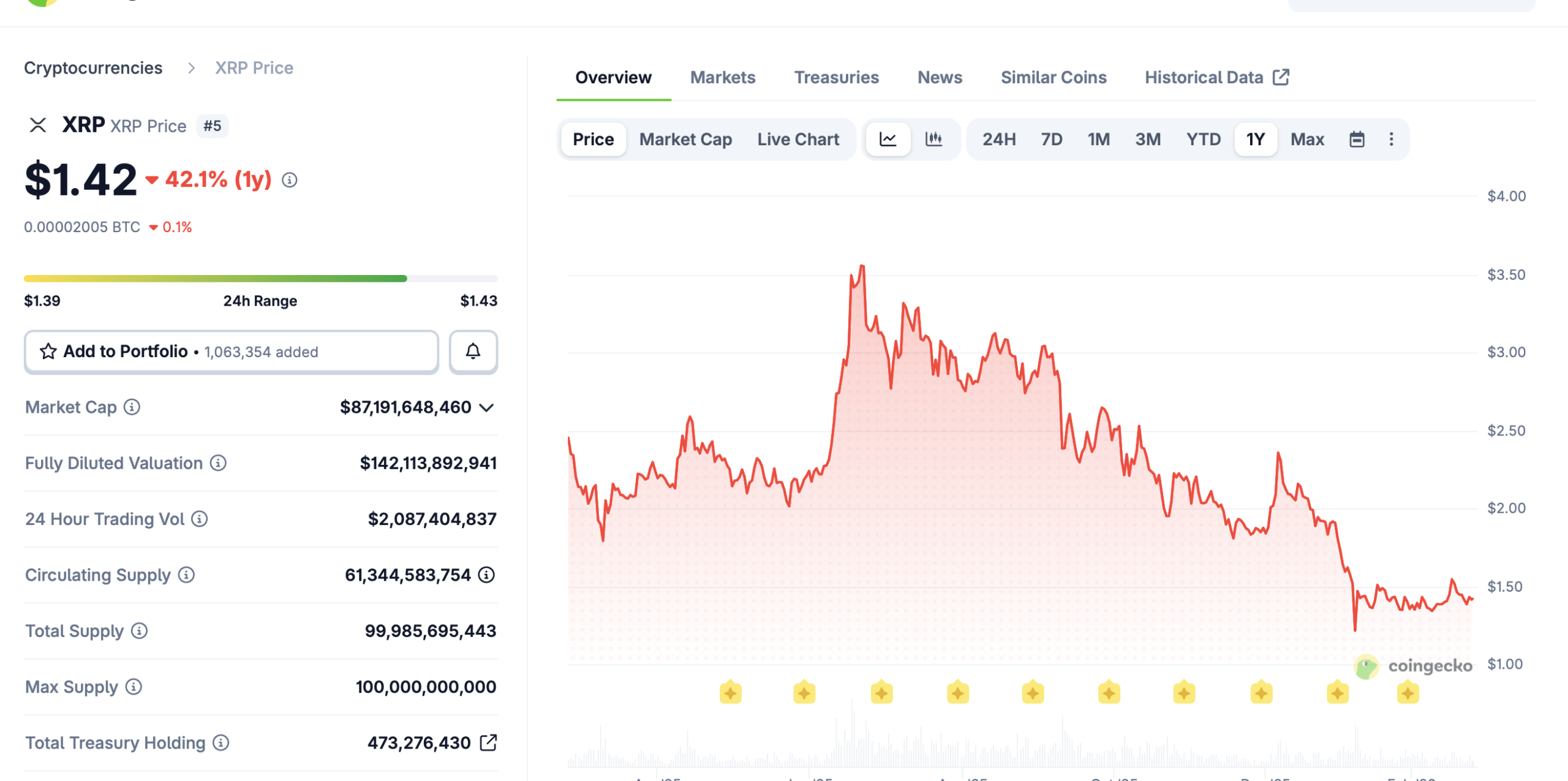
XRP trades at $1.42 as of March 25, 2026. The all-time high was $3.65 back in July 2025. Market cap sits at $87.2 billion – fifth largest in crypto. And the story behind this token has changed more dramatically in the past twelve months than any other asset in the top ten.
The Four-Year Cloud That Finally Lifted
You can’t understand XRP’s price without understanding the lawsuit. From December 2020 until the SEC-CFTC joint ruling on March 17, 2026, Ripple and XRP existed under a regulatory shadow that made institutional investment nearly impossible. Compliance teams at major funds had a simple rule: if the SEC says it might be a security, we don’t touch it.
That rule evaporated in a single 68-page document. XRP is now officially a digital commodity under federal law. Not guidance. Not a settlement. Binding regulatory classification.
The market barely reacted. XRP is up just 3.93% over the past 30 days – which, given that the biggest regulatory overhang in crypto history just got removed, feels like the price hasn’t processed the news yet.
Goldman Sachs apparently processed it faster. The bank holds a $153.8 million position in XRP ETFs – a fact we broke down in detail last week. When Goldman takes a position in an asset that’s down 61% from its high, they’re not chasing momentum. They’re pricing in something the market hasn’t.
RLUSD: The Catalyst Nobody’s Pricing In
Forget the token for a second. Look at what Ripple the company is building.
RLUSD – Ripple’s dollar-pegged stablecoin – hit $1.26 billion in market cap in under a year. That makes it the third-largest U.S.-regulated stablecoin, behind only USDC and USDT. For context, it took USDC three years to reach that milestone. RLUSD did it in eleven months.
But market cap isn’t why RLUSD matters. The partnerships are.
Mastercard – the company that processes $9 trillion in annual payment volume – is piloting RLUSD settlements on the XRP Ledger. Not “exploring.” Not “in discussions.” Piloting. With WebBank and Gemini as partners. Credit card transactions settling instantly on a blockchain, using Ripple’s stablecoin.
Ripple’s payment platform has processed over $100 billion in total volume. They’re expanding into Brazil with a VASP license application. They got conditional approval from the OCC – the Office of the Comptroller of the Currency – for a national trust bank charter. That’s the kind of regulatory infrastructure that takes years to build, and Ripple already has it.
So you’ve got a $1.26 billion stablecoin, a Mastercard pilot, $100 billion in processed volume, a bank charter, and a commodity classification. And the token that sits at the center of all this infrastructure is priced at $1.42.
Something doesn’t add up. And in our experience, when real-world adoption disconnects from price this severely, the price eventually catches up.
Where XRP Goes From Here
The ETF acceleration path. March 27 brings the final batch of ETF approvals. If Grayscale and Franklin Templeton get the green light – and at 90%+ odds, they probably will – the total number of spot XRP products available to U.S. investors roughly doubles. More products mean more distribution channels. More distribution means more capital access. Under this scenario, institutional participation climbs from 16% toward 30-40% through 2026, driving XRP to $2.50-$4.00 by year-end. RLUSD’s Mastercard integration scales in 2027, creating genuine payment volume on the XRP Ledger – $4.00-$8.00 becomes the range. By 2028-2029, if cross-border settlement adoption follows Ripple’s trajectory, Standard Chartered’s $12.50-$28 targets come into play. And if XRP captures even a small slice of the $33 trillion annual cross-border payment market by 2030, the upside gets difficult to put a ceiling on.
The slow institutional drip. Maybe the 16% figure isn’t a “wave building” – maybe it’s a ceiling. Institutions that wanted XRP exposure bought it in the first four months. The rest are waiting for more proof. Under this scenario, XRP grinds from $1.42 to $2.00-$2.80 through 2026 on steady but unspectacular ETF inflows. RLUSD grows but doesn’t crack the USDC/USDT duopoly. Standard Chartered’s $8 target for 2026 proves too aggressive. By 2027, $3.00-$5.00. The 2028 halving cycle lifts XRP alongside everything else to $4.00-$8.00. By 2030, somewhere around $6.00-$12.00. Solid returns from $1.42, but not the moonshot XRP’s community expects.
The Ripple dependency risk. XRP’s bull case leans heavily on one company: Ripple. If RLUSD adoption stalls, if the Mastercard pilot doesn’t scale, if the OCC bank charter hits bureaucratic delays – the “utility” narrative weakens. The XRP Ledger without Ripple’s business development is a moderately used blockchain competing against faster, cheaper alternatives. Under dependency risk, XRP stays rangebound at $1.00-$1.80 through 2026, drifts to $1.50-$3.00 by 2028, and reaches $2.00-$5.00 by 2030. The token survives but never reaches escape velocity.
Our editorial view: we lean toward the ETF acceleration path, but with lower conviction than our BTC or ETH predictions. The regulatory clarity is real. The RLUSD traction is real. Goldman’s position is real. But 16% institutional participation after four months is a warning sign we can’t ignore. If that number doesn’t climb meaningfully after the March 27 approvals, the bull case weakens. We think $2.00-$3.50 for the rest of 2026 is honest, with breakout potential above $4.00 if RLUSD partnerships scale.
The Levels That Tell the Story
$1.00 is the psychological floor that XRP hasn’t broken since the SEC ruling. Losing it would signal that the commodity classification failed to generate sustained demand – and would likely trigger a cascade of ETF redemptions.
$1.60 is near-term resistance. XRP was trading at this level before the Iran crisis knocked everything down. Reclaiming it with volume confirms the correction is over.
$2.50 is where XRP was trading during the initial ETF launch euphoria in late 2025. Getting back there requires institutional flows accelerating beyond the current 16% rate.
$3.65 is the all-time high from July 2025. It’s a 157% move from current levels – aggressive, but XRP went from $0.50 to $3.65 in about eight months during 2024-2025. This token moves fast when catalysts align.
What the XRP Community Keeps Asking
Will XRP hit $10? Standard Chartered says $12.50 by 2028 and $28 by 2030. Those are the most aggressive institutional targets we’ve seen for any major crypto asset. But they’re conditional on cross-border payment adoption scaling exponentially and RLUSD becoming a dominant settlement stablecoin. Possible? Yes. Base case? No. Our mid-range for 2030 is $6-$15.
What makes XRP different from other altcoins? Two things: a functioning payment network with $100 billion in processed volume, and a stablecoin (RLUSD) that Mastercard is actively integrating. Most altcoins have whitepapers. XRP has invoices.
Is the March 27 deadline actually important? Yes, because it expands distribution. More ETF products mean more financial advisors can offer XRP to their clients. The first wave of approvals brought $1.44 billion. A second wave with names like Grayscale and Franklin Templeton could bring multiples of that – if institutions decide the 16% participation rate was a starting point, not a destination.
Reference: Price Ranges by Year
| Year | Conservative | Mid-Range | Aggressive |
|---|---|---|---|
| 2026 | $1.00-$1.50 | $2.00-$3.50 | $4.00-$6.00 |
| 2027 | $1.50-$3.00 | $3.00-$5.00 | $6.00-$8.00 |
| 2028 | $2.00-$4.00 | $4.00-$8.00 | $8.00-$12.50 |
| 2029 | $3.00-$5.00 | $5.00-$10.00 | $10.00-$20.00 |
| 2030 | $2.50-$6.00 | $6.00-$15.00 | $15.00-$28.00 |
The Risk That Matters Most
XRP’s biggest risk isn’t regulation anymore – that battle is won. It’s execution. Ripple needs to convert pilots into production deployments, RLUSD needs to scale beyond $1.26 billion, and institutional ETF participation needs to climb from 16% to something that justifies the current valuation. The 100 billion XRP max supply also means dilution is a factor – 38.6 billion tokens are still not in circulation, controlled primarily by Ripple’s escrow. How and when those tokens enter the market affects every price target on this page. And there’s always the concentration question: XRP’s fate is more tied to a single company’s business decisions than any other top-five crypto asset. That’s a feature when Ripple is winning. It’s a vulnerability when they’re not.
This is not financial advice. DYOR. Price predictions are based on historical data, on-chain metrics, and analyst forecasts. Actual results may vary significantly. Data as of March 25, 2026.
Sources
- CoinGecko – XRP price, market cap, supply data
- SEC.gov – Joint SEC-CFTC commodity classification
- CoinDesk – Ripple $100B payment volume, RLUSD
- TradingNews – Standard Chartered XRP price targets
- Yahoo Finance – Mastercard XRP Ledger pilot
- 247 Wall St – XRP ETF landscape and March 27 deadline