


How to Buy Bitcoin in 2026: A Step-by-Step Guide for Beginners
🕑 5 min read
You’ve decided to buy Bitcoin. Good. Bad. Too early. Too late. Everyone has an opinion and none of them matter — what matters is that you know how to actually do it without getting scammed, overcharged, or locked out of your own money.
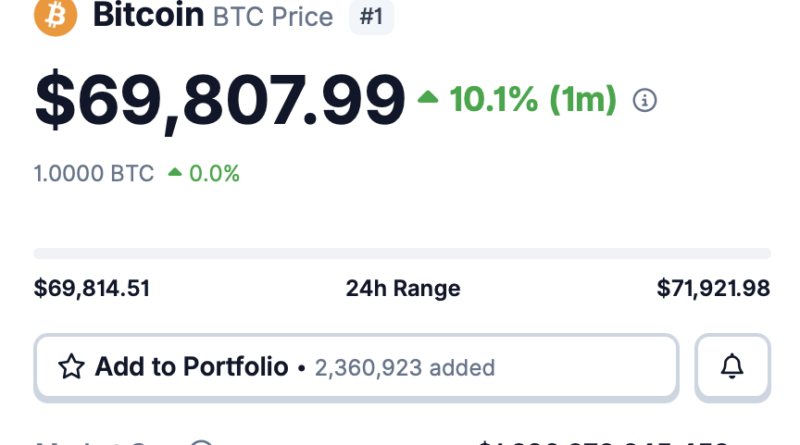
One Bitcoin costs about $69,800 right now. Before you close the tab — you don’t need a whole one. Ten dollars works. Seriously. We’ll get to that.
First Things First: Where Do You Actually Buy It?
You need an exchange. Think of it like a currency booth at the airport, except it’s an app on your phone, the exchange rate updates every second, and the fees are — believe it or not — actually lower than what the airport charges for euros.
If you’re in the US and want something that won’t make you throw your phone across the room, three names keep coming up.
Coinbase is what your parents would use if they bought crypto. Clean design. Publicly traded on NASDAQ. Insured deposits up to $250K. The catch? Fees around 1.5% per trade. For your first $100 purchase, that’s a buck fifty. Not ideal, not a dealbreaker.
Want cheaper? Kraken charges 0.16-0.26% and has a solid reputation stretching back to 2011. The interface assumes you can find a “Buy” button without a tutorial, which — if you’re reading this guide — you probably can.
Binance.US has the lowest fees at 0.1%, but the dashboard looks like a cockpit. Save it for when you’re comfortable. Or don’t — some people learn to swim by jumping into the deep end.
One trap worth mentioning: PayPal and Cash App let you “buy Bitcoin,” but many users can’t actually withdraw it to their own wallet. You’re buying an IOU, not Bitcoin. The distinction didn’t matter until FTX proved exactly why it does.
The ID Check Nobody Loves But Everyone Needs
Every legit exchange asks for identity verification. Passport or driver’s license. Sometimes a selfie holding said ID — glamorous, we know. Occasionally a utility bill.
Why? Because they’re legally required to. Any exchange skipping this step is either breaking the law or about to disappear with your money. Pick regulated. Always.
Approval takes anywhere from instant to 48 hours depending on the platform and how blurry your selfie is.
Money In: Three Ways, One Clear Winner
- Bank transfer (ACH): Free. Takes 1-3 days. Best option for literally everyone who isn’t in a rush.
- Debit card: Instant but 2-4% fee. Buying $100? You’re really getting $96 of Bitcoin. Fine for a test run, terrible for real money.
- Wire transfer: Same-day but $15-30 fee. Only makes sense above $5,000.
Our recommendation? Bank transfer. That 1-3 day wait feels annoying right now. In a year when you’re still holding that Bitcoin, you won’t remember it. But you’ll definitely remember the 3% you saved.
The Part Everyone Overthinks
Open the app. Find “Buy.” Type in how many dollars you want to spend. Hit confirm.
That’s it. You own Bitcoin now.
“But I can only afford $100 — isn’t that too small?” No. At $69,800 per coin, your $100 buys 143,300 satoshis (the smallest Bitcoin unit). Nobody’s judging your stack size. The billionaire who bought $100 million of Bitcoin owns the exact same asset you do. Just… more of it.
Dropping more than $500? Don’t do it all at once. Dollar-cost averaging — buying a fixed amount weekly or monthly — is the boring strategy that quietly outperforms trying to nail the perfect entry. Bitcoin crashed from $94K to $67K in three months. Lump-sum buyers at the top are still crying. DCA buyers averaged in around $78K and sleep fine.
Why Your Bitcoin Shouldn’t Live on the Exchange
“Not your keys, not your coins.” That phrase exists because people learned it the hard way.
Bitcoin on Coinbase means Coinbase holds the keys. They could get hacked. Freeze your account. Go under. Probably won’t. But probably isn’t definitely, and $8 billion in FTX customer funds is the footnote that proves the difference matters.
Two options for taking custody yourself:
Free route — download BlueWallet or Exodus on your phone. Software wallet. Good for smaller amounts. Takes 2 minutes to set up.
Serious route — buy a Ledger ($79) or Trezor ($70). Physical device, keys never touch the internet. Worth every penny once your portfolio passes a couple thousand.
Whichever you pick, the wallet spits out 12 words during setup. These words are your entire financial life. Write them on paper. Two copies. Two locations. Not your phone. Not a screenshot. Not Google Drive. Paper. Lose those words plus your device? Your Bitcoin is gone — and not the “call customer support” kind of gone. The “mathematically impossible to recover, ever” kind.
What You Now Own (and What You Don’t)
Bitcoin isn’t a stock. There’s no CEO, no office, no quarterly earnings call. Nobody can dilute your shares or vote to change the rules. The supply is capped at 21 million coins. Forever. About 19.8 million exist already. That scarcity is the entire thesis — digital gold with a fixed supply in a world where governments print unlimited money.
The price swings? Violent. Drops of 20-30% happen in bull markets. If that makes you nauseous, invest less. Bitcoin rewards patience and absolutely destroys panic.
The Expensive Mistakes (Learn From Others, Not Yourself)
Investing rent money. If losing this changes what you eat for dinner — you’ve gone too far.
Timing the market. Professional traders with $50M in quant models get this wrong. You scrolling charts on the toilet at 2 AM are not going to nail the bottom. DCA. Set it. Forget it.
The “send BTC to verify your wallet” scam. Nobody legitimate asks for this. Not Coinbase. Not Elon Musk. Not the friendly stranger in your DMs. Close the tab.
Panic selling during crashes. Bitcoin has dropped 50%+ six times in its history. Six times it recovered and made new highs. The only people who permanently lost money were the ones who sold at the bottom and never came back.
The Questions We Get Every Single Day
Am I too late? People asked this at $1. And $100. And $1,000. And $10,000. Bitcoin’s market cap is $1.4 trillion. Gold is $16 trillion. If BTC takes even a few more percent of the store-of-value market, the math from $69,800 still works.
Do I owe taxes? In the US — yes. Bitcoin is property according to the IRS. Sell at a profit, capital gains tax applies. Most exchanges generate tax forms automatically. Don’t ignore this. The IRS has been auditing crypto holders aggressively since 2024 and they’re not slowing down.
What’s the minimum? Most exchanges start at $1-10. Even $25 a month adds up to $6,500 over five years. That’s not nothing.
This is not financial advice. DYOR. Data as of March 26, 2026.