
🕑 7 min read
There’s a question hanging over Dogecoin that nobody in the DOGE community wants to confront directly.
Every major cryptocurrency in the top 10 set a new all-time high during the 2024-2025 bull cycle. Bitcoin hit $109,000. Ethereum reached $4,946. Solana touched $293. XRP broke through to $3.65. Even BNB and TRON made new highs.
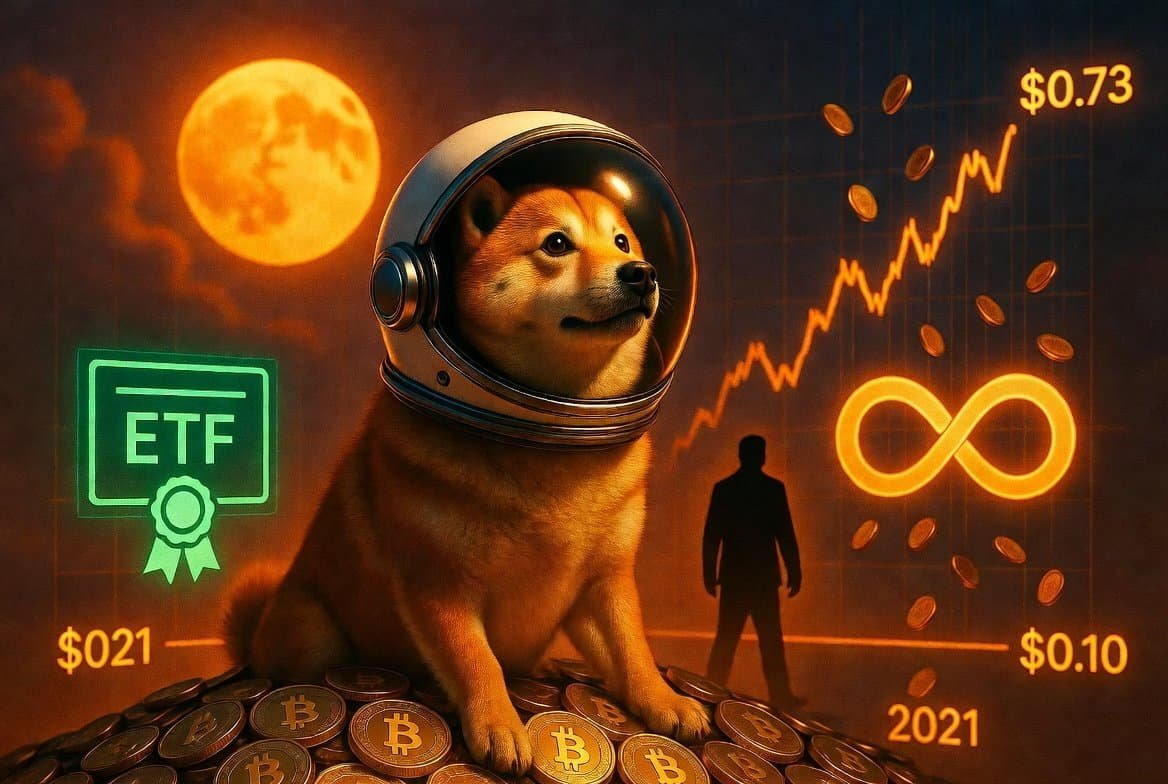
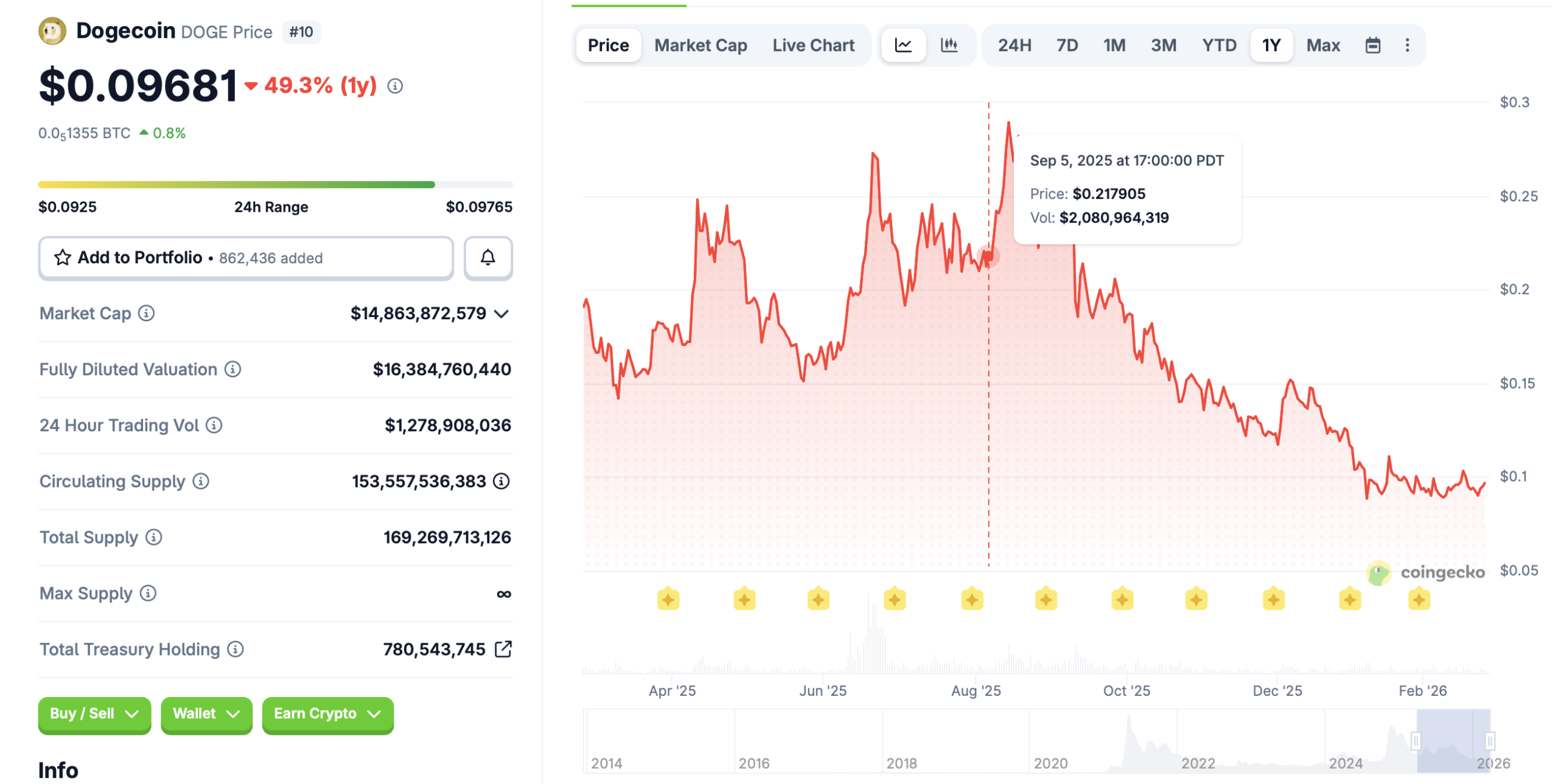
Dogecoin peaked at $0.73 in May 2021. Four years later, it’s trading at $0.097 – down 87% from that level. And the question isn’t whether DOGE will ever see $0.73 again. The question is whether the market is telling us something about memecoins that the community doesn’t want to hear.
We dug into the on-chain data, the ETF flows, the whale positioning, and the macro context. What we found is more nuanced than either the bulls or the bears want to admit.
The Musk Factor: What Happens When the Narrative Fades
For better or worse, Dogecoin’s price history is inseparable from one man’s Twitter account.
Elon Musk tweeted DOGE into a $88 billion market cap in 2021. He named his government cost-cutting initiative “DOGE” in a wink to the community. And for a while, the joke worked – the Department of Government Efficiency kept Dogecoin in headlines through all of 2025, even when the token’s fundamentals gave nobody a reason to buy.
Then the department was disbanded in November 2025. Musk stepped back from his government role. And DOGE quietly slipped from the conversation.
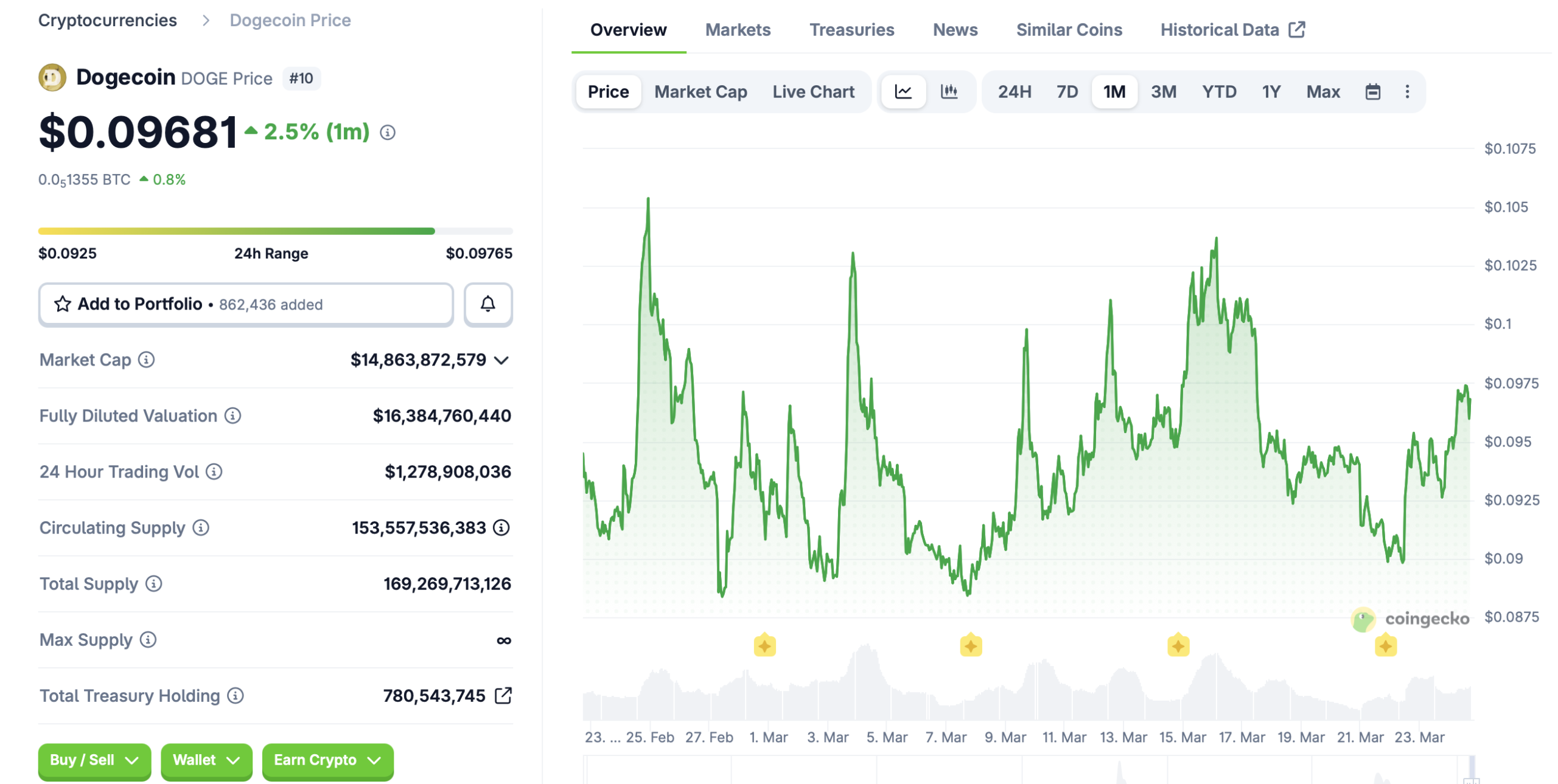
The price tells the story. Over the past year, DOGE has lost 49.8% of its value. Over 30 days? Essentially flat – up 0.37%. The Musk premium, whatever it was worth, appears to have fully evaporated.
But – and this matters – the infrastructure around DOGE kept building while the memes faded.
What the Smart Money Is Actually Doing
On-chain data from mid-March paints a picture that doesn’t match the “dead memecoin” narrative.
Whale activity exploded 400% in a 24-hour window, with large holders accumulating 470 million DOGE over 72 hours. Active addresses surged 176% in a single week. Trading volume hit $2.5 billion on March 17 – a 133% spike – before settling back down.
Futures open interest sits at $2 billion. That’s serious derivatives positioning for a token most institutional analysts refuse to cover.
And then there’s the ETF. In January 2026, 21Shares launched TDOG – the first spot Dogecoin ETF – on Nasdaq. It’s a small product so far, but the fact that it exists at all would have been unthinkable two years ago. The SEC’s March 17 commodity classification confirmed DOGE’s legal status alongside Bitcoin and Ethereum. A memecoin, officially classified as a commodity by the United States government.
You couldn’t make this up.
The Structural Problem Nobody Mentions
Before we get to price targets, we need to talk about supply. Because DOGE has a feature that makes it fundamentally different from Bitcoin, Ethereum, and every other top-10 asset we’ve covered.
There is no supply cap. None. Zero.
Bitcoin has 21 million coins. Ever. Ethereum became deflationary post-merge. Even XRP has a 100 billion cap. Dogecoin produces approximately 5.26 billion new tokens every year through mining rewards – and that will continue forever.
At current prices, that’s roughly $500 million in annual inflation being dumped onto holders. For DOGE to simply maintain its current price, it needs $500 million in new buying pressure every year just to absorb issuance. For it to go up, it needs substantially more than that.
This doesn’t mean DOGE can’t rally. It means every rally fights against a structural headwind that Bitcoin and Ethereum don’t have. And it’s the single biggest reason why DOGE never reclaimed its 2021 high while everything else did.
Where DOGE Goes From Here
The memecoin renaissance path. Memecoins have proven remarkably resilient as a category. If a new narrative catalyst emerges – a Musk tweet, a DOGE integration into X payments (still rumored, never confirmed), or a broader memecoin supercycle – DOGE would be the primary beneficiary as the original and most liquid memecoin. Under this scenario, DOGE could reclaim $0.15-$0.25 through 2026 as retail interest returns. If the 2028 Bitcoin halving triggers the same kind of altcoin mania we saw in 2021, DOGE could push toward $0.40-$0.75 – finally challenging its all-time high. By 2030, the most aggressive models suggest $1.00-$3.00, though these require sustained cultural relevance that no memecoin has ever maintained for a decade.
The ETF accumulation path. TDOG exists. More DOGE ETF products may follow. If institutional adoption grows slowly but steadily – similar to what we’re seeing with Bitcoin and Ethereum ETFs – it creates a baseline demand that partially offsets the inflationary supply. DOGE in this scenario grinds from $0.097 to $0.12-$0.18 through 2026. Nothing explosive, just quiet accumulation by funds that want memecoin exposure in a regulated wrapper. By 2027, $0.15-$0.25. By 2028, $0.20-$0.40 with halving tailwinds. By 2030, $0.30-$0.75. Respectable from current levels, but nowhere near the $1 dream.
The slow fade. This is the scenario the DOGE subreddit will downvote, but the data supports it as a possibility. Musk’s attention has moved on. The DOGE Department is gone. Unlimited supply dilutes holders every day. Newer memecoins with actual utility features (Shiba Inu’s Shibarium, BONK’s Solana ecosystem) compete for the same speculative capital. If no new catalyst emerges and the memecoin sector rotates to newer tokens, DOGE drifts sideways between $0.06 and $0.12 through 2026, slowly bleeds to $0.04-$0.10 by 2028, and becomes the crypto equivalent of a penny stock by 2030 – still alive, still traded, but irrelevant to most portfolios.
Our editorial take: somewhere between the ETF accumulation and the renaissance paths. DOGE isn’t dying – the whale activity and ETF launch prove that. But reclaiming $0.73 requires the kind of cultural mania that doesn’t repeat on demand. We think $0.12-$0.20 for the rest of 2026 is realistic, with upside to $0.30+ if a genuine catalyst appears.
The Levels Worth Watching
$0.08 has been the floor through early 2026. Every dip gets bought here. Losing it would be technically devastating – there’s not much support between $0.08 and $0.05.
$0.10 is the current battle. DOGE keeps flirting with it and failing to hold. A sustained close above $0.10 is the first sign of trend change.
$0.17 was the March 2025 rejection level. Breaking through it would confirm a genuine reversal and open the path toward $0.25.
$0.73 is the all-time high from May 2021. It sounds absurd from $0.097, but remember – DOGE went from $0.002 to $0.73 in about four months during the 2021 mania. This token doesn’t move in straight lines. It doesn’t move at all, and then it moves all at once.
The Questions You’re Googling
Will Dogecoin reach $1? At $1, DOGE would have a market cap of roughly $160 billion – larger than Solana’s current valuation. That’s not impossible in a full-blown bull market with memecoin mania, but it requires conditions that haven’t existed since early 2021. Our honest assessment: unlikely before 2028, possible but not probable by 2030.
Is DOGE a good buy at $0.097? The whale data says smart money is accumulating. The ETF provides a floor of institutional demand. And an 87% drawdown from ATH means you’re buying after most of the pain has already happened. The counterargument: unlimited supply means your position gets diluted every day. This isn’t a “set and forget” investment – it’s a bet on another wave of attention.
Does the DOGE Department shutdown matter? The narrative boost from Musk’s government role is gone. But DOGE existed for seven years before the Department – and it’ll exist long after. The real question is whether DOGE can generate attention without Musk as its de facto marketing department. So far in 2026, the answer is: barely.
Reference: Price Ranges by Year
| Year | Conservative | Mid-Range | Aggressive |
|---|---|---|---|
| 2026 | $0.06-$0.10 | $0.12-$0.20 | $0.25-$0.40 |
| 2027 | $0.08-$0.15 | $0.15-$0.25 | $0.30-$0.50 |
| 2028 | $0.06-$0.12 | $0.20-$0.40 | $0.40-$0.75 |
| 2029 | $0.05-$0.15 | $0.25-$0.50 | $0.50-$1.00 |
| 2030 | $0.04-$0.10 | $0.30-$0.75 | $0.75-$3.00 |
The Risk That Defines DOGE
Every other token we’ve covered in this series has a fundamental value proposition: Bitcoin’s scarcity, Ethereum’s DeFi ecosystem, Solana’s speed, XRP’s payment network. Dogecoin’s value proposition is cultural relevance. That’s powerful when it’s working – nothing moves faster than a memecoin with momentum. But cultural relevance isn’t a protocol feature you can measure on a dashboard. It comes and goes. And right now, with Musk focused on xAI and Tesla, with the DOGE Department disbanded, and with newer memecoins competing for attention – it’s more “goes” than “comes.”
The unlimited supply just makes it harder. Every year, 5.26 billion new DOGE enter circulation regardless of demand. That’s the tax DOGE holders pay for the privilege of owning the original memecoin. Whether the memes are worth that tax is, ultimately, what this prediction comes down to.
This is not financial advice. DYOR. Price predictions are based on historical data, on-chain metrics, and analyst forecasts. Actual results may vary significantly. Data as of March 25, 2026.
Leave a Reply