
🕑 3 min read
Ninety-two percent.
That’s how far Cardano has fallen from its September 2021 peak of $3.09. At $0.26, ADA has given back virtually everything it gained during the last bull cycle – and then some. For context, Bitcoin is down 36% from its high. Ethereum is down 56%. Even Dogecoin, the literal joke coin, has only dropped 87%.
ADA is the most destroyed blue-chip token in the top 15. And yet – and this is the part that makes us do a double-take when we look at the data – the development pipeline has never been fuller. Midnight is launching mainnet this month. Leios promises 10,000 TPS. The SEC just classified ADA as a commodity. Over 1.3 million wallets are actively staking.
The price says nobody cares. The GitHub commits say otherwise. One of these signals is wrong.
The Problem Nobody In the Cardano Community Can Solve
Cardano has a reputation problem that no amount of peer-reviewed research can fix.
In crypto, speed wins narratives. Solana shipped fast and broke things. It went down, came back, and the market rewarded the hustle. Ethereum built DeFi in real-time, bugs and all, and captured $97 billion in TVL. Cardano took the academic approach – move slowly, publish papers, prove everything mathematically before deploying.
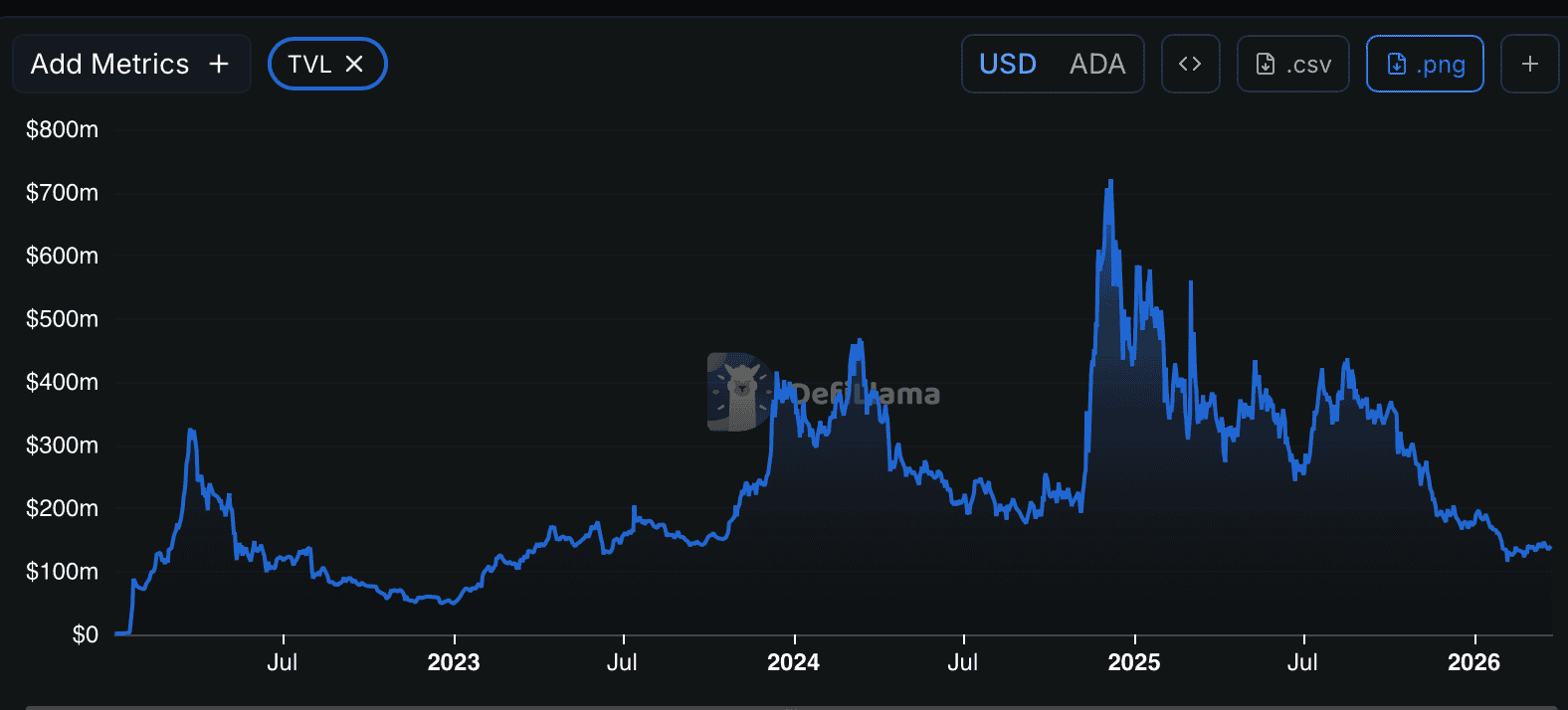
The result? A technically sound blockchain that most of DeFi forgot about. Cardano’s TVL sits around $178 million. Ethereum has $97.6 billion. Solana has $6.3 billion. Even Base – a chain that didn’t exist two years ago – has more DeFi activity than Cardano.
At $0.26 with a $9.6 billion market cap, the market is telling you something: it values shipping over research papers. Whether that’s short-sighted or just realistic depends on what happens next.
What’s Actually Shipping in 2026
Midnight is Cardano’s zero-knowledge privacy sidechain, and mainnet is confirmed for Q1 2026. It uses a dual-token model: NIGHT for governance and DUST (shielded) for fees. The pitch is regulatory-compliant privacy for healthcare, finance, and enterprise applications.
Leios is the Ouroboros consensus upgrade targeting 10,000 transactions per second. For a chain that currently processes around 250 TPS, this would be a 40x improvement. Paired with Hydra (off-chain scaling), Cardano’s performance ceiling goes from “adequate” to “competitive” in 2026.
SEC commodity classification landed on March 17, alongside Bitcoin, Ethereum, and 13 other tokens. ADA is now officially not a security under federal law.
The staking ecosystem remains one of Cardano’s genuine strengths. Over 1.3 million wallets are staking ADA – one of the highest participation rates in crypto.
Where ADA Goes From Here
The Midnight catalyst path. If Midnight launches successfully and attracts enterprise adoption, ADA climbs from $0.26 to $0.40-$0.60 through 2026. Leios deployment opens the door to $0.80-$1.50 by 2027. The 2028 halving cycle lifts ADA to $1.50-$2.50. By 2030, $2.00-$3.50 becomes possible.
The slow grind path. Midnight launches but adoption is slow. ADA drifts to $0.30-$0.45 through 2026. By 2027, $0.40-$0.80. By 2030, $0.80-$1.50.
The irrelevance risk. If Midnight fails to attract users and the TVL gap widens – ADA stays flat at $0.15-$0.30 through 2026 and becomes a sub-$0.20 token by 2030. The technology works. Nobody uses it.
Our view: $0.35-$0.55 for the rest of 2026 is realistic, with significant upside if Midnight gets traction.
The Levels That Define ADA’s Chart
$0.20 is the multi-year floor. $0.30 is near-term resistance. $0.50 is where ADA traded in late 2025. $1.00 is the psychological target – a 285% move from current levels.
Reference: Price Ranges by Year
| Year | Conservative | Mid-Range | Aggressive |
|---|---|---|---|
| 2026 | $0.15-$0.25 | $0.35-$0.55 | $0.60-$1.00 |
| 2027 | $0.20-$0.40 | $0.40-$0.80 | $0.80-$1.50 |
| 2028 | $0.25-$0.50 | $0.60-$1.20 | $1.50-$2.50 |
| 2029 | $0.30-$0.60 | $0.70-$1.30 | $1.50-$3.00 |
| 2030 | $0.20-$0.50 | $0.80-$1.50 | $2.00-$3.50 |
This is not financial advice. DYOR. Data as of March 26, 2026.
Sources
- CoinGecko – ADA price, market cap, supply data
- DefiLlama – Cardano DeFi TVL
- CoinCentral – Midnight, Leios roadmap
- SEC.gov – Digital commodity classification
Leave a Reply