
🕑 5 min read
Your crypto is sitting on an exchange right now. Coinbase, probably. Maybe Binance. And nothing bad has happened yet, so you figure it’s fine.
Key word: yet.
When Bitcoin lives on an exchange, the exchange controls the private keys — the thing that actually proves ownership. You see a number on a screen. They hold the real thing. It’s the difference between owning a house and having a photo of a house. FTX customers had very nice photos. $8 billion worth.
Setting up your own wallet takes five minutes and costs zero dollars. And once you’ve done it, trusting an exchange with serious money feels about as comfortable as leaving your car unlocked in a parking garage overnight.
Wait — Wallets Don’t Actually Hold Anything?
Correct. And this trips up everyone at first.
Your Bitcoin doesn’t live “inside” your wallet the way money sits in a bank account. It lives on the blockchain — a public ledger that nobody controls. What the wallet stores is your private key, which is just the cryptographic proof that says “this Bitcoin belongs to me and I’m allowed to move it.”
Two things to understand. Only two.
Public key = your address. Like an email address — share it freely, people use it to send you crypto, and knowing it gives them zero access to your funds.
Private key = your password. Share it with absolutely nobody. Someone gets this, they empty your wallet. No reversal. No refund. No “I’d like to speak to a manager.”
That’s the whole concept. Everything else is just choosing which app or device holds that key for you.
The Two Types (It’s Simpler Than the Internet Makes It Sound)
Walk into any crypto forum and you’ll drown in wallet recommendations. Ignore 90% of it.
Hot wallets are apps on your phone or browser extensions on your laptop. Free. Always connected to the internet. Quick and convenient for everyday amounts. Think of it like cash in your pocket — accessible, but if someone picks your pocket, it’s gone.
Cold wallets are physical devices about the size of a USB drive. $55-150. They store keys completely offline. Think of it like a safe bolted to the floor in your closet — nobody’s breaking in remotely, but you need to physically walk over and open it every time you want to do anything.
Which do you need? Both, eventually. But start with hot. It’s free and takes three minutes. Graduate to cold when your portfolio crosses the “this would actually hurt to lose” threshold — which for most people is somewhere around $1,000-2,000.
Trust Wallet: Our Pick for People Starting From Zero
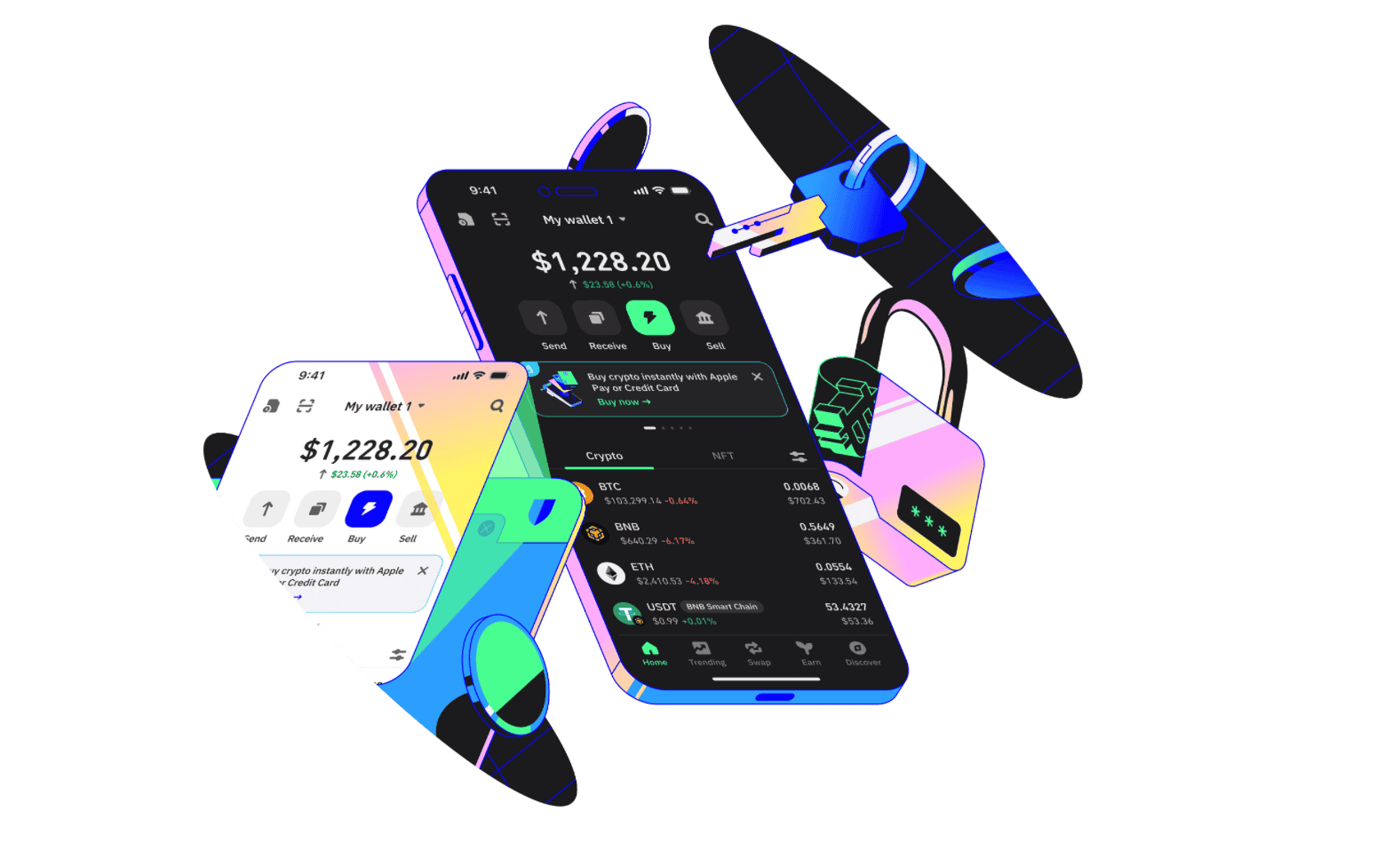
Why Trust Wallet? Because it supports 100+ blockchains, costs nothing, and was designed by people who apparently remember what it’s like to be confused by crypto for the first time. The interface is clean enough that your non-technical friend could figure it out without texting you for help.
Download it from the App Store or Google Play — but check the developer name says “Trust Wallet.” Fake versions exist because of course they do.
Tap “Create a new wallet” and the app shows you 12 words. Stop. Right here is where most people make the mistake that costs them everything later. Those 12 words aren’t a nice-to-have backup feature. They ARE the wallet. Grab a pen. Grab paper. Write the words down in order. Not in your phone notes — those get synced to iCloud where they can be hacked. Not in a screenshot — same problem. Physical paper that lives in a drawer or a safe.
The app quizzes you to verify you wrote them down. Tap the words in the right order, and you’re done. Wallet created. Every major blockchain — Bitcoin, Ethereum, Solana, the works — is already set up and waiting.
Zero fees from Trust Wallet itself. You only pay whatever the blockchain charges for gas — pennies on Solana, a couple bucks on Ethereum, somewhere in between on Bitcoin.
MetaMask: If You’re Going Down the DeFi Rabbit Hole
Planning to swap tokens on Uniswap? Deposit into Aave? Buy an NFT? MetaMask is what every Ethereum-based app expects you to have. Browser extension for Chrome, Firefox, and Brave, plus a mobile app.
Setup is nearly identical — install, create wallet, write 12 words, done. Two minutes if you type fast.
The limitation nobody mentions until you’re frustrated: MetaMask doesn’t do Bitcoin. Or Solana. It’s Ethereum and EVM-compatible chains only (Polygon, Arbitrum, Base, BSC). Want everything in one wallet? Trust Wallet or Exodus. Want the deepest Ethereum integration? MetaMask.
Also watch the swap fees — MetaMask takes 0.3-0.875% when you swap through their built-in tool. Going directly to Uniswap through your browser costs just the gas fee. Same result, less money skimmed.
Ledger: For When the Numbers Get Serious
Remember the safe-bolted-to-the-floor analogy? That’s Ledger.
The Nano S Plus at $79 handles 5,500+ coins and does everything a beginner needs. The Nano X at $149 adds Bluetooth so you can manage from your phone without cables. Both require a 24-word recovery phrase (longer than hot wallets for extra security) and a PIN.
What makes it worth $79? When you sign a transaction on a Ledger, the private key processes everything inside the chip and never — ever — touches your computer. Your laptop could be swimming in malware and the Ledger wouldn’t blink. That’s the entire value proposition in one sentence.
Those 12 Words Again (Because People Keep Losing Money)
Phone breaks? Enter the 12 words on a new phone. Everything reappears. Ledger gets stolen? Buy a new one, type in the 24 words. Your crypto comes back like nothing happened.
But — and this is the part people learn too late — if someone else types your words into their device, they now own your crypto. And if you lose the words AND lose the device? Nobody can help. Not Trust Wallet’s support team. Not Ledger. Not the blockchain itself. The funds sit in a mathematical lockbox with no key. Forever.
Paper. Two copies. Two physical locations. This isn’t paranoia. It’s the cost of being your own bank.
The Mistakes That Turn a Learning Experience Into an Expensive One
Sending Bitcoin to an Ethereum address. This isn’t like mailing a letter to the wrong house where someone forwards it. This is throwing money into a black hole. BTC addresses start with “1” or “bc1.” ETH starts with “0x.” They’re different planets. Check. Then check again.
Skipping the test send. About to transfer $5,000 to your new wallet? Send $10 first. Costs a few cents in gas. Saves you from the kind of mistake that ruins a month.
Clicking “Approve” on sketchy DeFi sites. Connecting your wallet to Uniswap or Aave? Safe. Connecting to the random link someone posted in a Telegram group? That’s how wallets get drained faster than you can screenshot the transaction. Stick to bookmarked URLs of protocols you trust.
This is not financial advice. DYOR. Data as of March 26, 2026.
Sources
- Trust Wallet – Official documentation
- MetaMask – Official documentation
- Ledger – Hardware wallet specs
- CoinLedger – Best wallets 2026
Leave a Reply