

🕑 6 min read
Wall Street’s first yield-bearing crypto ETF just outpaced the most successful ETF launch in history – and barely anyone noticed.
The $155 Million Nobody Talked About
On March 12, BlackRock listed the iShares Staked Ethereum Trust – ticker ETHB – on Nasdaq. First-day net inflows: $155 million.
That number deserves context. When BlackRock launched IBIT, its spot Bitcoin ETF that went on to accumulate over $52 billion in assets, day-one inflows clocked in at $110 million. ETHB crushed that by 40%. On a product most retail traders haven’t even heard of yet.
Within seven days, AUM hit $254 million. CoinShares data shows ETHB spearheaded a $1 billion weekly inflow into staked Ethereum products across the industry. And it wasn’t just BlackRock – Grayscale and 21Shares both made their first staking reward distributions to shareholders in the same month.
But the twist that makes this story genuinely unusual? Traditional ETH ETFs – the ones without staking – are hemorrhaging capital. Seven straight days of outflows. Negative $92.5 million and counting, with BlackRock’s own non-staking ETHA fund shedding $31.45 million in a single session on March 20.
So the money isn’t leaving Ethereum. It’s upgrading.
The Yield That Changes the Conversation
Why would an institution buy ETHB when 10-year Treasuries pay 4.5% risk-free?
That’s the question every crypto skeptic is asking, and it’s a fair one. ETHB stakes between 70% and 95% of its ETH holdings through Coinbase Prime, generating roughly 3.1% gross staking yield. After BlackRock and Coinbase take their 18% cut, investors receive about 1.9-2.2% net annually, distributed monthly.
Compared to a T-bill, that looks terrible. On paper.
But Treasuries don’t come with exposure to a network processing $162 billion in stablecoins and running over $97 billion in DeFi protocol value. Treasuries don’t give you upside if the asset recovers from a 60% drawdown. And Treasuries can’t be rebalanced into a portfolio model that treats ETH as a “digital dividend stock” – which is exactly how BlackRock is positioning this.
“Ethereum is very clearly a technology centred bet around blockchain innovation,” Robert Mitchnick, BlackRock’s global head of digital assets, said during ETHB’s launch on CNBC. “For a lot of investors, being able to capture some additional yield is a point of attraction.”
Translation: they’re not competing with Treasuries. They’re building a new asset class.
The Bifurcation in Real Time
What’s happening inside the ETH ETF market right now is something we haven’t seen in crypto before. Capital is rotating within the product category – not out of it.
Total spot ETH ETF assets sit at $12.33 billion with $11.73 billion in cumulative inflows since inception. That’s healthy overall. But drill into the flow data and a pattern emerges: non-staking ETH ETFs are leaking, while staking-enabled funds absorb the runoff plus fresh capital.
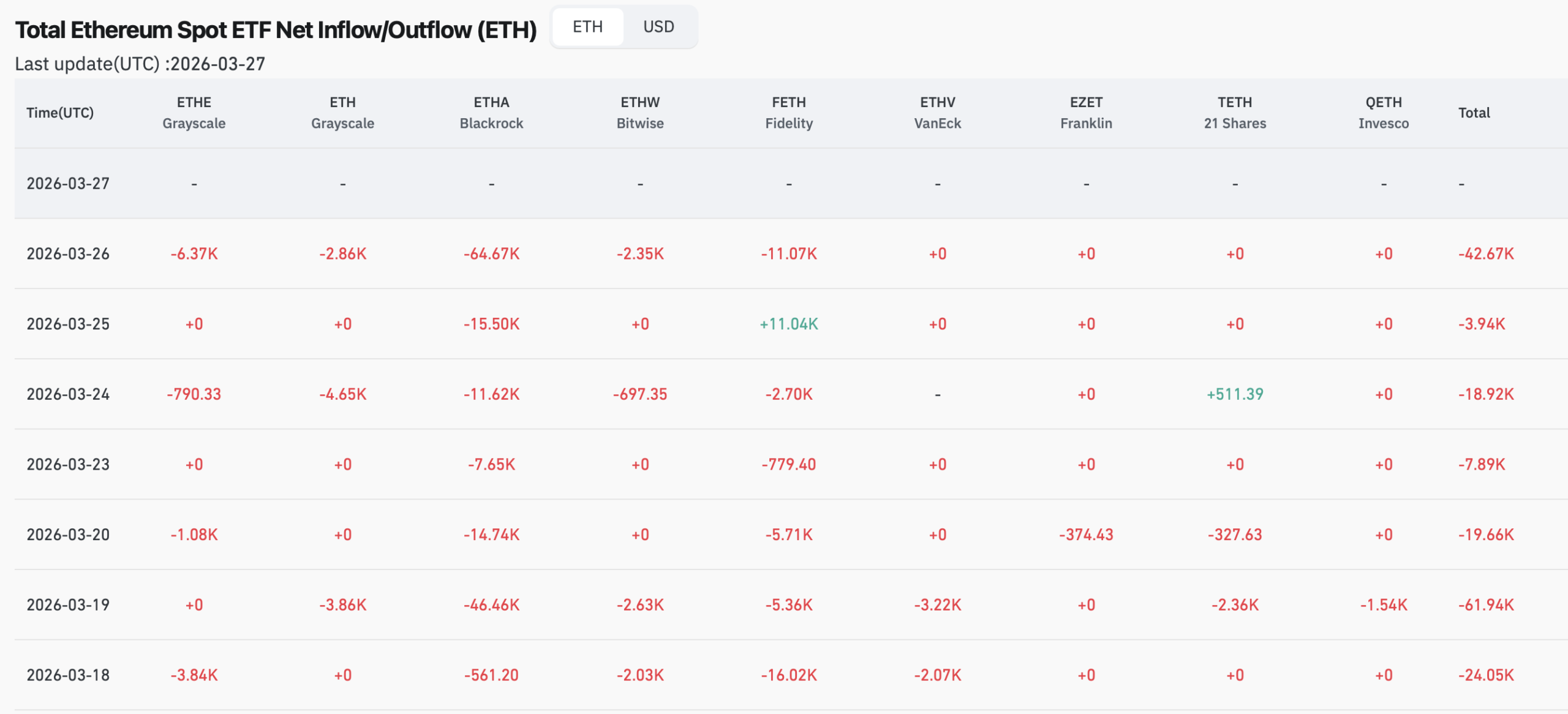
21Shares TETH, which waived its management fee entirely until October 2026, holds $34 million in AUM. Fidelity’s Ethereum fund still doesn’t distribute staking rewards to shareholders. Grayscale just started. BlackRock walked in with the infrastructure, the fee discount (0.12% for the first year on up to $2.5 billion in assets), and the Coinbase Prime staking pipeline already warm.
This isn’t a competition. It’s a rout.
And the implications stretch beyond ETH. If yield-bearing ETFs consistently attract more capital than price-only products, every crypto ETF issuer will need to add staking. That means more ETH locked up, tighter circulating supply, and a structural bid that didn’t exist six months ago.
The On-Chain Paradox BlackRock Is Betting On
ETH below $2,000 looks broken. Down 60% from the $4,946 all-time high set in August 2025. The Fear & Greed Index has spent 46 consecutive days in extreme fear territory – the longest streak since FTX collapsed.
But the network underneath that price tag tells a completely different story.
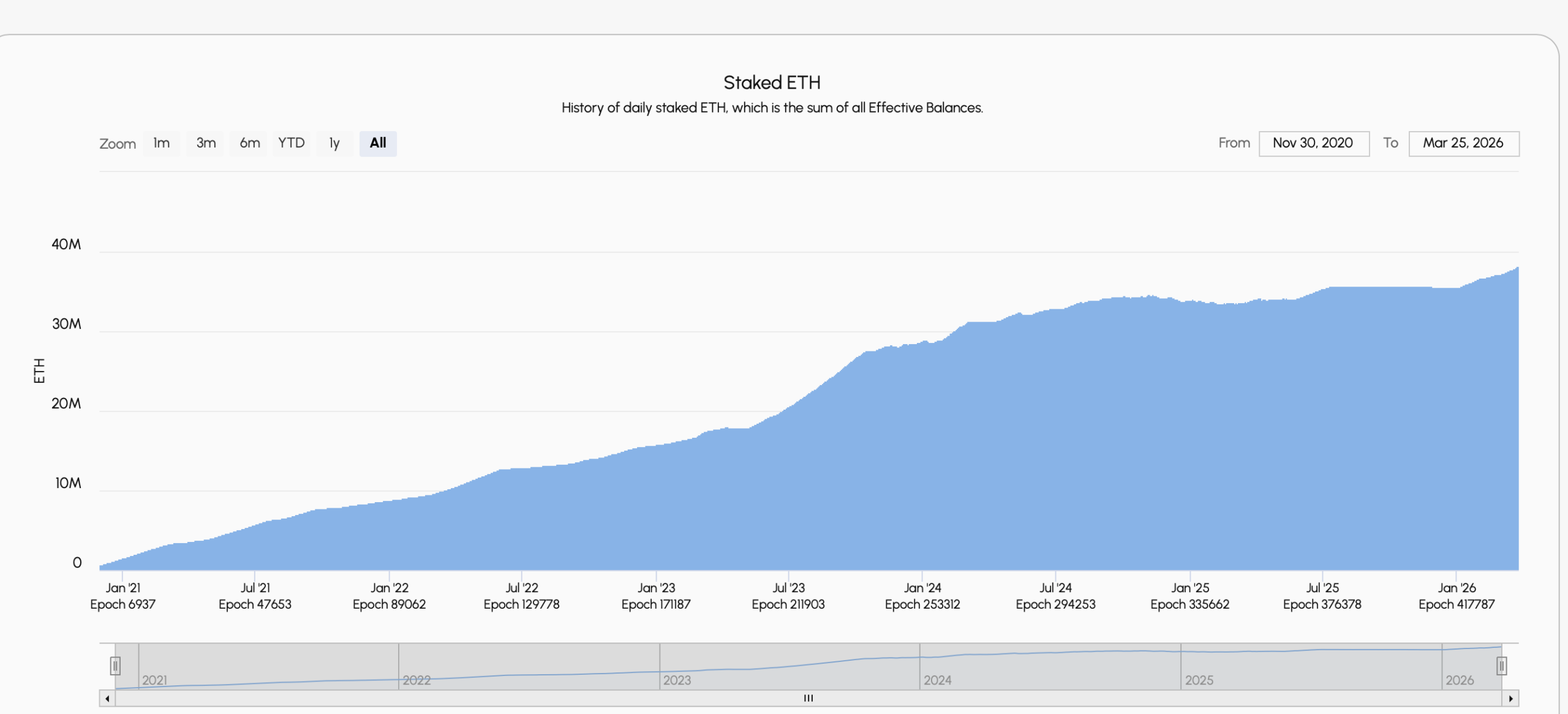
Daily active addresses surpassed 2 million in February – an all-time record that topped even the 2021 bull market peak. Smart contract calls exceeded 40 million per day. DeFi deposits hit 25.3 million ETH, another all-time high, with users adding 2.7 million ETH during the February crash instead of pulling out. Nearly 29% of all ETH in existence is staked across 1.1 million validators.
CryptoQuant data paints the exchange picture even sharper. ETH reserves across all exchanges dropped from 15.87 million on March 20 to 15.0 million by March 26 – that’s 870,000 ETH yanked off exchanges in less than a week. On March 22 alone, net outflows hit 827,000 ETH. Someone is accumulating aggressively, and they’re not keeping it on Binance.
So you’ve got record usage, record deposits, record staking, accelerating exchange withdrawals – and a price trading at $1,987. Either 2 million daily active users are wrong about Ethereum’s value, or the market hasn’t caught up to what they already know.
BlackRock is clearly betting on the latter. Larry Fink told shareholders that digital assets could each become a $500 million annual revenue line for the firm within five years. ETHB isn’t a side project. It’s a bet that ETH becomes the first institutional-grade yield-bearing digital asset – and that the firm collecting fees on $130 billion in crypto products wants to be the tollbooth.
What the Fee Structure Actually Tells You
Worth parsing the economics, because they reveal BlackRock’s confidence level.
The 0.25% sponsor fee – discounted to 0.12% for the first year on the first $2.5 billion – is designed to dominate market share early. At $254 million AUM after one week, BlackRock is running ETHB at a loss right now. They’re subsidizing adoption. That’s not something you do for a product you expect to sunset in twelve months.
Coinbase handles the actual staking infrastructure through Prime. They split the 18% staking fee with BlackRock. At current staking rates of 3.3% on ~$250 million in assets, that’s roughly $1.5 million a year in staking fees split between two companies. Rounding error for both.
The real money comes at scale. If ETHB follows IBIT’s trajectory – even capturing 10% of that $52 billion AUM – the fee machine becomes significant. And with every dollar that flows in, more ETH gets locked up and staked, tightening supply for everyone else.
It’s a flywheel. BlackRock built a flywheel.
What Happens Next
The XRP ETF deadline lands today, March 27. If the SEC approves – and with the commodity classification ruling from March 17, the odds sit above 90% – it validates the entire framework that made ETHB possible. More assets get the green light. More staking gets approved. More yield-bearing products hit the market.
And ETH sits at the center of all of it, because no other major blockchain has the staking infrastructure, the regulatory clarity, and the institutional custody pipeline that Ethereum already has in production.
The price doesn’t reflect any of this. Not yet. Whether it will is the $12 billion question that every ETH ETF holder is asking – and that BlackRock just answered with $155 million on day one.
Disclaimer: This is not financial advice. DYOR. Data as of March 27, 2026.
Sources
- CoinGlass – Ethereum ETF Fund Flows
- BlackRock – iShares Staked Ethereum Trust ETF (ETHB)
- HedgeCo Insights – BlackRock ETHB Leads $1B Weekly Inflow
- CNBC – Robert Mitchnick on ETHB Launch
- CryptoQuant – ETH Exchange Flows API
- CoinGecko – Ethereum Market Data
- DefiLlama – Ethereum DeFi TVL
- Beaconcha.in – ETH Staking Charts
Leave a Reply