

🕑 5 min read
The stablecoin market didn’t shrink last week. It splintered.
Between March 21 and March 31, the fiat-pegged token economy shed $1.04 billion in total market cap. Headlines screamed “stablecoin outflows.” But follow the money – not the headlines – and a completely different picture emerges.
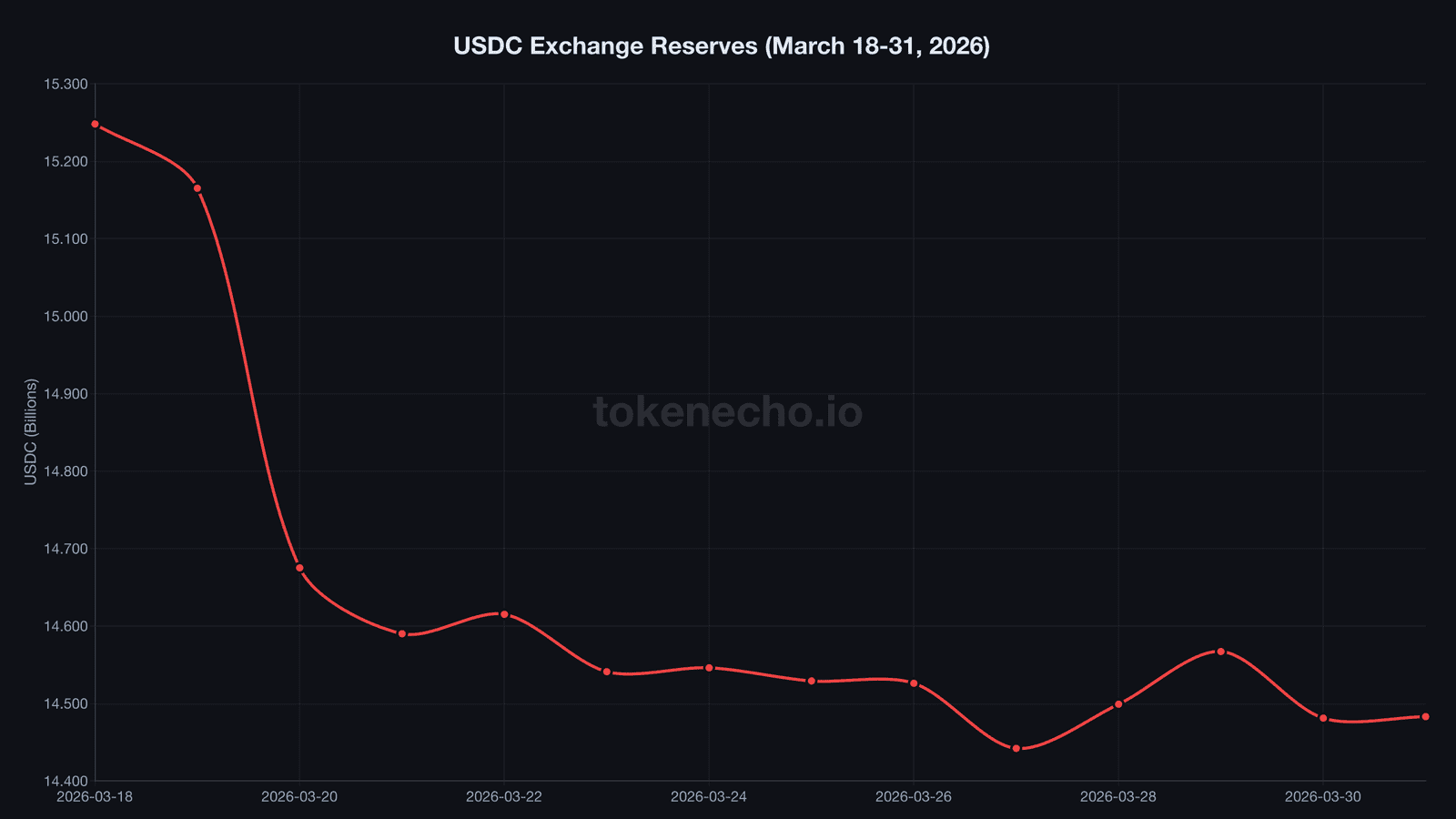
USDC, Circle’s flagship dollar token, bled $1.37 billion in that stretch. Its exchange reserves dropped from $15.25 billion to $14.48 billion, a $765 million drain in just 13 days. That capital didn’t evaporate. It migrated.
And the biggest beneficiary? A stablecoin backed by the Trump family.
USDC’s Quiet Hemorrhage
Circle’s problems aren’t existential – not yet. USDC still commands a $77.1 billion market cap and processes $13.5 billion in daily volume. But the direction is unmistakable.
Seven of the top ten stablecoins posted net outflows during the final week of March. USDC absorbed the brunt. On exchanges tracked by CryptoQuant, reserves slid from $15.25 billion on March 18 to $14.48 billion by March 31 – a 5% drop in under two weeks.
Where’d it go? Some got redeemed outright. Some rotated into DeFi yields. And some – a growing chunk – simply moved to newer, shinier alternatives.
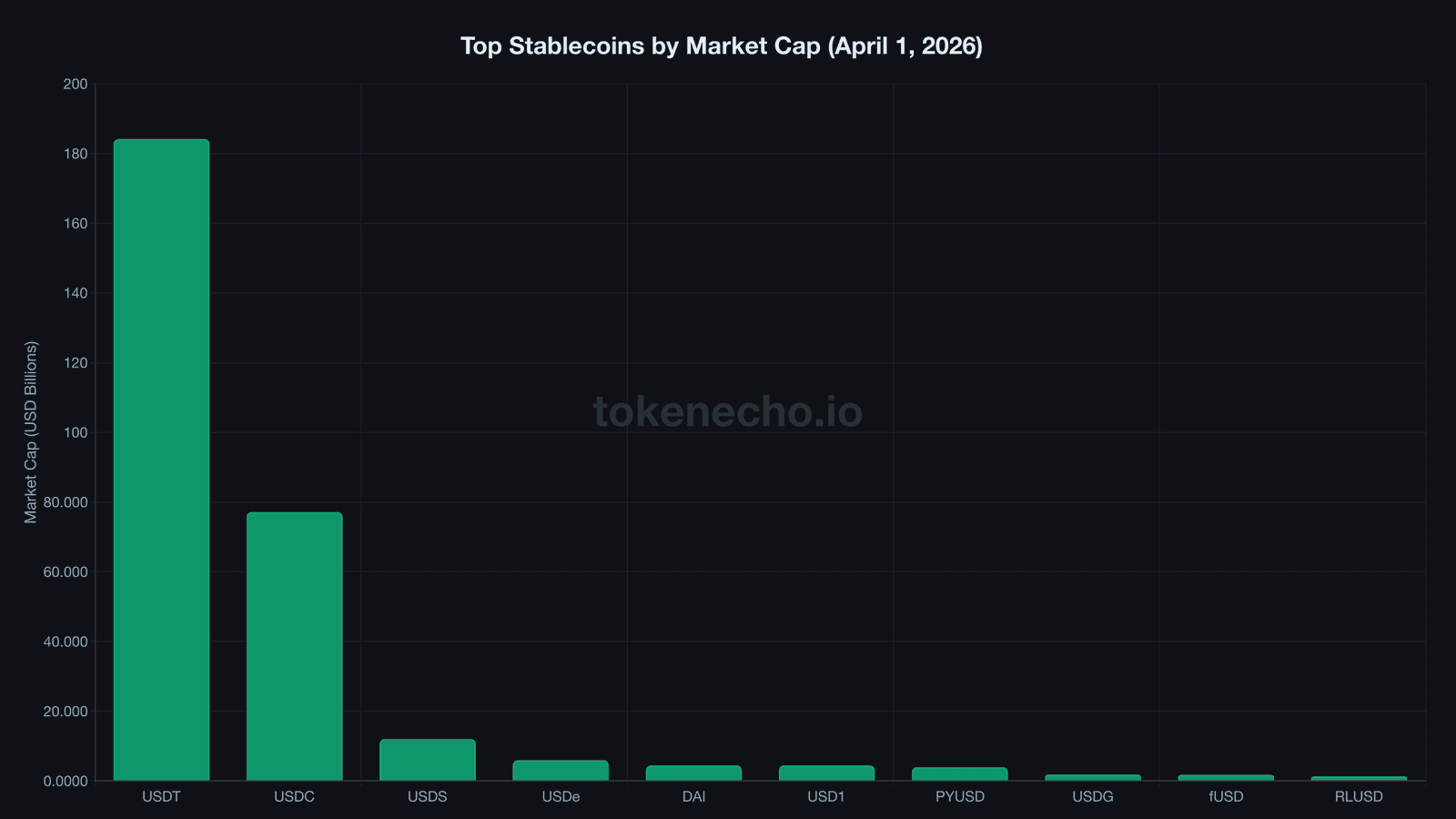
USDT, true to form, barely flinched. Tether’s $184.1 billion market cap held steady, its 24-hour change a rounding error at +0.05%. When stablecoin holders panic, they don’t run to USDC. They run to Tether.
That’s not a compliment to Tether’s transparency. It’s just what the data shows.
Trump’s USD1: From $3.3B to $4.4B in Ten Days
When we covered Trump’s broader crypto empire on March 23, USD1 sat at $3.3 billion. Ten days later, it’s $4.39 billion.
That’s a 33% jump. For a stablecoin. In a week and a half.
“USD1 has grown faster than any other stablecoin in history,” Zach Witkoff, World Liberty Financial’s co-founder, said in a recent statement. The claim sounds like marketing. The CoinGecko data backs it up – USD1 now sits neck-and-neck with DAI ($4.4 billion), a protocol that took years to reach that milestone.
World Liberty Financial filed to become a U.S. national trust bank, which would make USD1 the first presidential-adjacent stablecoin with a banking charter. Whether that’s innovation or a conflict of interest depends entirely on who you ask. But the capital flows don’t care about politics. They care about yield, trust, and distribution – and USD1 is nailing at least two of those three.
Seven Stablecoins Above $500M That Didn’t Exist a Year Ago
Zoom out from the USDC-versus-USD1 drama and the structural shift becomes obvious. The stablecoin landscape has fractured into something unrecognizable.
USDS, Sky’s rebranded DAI successor, quietly climbed to $12 billion – making it the third-largest stablecoin without anyone throwing a party. Ethena’s USDe, a synthetic dollar backed by delta-neutral hedging strategies rather than actual bank deposits, holds $5.9 billion. PayPal USD crossed $3.9 billion. Falcon USD reached $1.75 billion. Even Ripple’s RLUSD, despite a rough 12% single-day drop, maintains $1.25 billion.
And then there’s YLDS, a yield-bearing stablecoin at $600 million that regulatory clarity under the GENIUS Act, legislation that clarified the framework for payment stablecoins, has made suddenly viable.
A year ago, the stablecoin market was a two-horse race. USDT and USDC controlled roughly 90% of the market. Today? USDT holds 58% dominance. USDC sits at about 25%. That leaves 17% – north of $50 billion – scattered across a dozen competitors.
When we reported the stablecoin market hitting a record $320 billion in late March, USDC’s 64% share of transaction volume looked like a moat. It’s starting to look more like a sandcastle.
Europe Wants In – With Its Own Currency
The fragmentation isn’t just a crypto story anymore. Ten European banks – ING, UniCredit, BNP Paribas among them – announced plans for Qivalis, a euro-denominated stablecoin, targeting the second half of 2026.
That’s ten banks. One stablecoin. Denominated in euros, not dollars.
If Qivalis launches at any meaningful scale, it won’t compete with Tether directly. It’ll compete for the same institutional capital that currently parks in USDC for want of a euro alternative. BNB Chain already extended zero-fee stablecoin transfers through April 30, practically begging projects to build on its rails. Pine Labs is rolling out stablecoin-backed prepaid cards across nine countries.
The infrastructure for a multi-stablecoin world isn’t hypothetical. It’s being built right now.
What the Stablecoin Supply Ratio Tells Us About BTC
All this stablecoin reshuffling has a direct consequence for Bitcoin.
The Stablecoin Supply Ratio, a metric that measures BTC’s market cap relative to total stablecoin supply, dropped from 10.31 on March 18 to 9.68 on March 29 before recovering slightly to 10.07 on March 31. Lower SSR means more dollar firepower sitting on the sidelines relative to Bitcoin’s size.

At current levels, roughly $139 billion in stablecoins sits on exchanges. BTC’s market cap is $1.37 trillion. That’s enough stablecoin ammunition to absorb a 10% move without breaking a sweat.
And BTC exchange reserves? They’ve been grinding lower – from 2,724,198 BTC on March 19 to 2,710,252 on April 1. That’s about 14,000 BTC withdrawn from exchanges in two weeks, worth roughly $960 million at today’s $68,667 price.
So the stablecoins are fragmenting, the new entrants are growing, and Bitcoin is quietly leaving exchanges. The stablecoin map isn’t just being redrawn for stablecoin holders. It’s reshaping the buying power dynamics for every crypto asset.
If and when that $139 billion deploys – regardless of which stablecoin denomination it carries – the impact on BTC won’t depend on whether the dollars came from USDC, USD1, or some European bank’s Qivalis.
Money doesn’t have a logo. It just moves.
This is not financial advice. DYOR. Data as of April 1, 2026.
Leave a Reply