
Updated on March 30, 2026
🕑 7 min read
The recent addition of record storage to alleviate congestion in the Hard Drive category has not prevented the planned withdrawal of $4.5B from the ETF for Q2 2026. How will this impact storage pricing in the coming months?
Bitcoin is seeing a very rare divergence in the market right now. On the one hand, for the first time ever, whale wallets holding over 100 BTC are above 20,000 BTC, which is a cap that used to limit their ability to buy more BTC. On the other hand, the amount of BTC being transacted on the blockchain remains far, far below the 20,000 cap that has just been lifted for the whales. new high and all time high for the market value. Meanwhile, U.S. spot Bitcoin ETFs are down $4.5 billion in net market value. Bitcoin has fallen for every month of outflows since January. As of March 22, Bitcoin is trading at $68,951, down about 10% from its February peak of $76,000. on-chain picture tells a story that price alone doesn’t capture.
Let’s dig into the numbers.
Whale Accumulation Hits 13-Year Record
Just few hours ago, CryptoQuant released a note on whales that can be summarized as follows: A whale is a person or an organization with an enormous amount of BTC stored in their wallets. Generally, if someone has more than 100 BTC in a wallet, then they are considered a whale. Now, the Bitcoin wallets with the BTC supply that have recently had transactions in the short term have generally been sending more BTC than they are receiving.
Institutional investors have bought 270,000 BTC in the last 30 days. This is the largest monthly net purchase from this group of investors in the last 13 years and is more than 3.5 times the amount of BTC purchased in August, which was the previous largest monthly purchase. even the aggressive buying seen during the 2020 COVID crash.
Whale wallets now hold 20,031 $WHALE, a new all-time high. To give you an idea of just how many individuals we are talking about, each of these whale wallets holds over 100 $WHALE. In 2010, some person or institution invested $100,000 in Bitcoin at a price of $100 per coin. Today, the same amount of Bitcoin is worth at least $6.9 million at today’s prices. That is not a bunch of retail traders chasing a popular trend. There’s a very different dynamic at work with the price of Bitcoin than there is with the price of something as mundane as Apple stock. — it’s patient capital positioning for a move.
Meanwhile, around 15,000 BTC are being withdrawn from exchanges each day. Binance, for example, has seen an average of 5,800 BTC withdrawn each day. Cryptocurrency exchanges are currently seeing an outflow of about $55 million worth of crypto assets, as per CryptoQuant’s 30-day moving average netflow data (SMA30: -774 BTC). When the weekly exchange outflow reached 47,700 BTC last week — one of the highest levels in the last 12 months — BTC shot up by 5% in a short amount of time. In a post on Twitter, Arcane Research analyst Emilia Langfeldt mentioned that this is the largest weekly movement in the BTC price over the past 12 months. 13.8% from $65,000 to $74,000.

The ETF Paradox
Oh this is entertaining. Whales are stacking up on-chain, while the institutional ETF space is about as exciting as watching paint dry. been a net seller.
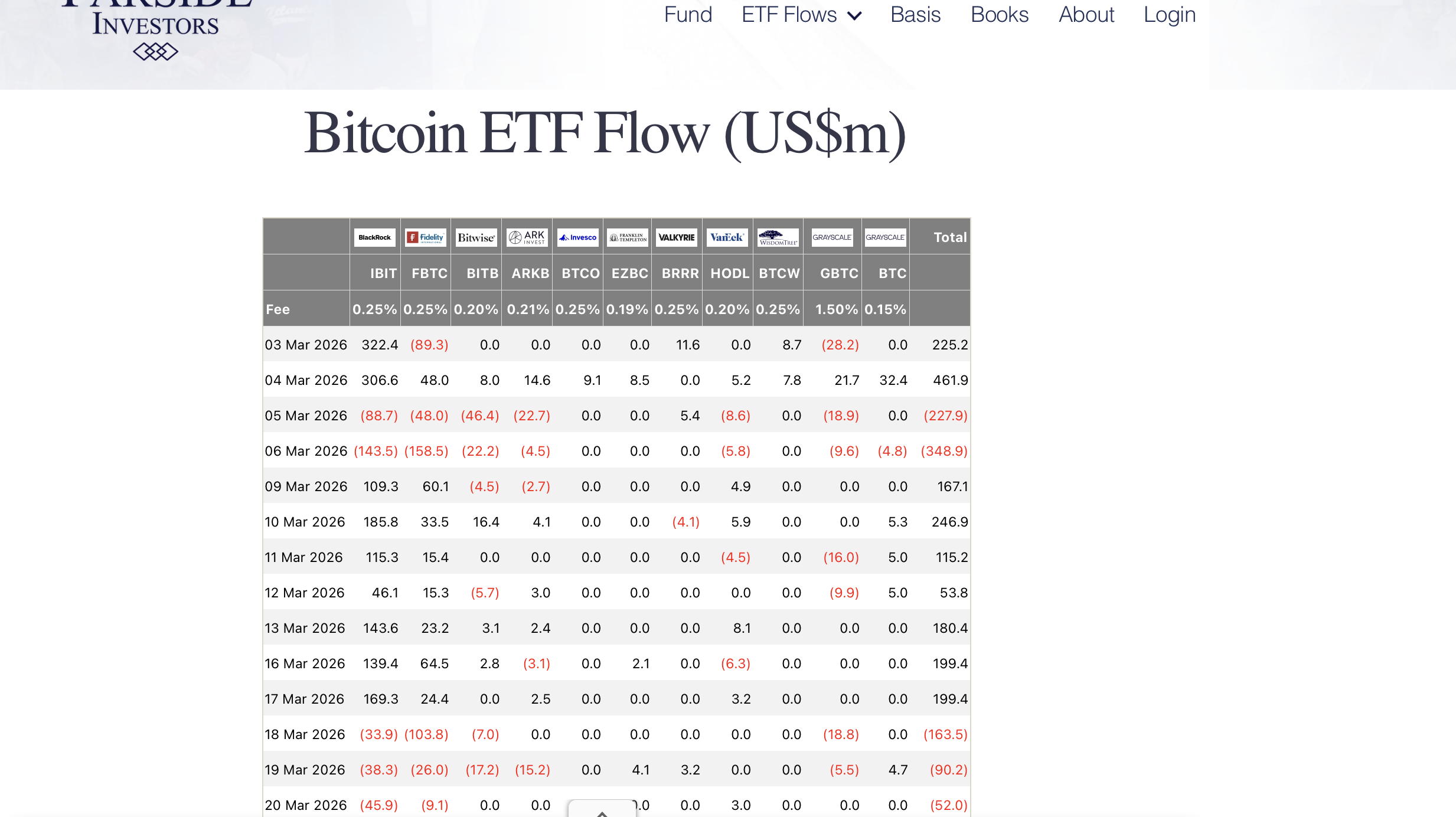
Farside Investors data suggests that U.S. spot Bitcoin ETFs have collectively lost about $4.5 billion in net assets since the week that the first ETF launched. This week’s Bloomberg ETF weekly survey found that all four issuers that currently offer spot Bitcoin ETFs are seeing a reduction in assets under management (AUM) relative to their previous weeks. ProShares Bitcoin Strategy ETF – BITO ProShares is the largest ETF issuer in the U.S. and currently has the most funds tracking Bitcoin. The ProShares Bitcoin Strategy ETF, or BITO, has lost the least amount of funds in the spot Bitcoin ETF space as it currently holds $4.13 billion. At the start of 2026 the monthly offset was only $1.8 billion, consisting of the usual inflows in the first and third weeks of the new year. The most surprising aspect was that the monthly dip, which had always occurred in the third week of January, was almost non-existent in 2026. outflow of $129.62 million recorded on Mar 18; ends 7 days of inflows totaling $1.167 billion.
As of March 18, combined net inflows for all U.S. spot Bitcoin ETFs were at $56.41 billion — a relatively small amount. After reaching a high in late January, weekly fund inflows have started to fall as Bitcoin and the overall market have declined. massive number, but the trend is clearly cooling.
Inflows into the Wise Origin Bitcoin Fund (FBTC) hit on Mar 18 led to a large selloff in the spot price of Bitcoin. A familiar trend continues to play out, with Fidelity’s offerings still having an outsize effect on price action for Bitcoin. This is not the first time that such large outflows while BlackRock’s IBIT is stable — we have seen it a few times in Q1 2026 so far and may see it happen again. investor bases with different time horizons.
What the Derivatives Market Says
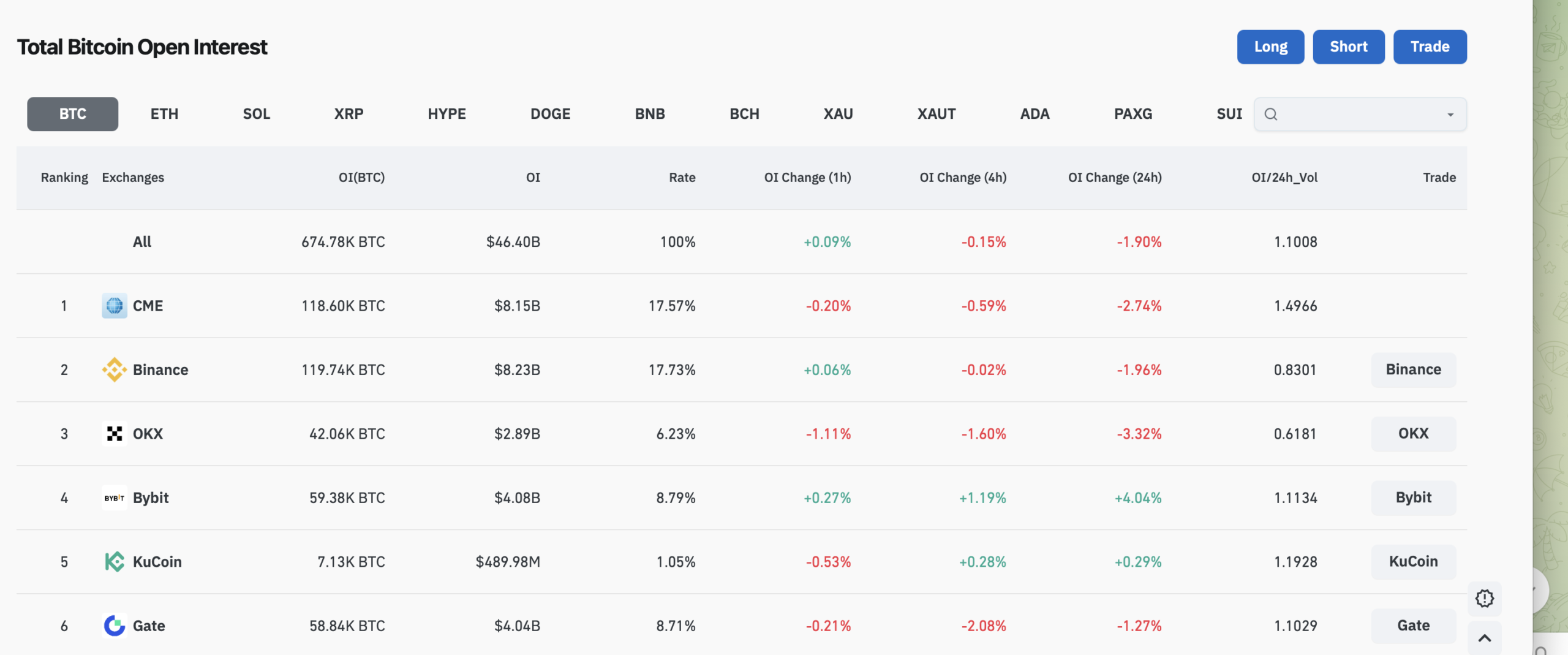
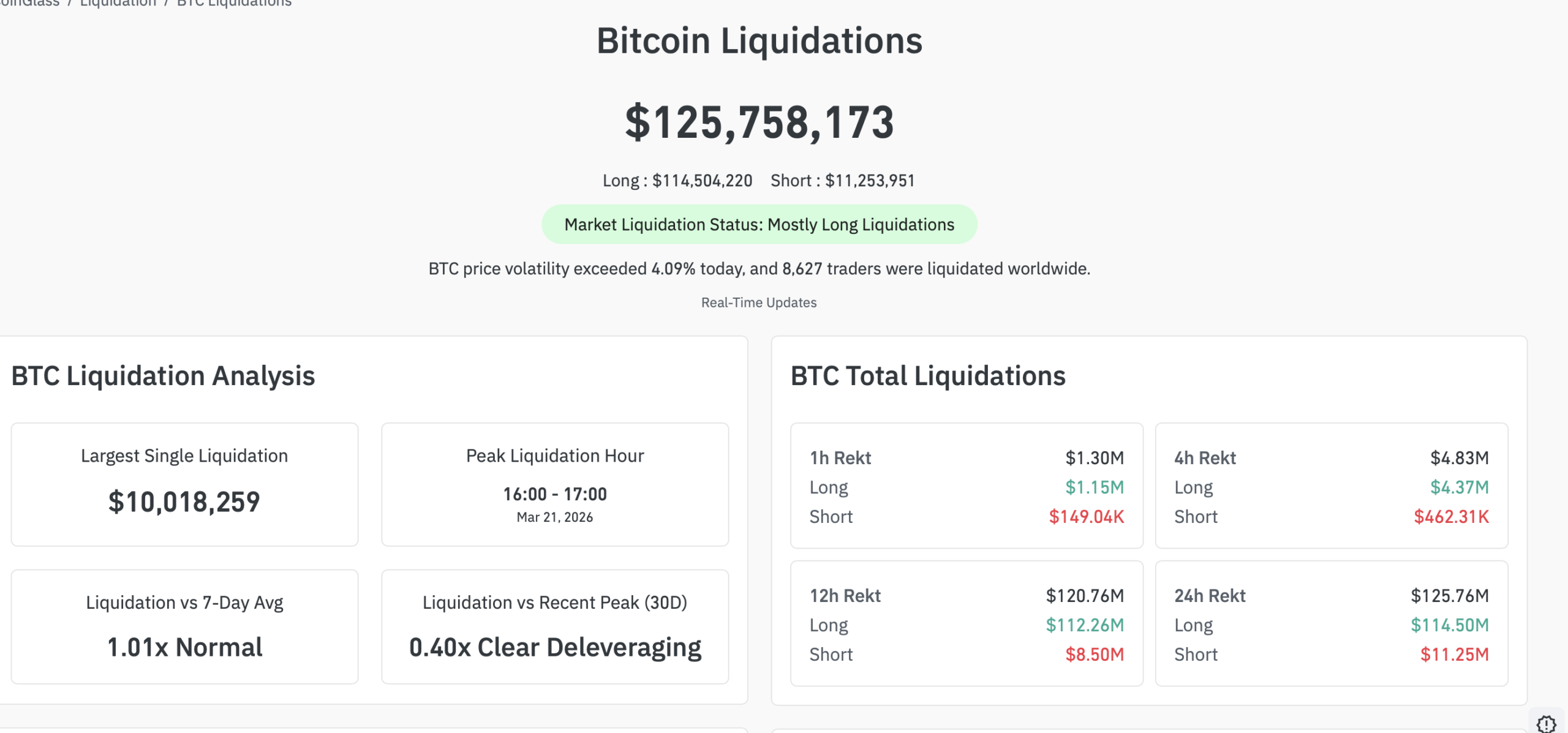
As of March 22, CoinGlass’ data showed that the total Bitcoin open interest was at $46.17 billion. At the same time, the site calculated that $118.89 million in BTC would need to be rolled over in order to avoid liquidation. In the last 24 hours, there have been a few liquidations. This update looks at the 24hr Futures volume which has reached $37.66 billion. This is about 6 times the $3.19 billion in spot volume for a leverage of about 600%. ratio that suggests the derivatives market is driving short-term price action.
The fact that there wasn’t a wild long or short liquidation wipeout coupled with high open interest is what makes this move so balanced. Benchmark of a coiled market. Traders are in place but no one has been knocked out yet. They will be in a hurry to rearrange themselves when the market breaks out. directional move.
Supply Scarcity Is Building
Summary Report Binance BTC Scarcity Index is at its highest level since October 2025. The last time Bitcoin (BTC) was below $60,000 was before the 40% surge into the end of 2021. The Open Interest Index is a measure of available sell-side liquidity. Liquidity is relatively low vs historical averages and the shelves are being cleaned out.
Math wise the picture is quite simple. 15,000 Bitcoins are being withdrawn from exchanges on a daily basis and the block reward post halving will always remain just about 1,800 Bitcoins per day, so withdrawals are always going to be higher than the sum of all the deposits. Current daily supply deficit is 450 BTC per day. Which is about 14,550 BTC per day in terms of absolute supply deficit. $69,000 * 450 = $31M per day * 365 = $1.136 Billion per year. billion in net demand versus supply every single day.
The Disconnect — and What It Means
So why are ETFs selling while whales are buying? Here are a few theories we have:
TLH Rotation The tax-loss harvesting rotation is back for those that hold ETFs and bought in at prices higher than $90,000 in late 2025. Time to realize losses for the first quarter. Cryptocurrencies like Bitcoin and Ethereum are considered a capital asset and therefore are subject to capital gains tax. Changes to the Internal Revenue Code in the Tax Cuts and Jobs Act of 2017 significantly altered the calculation and reporting of capital gains. The purpose of capital gains tax is to discourage individuals from rapidly accumulating wealth. supply.
Foreign exchange rates Institutional rebalancing We continue to forecast year-end FX rate of $150,000 per pound. A 10 per cent appreciation in the dollar would add around $40 billion to the annual US trade deficit. Rates and liquidity are rising. Institutional investors are positive on bonds and we believe the recent ETF redemptions were just a play of positioning and do not signal a change in the underlying trend. rebalancing, not a loss of conviction.
Smart money front-running? The on-chain cohort has led ETF flows by 2-4 weeks historically. If that trend were to continue, we could see a sharp surge in activity in the weeks ahead. should see ETF inflows resume by early April.
Outlook
Data Suggests Market In Late-Stage Accumulation A record number of whale buys and shrinking exchange reserves both suggest that the market is in late-stage accumulation. The tightening of the on-chain supply and the stable derivatives positioning also hint that the market is heading in a direction that will likely lead to more price pressure. The ETF is seeing outflows. Bitcoin are the outlier. Historically, when on-chain signals diverge from ETF flows, on-chain wins. This may change.
The key levels to watch are $65,000, which is the area where whales were buying heavily in early March, and $76,000, which is the level that was breached with the help of heavy institutional buying. Want to stay ahead of the market and avoid loss? Join now to get instant updates. Last week’s weekly close above the 50-week moving average confirms the short term positive bias. A fall back to $70,000 would not change the medium term view, which is still positive, especially for Bitcoin, as it remains the clear leader in terms of relative strength vs. equities, as shown in the chart below. below $65,000 would force a reassessment.
This is not financial advice. DYOR. Data as of March 22, 2026.
Leave a Reply