
🕑 5 min read
After a decade of regulatory ambiguity, U.S. regulators draw a clear line between digital securities and digital commodities.
The crypto industry just got what it has been asking for since 2017 – clarity.
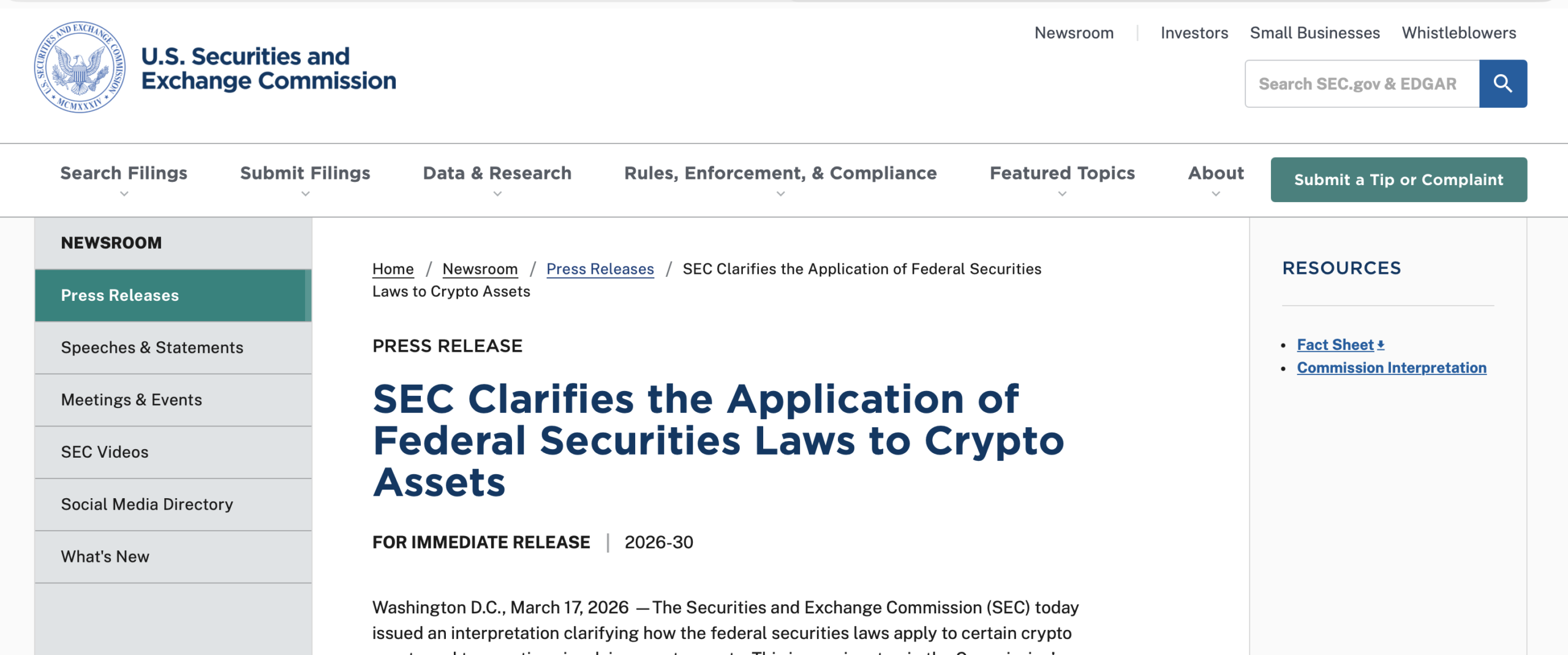
On March 17, 2026, the U.S. Securities and Exchange Commission and the Commodity Futures Trading Commission issued a joint interpretation that, for the first time, establishes a formal taxonomy for crypto assets under federal law. The document splits the digital asset universe into five distinct categories: digital commodities, digital collectibles, digital tools, stablecoins, and digital securities. Only one of those – digital securities – falls under the SEC’s jurisdiction.
The implications are massive. Let’s break it down.
What Changed
For years, the biggest question in crypto was deceptively simple: is this token a security or not? The SEC under former Chairman Gary Gensler largely argued that most tokens were securities, leading to enforcement actions against Ripple, Coinbase, Kraken, and dozens of others. The industry pushed back, calling for legislative clarity.
Things are finally clear now, and it’s not because of anything Congress did – it’s actually the regulators who made it happen.
SEC Chairman Paul S. Atkins put it bluntly: “After more than a decade of uncertainty, this interpretation will provide market participants with a clear understanding of how the Commission treats crypto assets under federal securities laws. This is what regulatory agencies are supposed to do: draw clear lines in clear terms.”
The Five-Category Framework
The joint interpretation creates a coherent token taxonomy:
1. Digital Commodities – Tokens that function primarily as a store of value or medium of exchange without reliance on a central issuer’s ongoing efforts. Bitcoin and Ethereum fall squarely here. These assets fall under CFTC oversight. When it comes to derivatives, there are rules in place, but the spot markets are a different story and don’t have many federal regulations.
2. Digital Collectibles – Non-fungible tokens (NFTs) representing unique digital or physical items. Art, music, gaming assets. Not securities unless they are marketed as investments with expected returns.
3. Digital Tools – Utility tokens that provide access to a specific product, service, or network function. Think governance tokens, gas tokens, or access passes. Not securities when the utility is real and functional.
4. Covered Stablecoins – Crypto assets designed for payments, money transmission, or value storage, maintaining a stable value relative to the US dollar and backed by low-risk, liquid reserves. These are explicitly carved out from securities law. This aligns with the GENIUS Act stablecoin framework moving through Congress.
5. Digital Securities – The only category subject to SEC securities laws. A digital asset becomes a security when its issuer offers it as an investment in a common enterprise with promises of profits based on management’s efforts. Crucially, the interpretation states that this classification can end when the issuer has fulfilled or failed to meet its representations.
Why This Matters for Markets
The immediate impact is legal certainty. Projects that have been operating in a gray zone now have a framework to reference. Exchanges can list tokens with clearer compliance guidelines. Institutional investors – particularly those who are bound by a duty to act in the best interests of their clients – now have the regulatory approval to put money into digital commodities and stablecoins.
The timing is not accidental. The CLARITY Act, a bipartisan market structure bill, is currently moving through committee in the House. This joint interpretation effectively previews the regulatory framework that legislation would codify into law.
For stablecoins, the carve-out is particularly significant. Tether (USDT) and Circle (USDC) have long operated in regulatory limbo. With covered stablecoins now explicitly outside securities law, the path to full banking integration accelerates.
The Investment Contract Exit Ramp
Perhaps the most nuanced element of the ruling: the concept that a token can stop being a security.
Under the new interpretation, an investment contract – and thus securities classification – ends when either the issuer fulfills its promises or fails to do so. This creates a lifecycle model for token classification. A token sold in an ICO as a security could later become a digital commodity or digital tool once the network is sufficiently decentralized and the issuer’s promises are met.
This directly addresses the Ripple precedent and could have retroactive implications for ongoing enforcement cases.
Market Reaction
It’s been five days since the announcement, and the crypto market is still being pretty cautious. Bitcoin is still stuck in the same range, not really going up or down much. The price of Bitcoin was around $68,900, and Ethereum was trading at approximately $2,200. What’s interesting is that the market didn’t react much to this news, which implies that investors had already factored in regulatory clarity under the current administration.
The effects on the structure may not be seen right away, it could take a few months. Meanwhile, the legal teams at some of the bigger exchanges have started making changes to listing criteria. Venture capital firms are reportedly revisiting token launch strategies that had been shelved due to regulatory uncertainty.
What’s Still Missing
The joint interpretation is not legislation. It provides interpretive guidance but does not carry the same legal weight as a statute. Key gaps remain:
- Spot market regulation – Who regulates spot trading of digital commodities? Neither the SEC nor CFTC has clear authority.
- DeFi protocols – Decentralized exchanges and lending platforms are not addressed in the framework.
- Cross-border enforcement – This rule only applies to the United States, it doesn’t cover other countries.
- Tax treatment – The IRS hasn’t changed its rules to match the new way of grouping things.
Congress will need to pass the CLARITY Act or similar legislation to fill these gaps. But the joint interpretation sets the template.
Outlook
This is a major milestone for crypto regulation in the US, marking the most significant development since the green light was given for spot Bitcoin ETFs back in January 2024. It does not solve everything, but it establishes the vocabulary and framework that the industry, courts, and legislators will use going forward.
For crypto markets, the message is clear: the era of regulation by enforcement is over. The era of regulation by definition has begun.
This is not a recommendation to buy or sell anything. Do your own research. The information is current up to March 22, 2026.
Leave a Reply