
🕑 6 min read
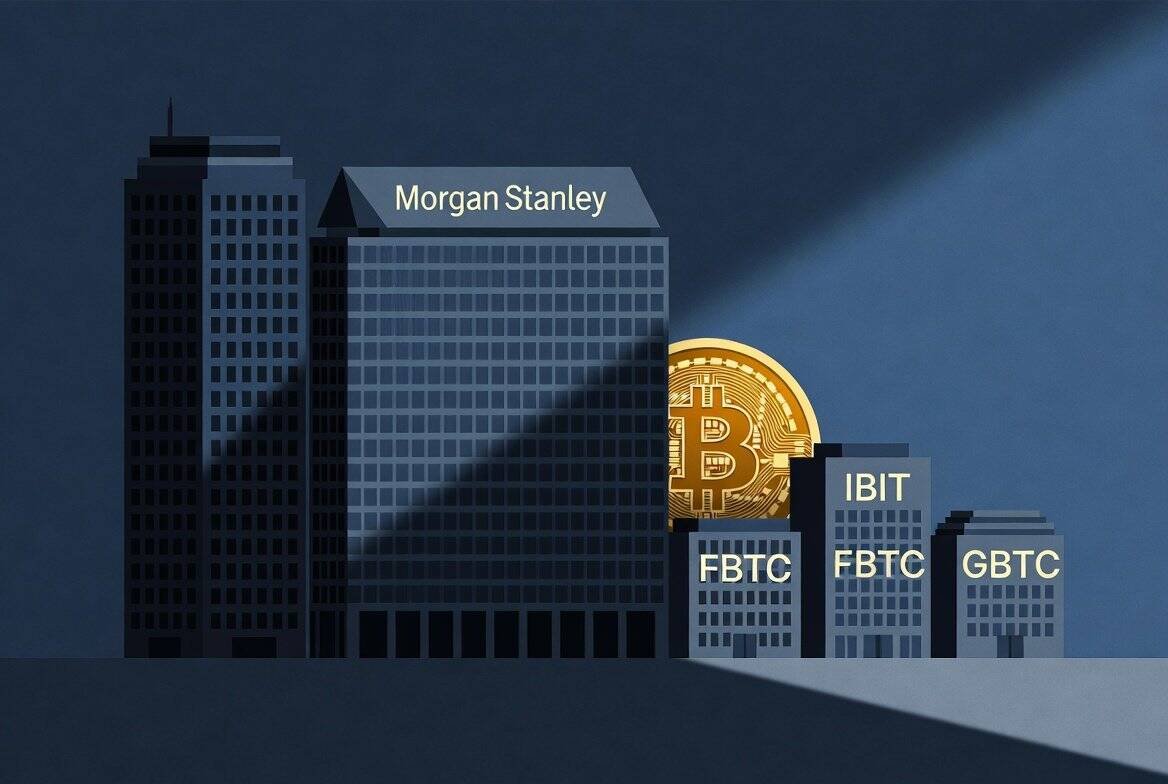
The first bank-issued spot Bitcoin ETF charges 44% less than BlackRock’s IBIT – and it’s launching into maximum fear.
0.14%.
That’s what Morgan Stanley plans to charge for MSBT, its spot Bitcoin ETF now awaiting final SEC approval. For context, BlackRock’s IBIT – the undisputed king of crypto ETFs with $53.2 billion in assets – charges 0.25%. Morgan Stanley just walked into the room and undercut the biggest asset manager on Earth by 44%.
And they didn’t do it quietly. NYSE Arca issued an official listing notice. Bloomberg ETF analyst Eric Balchunas called it a “semi-shock.” The seed capital is locked at $1 million via 50,000 initial shares. Jane Street, Virtu Americas, and Macquarie Capital signed on as authorized participants. Coinbase handles custody. BNY Mellon runs the back office.
This isn’t a test. It’s an invasion.
0.14% Fees and $6.2 Trillion in Assets – BlackRock Has a Problem
The biggest bank on Wall Street just filed the cheapest Bitcoin ETF. That doesn’t happen by accident.
Morgan Stanley oversees $6.2 trillion in client assets across roughly 16,000 financial advisors – a distribution network that dwarfs anything BlackRock, Fidelity, or Grayscale can deploy through third-party broker channels. Back in August 2024, Morgan Stanley became the first major wirehouse to let its advisors actively pitch Bitcoin ETFs to clients. They recommended a 2-4% portfolio allocation.
Do the math. Even 2% of $6.2 trillion is $124 billion. That’s more than the entire current spot Bitcoin ETF market combined.
“First bank to do a Bitcoin ETF… a big boy bank with the largest network of financial advisors,” Balchunas said. His colleague James Seyffart was more blunt: “They are not messing around.”
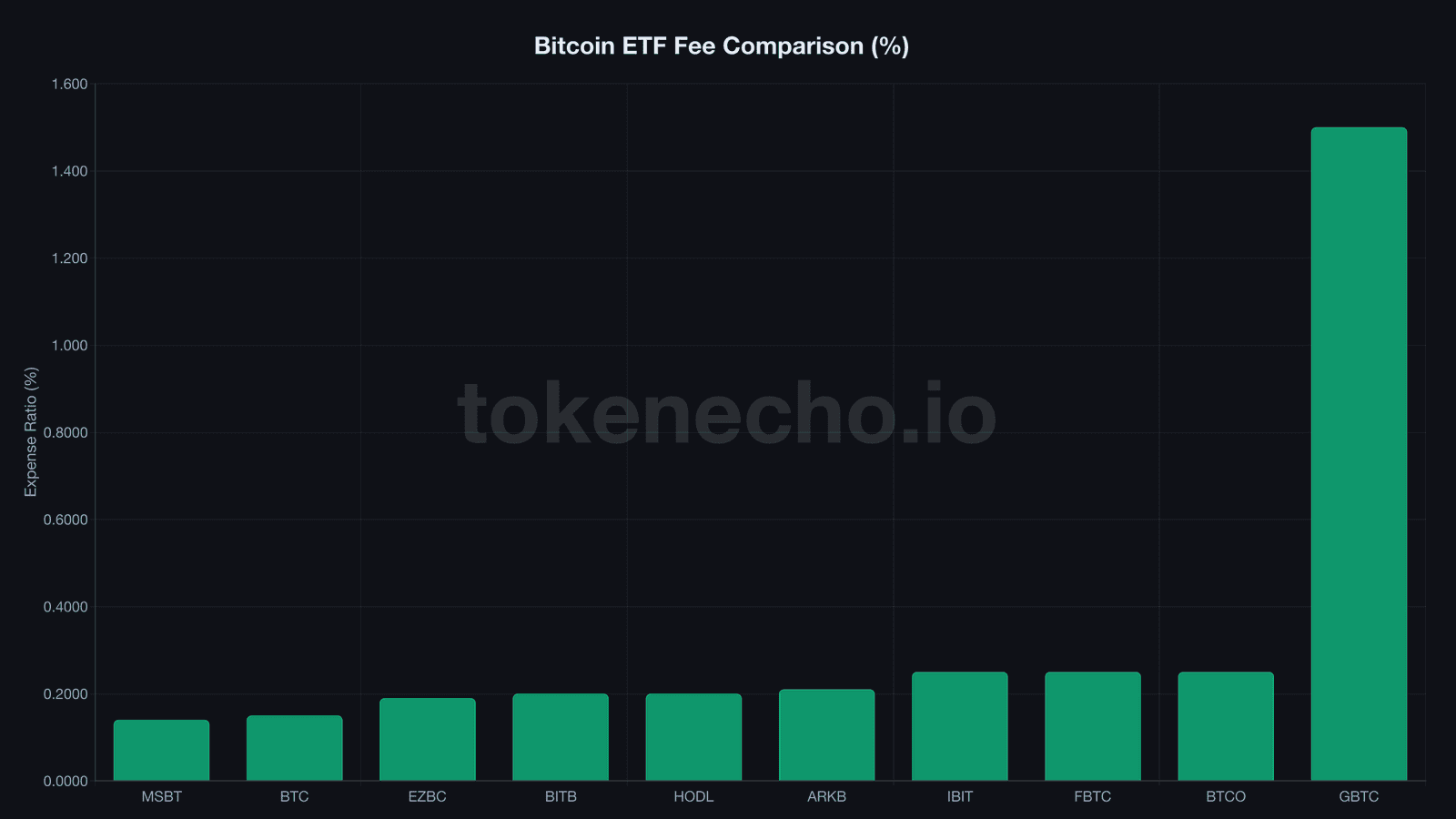
The fee table tells the full story:
| ETF | Ticker | Fee |
|---|---|---|
| Morgan Stanley | MSBT | 0.14% |
| Grayscale Mini | BTC | 0.15% |
| Franklin Templeton | EZBC | 0.19% |
| Bitwise | BITB | 0.20% |
| VanEck | HODL | 0.20% |
| ARK 21Shares | ARKB | 0.21% |
| BlackRock | IBIT | 0.25% |
| Fidelity | FBTC | 0.25% |
| Grayscale | GBTC | 1.50% |
That’s 44% cheaper than IBIT. One basis point cheaper than the Grayscale Mini Trust. And Morgan Stanley doesn’t need to steal clients – it already has them.
This is the crypto equivalent of Walmart opening next door to every boutique on the block and charging half price. Except the boutiques are BlackRock and Fidelity.
An $87.5 Billion Market Morgan Stanley Plans to Crack Open
$87.55 billion sits in US spot Bitcoin ETFs right now, spread across 12 funds holding a combined 1.29 million BTC. Morgan Stanley wants a piece – and the market’s concentration makes it vulnerable.
Three funds control 87.4% of everything. IBIT holds 782,293 BTC ($53.2 billion), Fidelity’s FBTC holds 186,894 BTC ($12.78 billion), and Grayscale’s legacy GBTC clings to 154,710 BTC ($10.52 billion) despite bleeding assets for over a year at its 1.50% fee. The remaining 9 funds split $11 billion between them.
But the trend underneath tells a different story. Total ETF holdings peaked at 1,329,742 BTC on March 17 and have bled steadily since – down 12,521 BTC to 1,317,221 as of March 31. That’s roughly $852 million walking out the door in two weeks.
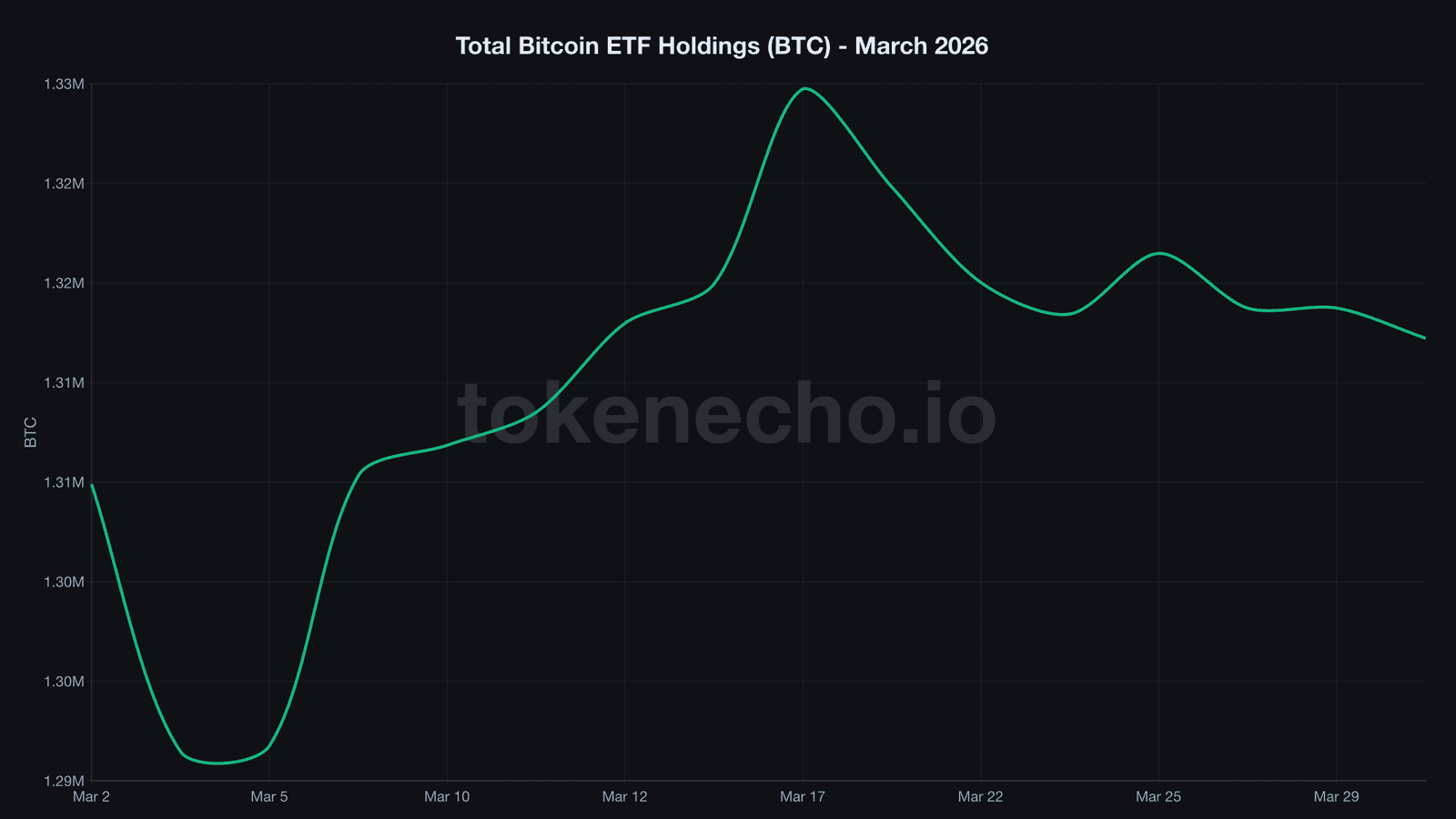
March still closed positive overall – $1.32 billion in net inflows, the first green month since October 2025 after four consecutive months of redemptions. But almost all of that came in the first two weeks. The back half was pure distribution.
The average ETF investor bought in around $84,000. Bitcoin trades at $68,079. That’s a 19% unrealized loss across the entire ETF complex – hundreds of thousands of holders sitting underwater, waiting for either a recovery or a reason to sell.
Morgan Stanley is betting they won’t sell. It’s betting they’ll buy more – through MSBT, at a lower fee, through an advisor they already trust.
When BlackRock launched IBIT in January 2024, it sucked in $10 billion within its first month – the fastest ETF launch in history. Morgan Stanley doesn’t need to match that. If it captures even 5% of its advisory network’s assets at the recommended 2% allocation, that’s $6.2 billion in flows. Enough to become the fourth-largest Bitcoin ETF overnight.
Maximum Fear, Maximum Conviction – The Timing Says Everything
Why launch a Bitcoin product at maximum fear?
The Fear & Greed Index has sat at or below 11 for weeks – Extreme Fear territory that hasn’t persisted this long since the FTX collapse in late 2022. Bitcoin trades 46% below its October 2025 all-time high of $126,080. The entire market feels broken.
And yet the on-chain data tells a completely different story.
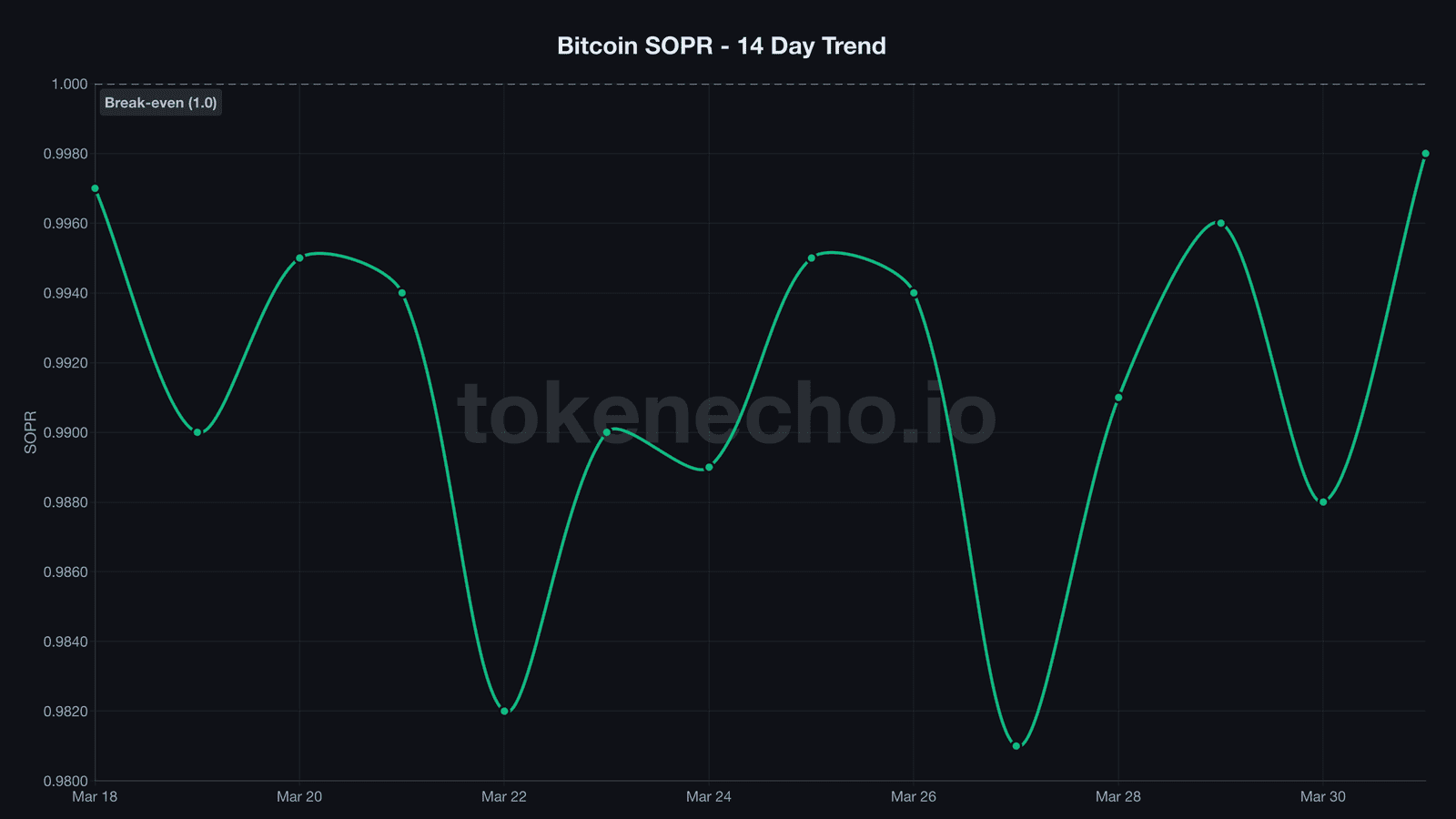
SOPR, the Spent Output Profit Ratio that measures whether sellers are realizing profits or losses, has printed below 1.0 for ten consecutive days. It hit 0.998 on March 31 – agonizingly close to break-even. The last time SOPR ground along sub-1.0 for this long was November 2022, when BTC bottomed at $15,500. Within 60 days it had doubled.
NUPL, the Net Unrealized Profit/Loss indicator that gauges aggregate holder profitability, recovered to 0.206 from a cycle low of 0.178. Still dangerously close to the capitulation threshold – but no longer falling. MVRV, the ratio of market value to realized value, sits at 1.259. Translation: the average Bitcoin holder has just $14,000 in profit per coin. The last time margins were this thin, BTC tripled over the following year.
Morgan Stanley’s filing didn’t land in a vacuum. It landed at a moment when leverage has been flushed (estimated leverage ratio dropped from 0.240 to 0.223), when exchange netflows just flipped negative (-1,227 BTC on April 1 – meaning outflows exceeded inflows for the first time in days), and when $136 billion in stablecoins sits on the sidelines waiting for deployment.
Warren Buffett’s most famous line isn’t about stocks. It’s about temperament. “Be fearful when others are greedy, and greedy when others are fearful.” Morgan Stanley, a bank that manages more wealth than Merrill Lynch, Goldman Sachs, and JPMorgan’s advisory arms combined, just announced its greediest Bitcoin move ever – at the exact moment retail sentiment hit rock bottom.
That doesn’t guarantee anything. ETF holdings still declined 4,259 BTC last week. Exchange inflows totaled +4,645 BTC in the three days ending April 1. If the Iran conflict escalates or macro conditions worsen, Morgan Stanley’s timing could look premature.
But banks with $6.2 trillion don’t file ETFs on a whim. They don’t undercut BlackRock by 44% without a plan. And they definitely don’t launch at maximum fear unless they see something the rest of us don’t.
No other major bank – not Goldman, not JPMorgan, not Bank of America – has filed for its own spot Bitcoin ETF. Morgan Stanley filed for three: Bitcoin, Ethereum with staking, and Solana with staking. Plus an OCC application for a National Trust Bank Charter covering digital asset custody.
If SOPR breaks above 1.0 while Morgan Stanley’s launch funnels fresh institutional capital into a market sitting on $136 billion in dry powder, the setup rhymes uncomfortably with late 2022. That parallel ended with Bitcoin tripling from $16K to $73K.
Until the SEC gives final approval and those 16,000 advisors start making calls, it’s just a filing. But the cheapest Bitcoin ETF from the biggest advisory network on Earth, launching into the deepest fear since FTX – that’s not a coincidence. That’s a thesis.
For our full Bitcoin outlook, see our Bitcoin (BTC) Price Prediction 2026-2030 and recent ETF flow analysis.
Morgan Stanley hasn’t sold a single MSBT share yet. But the 1.29 million BTC already sitting in ETFs are about to face their first real fee war. What matters more – the price of Bitcoin, or the price of holding it?
This is not financial advice. DYOR. Data as of April 1, 2026.
Leave a Reply