
🕑 8 min read
The most trusted exchange in America charges the highest fees. Here’s exactly where your money goes.
Coinbase built its reputation on simplicity and regulatory compliance. It didn’t build it on cheap trading. As of April 2026, Coinbase fees add up faster than most users realize – and the gap between what you’d pay here versus competitors like Kraken or Binance isn’t a rounding error. It’s a chasm.
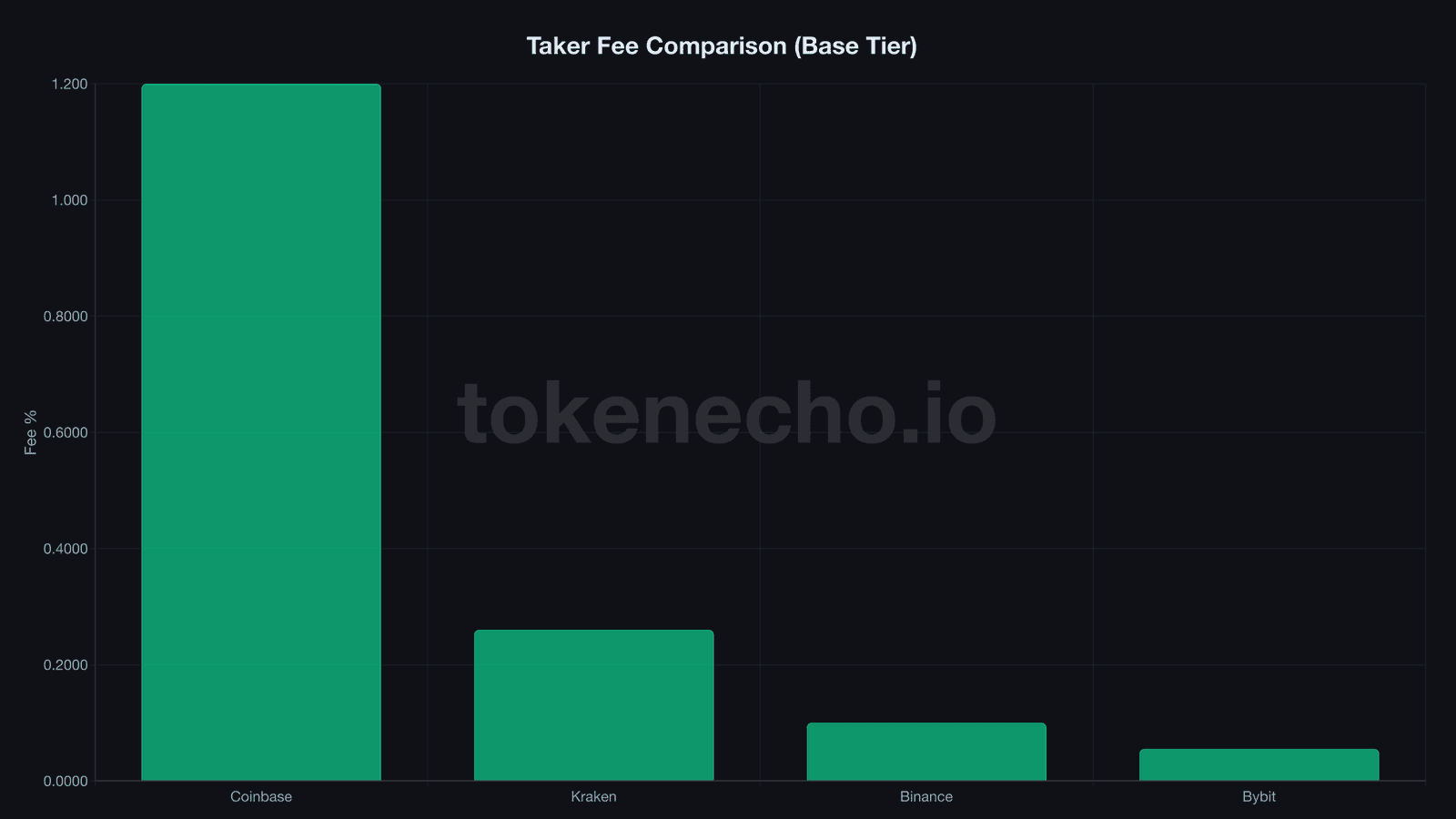
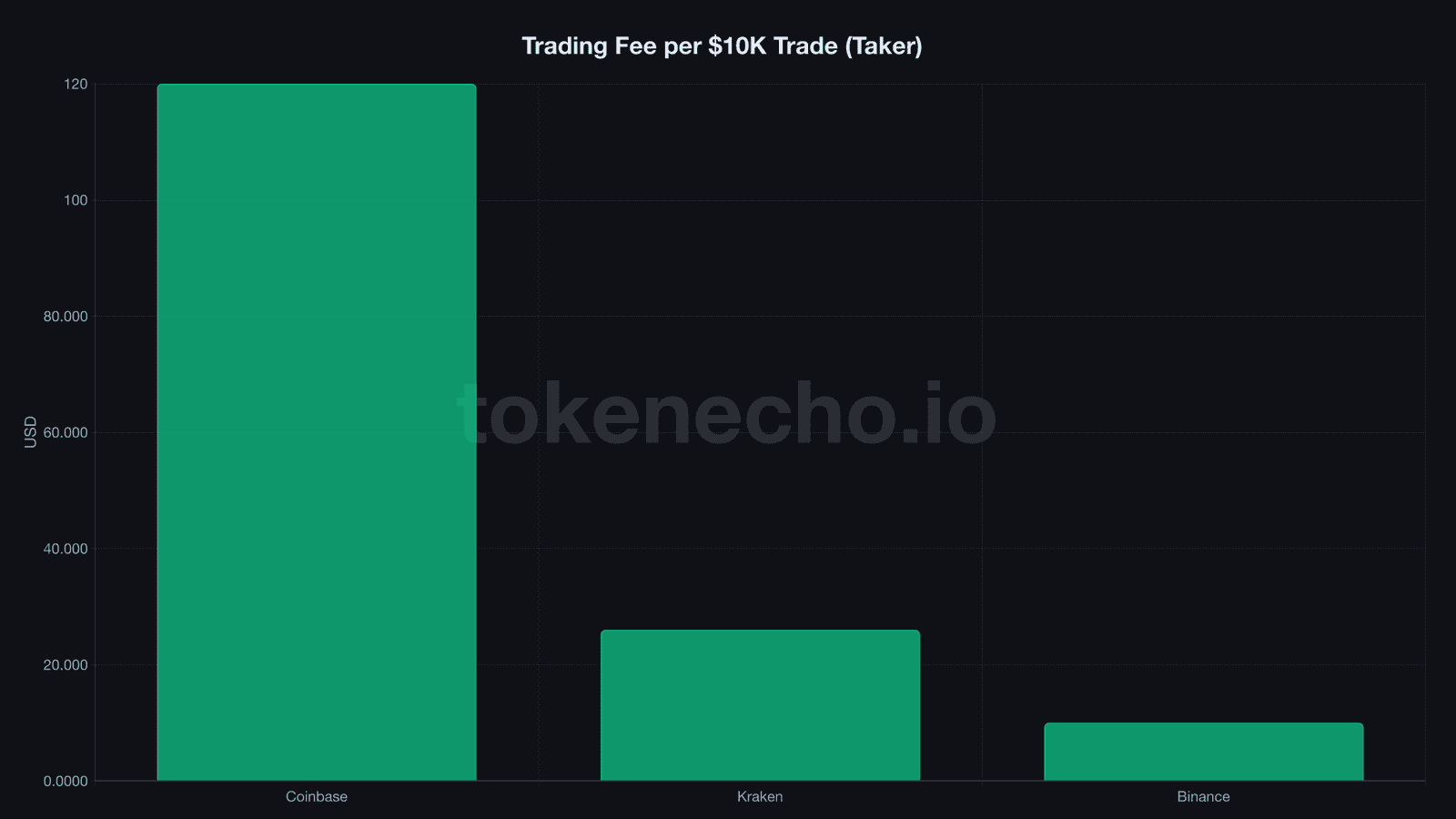
A $10,000 Bitcoin purchase on Coinbase’s base tier costs $120 in trading fees. The same trade on Binance? Ten bucks.
So why do 110 million verified users still keep coming back? And more importantly – can you actually use Coinbase without getting fleeced?
What you’ll learn
- A $10,000 Bitcoin purchase on Coinbase costs $120 in trading fees at the base tier – 12x more than Binance’s $10 for the same trade.
- Coinbase takes a 35% cut of staking rewards, charges a hidden 0.5-2% spread on Simple Trade conversions, and tacks on 3.99% for debit card deposits.
- Switching to Advanced Trade limit orders and ACH funding can cut total fees by 80% or more – no subscription required.
Trading fees start at 0.60% – and most users pay more
$120. That’s what a $10,000 BTC purchase costs on Coinbase’s default taker rate of 1.20%. Buy-and-hold investors who never heard of “Advanced Trade” pay this without blinking.
Coinbase restructured its fee tiers in late 2024, collapsing Simple Trade into the same maker/taker schedule as Advanced Trade. That sounds like progress until you actually read the schedule.
Here’s the full breakdown:
| 30-day volume | Maker fee | Taker fee |
|---|---|---|
| $0 – $10K | 0.60% | 1.20% |
| $10K – $50K | 0.40% | 0.60% |
| $50K – $100K | 0.25% | 0.40% |
| $100K – $1M | 0.15% | 0.25% |
| $1M – $15M | 0.05% | 0.15% |
| $15M – $75M | 0.02% | 0.08% |
| $75M – $500M | 0.00% | 0.06% |
| $500M+ | 0.00% | 0.05% |
Most retail users never escape that first tier. You’d need to trade $10,000 in a single month just to drop from 1.20% to 0.60% taker. That’s a lot of Bitcoin.
But the tier table doesn’t tell the whole story. Coinbase’s Simple Trade interface still layers a spread on top of trading fees – typically 0.5% to 2% depending on the asset and market conditions. You won’t see it as a line item. It’s baked into the quoted price, the way a car dealer marks up invoice cost before you even start negotiating.
‘The fees are outrageous,’ said Alex Svanevik, CEO of on-chain analytics firm Nansen, during a February 2026 industry panel. ‘Coinbase charges 12x what Binance does. At some point, convenience has a ceiling.’
For active traders willing to use Advanced Trade and post limit orders, maker fees drop to 0.60%. That’s still 6x Binance. But it’s a 50% discount over taker orders on the same platform – and it doesn’t cost a dime to switch.
One detail worth flagging: stablecoin trading pairs (USDT-USD, USDC-USD, and similar) carry 0% maker fees and reduced taker fees on Advanced Trade. So converting between stablecoins and fiat is genuinely cheap.
Deposits cost nothing, withdrawals cost everything
Does it cost money just to get your dollars onto Coinbase? Depends on how you do it.
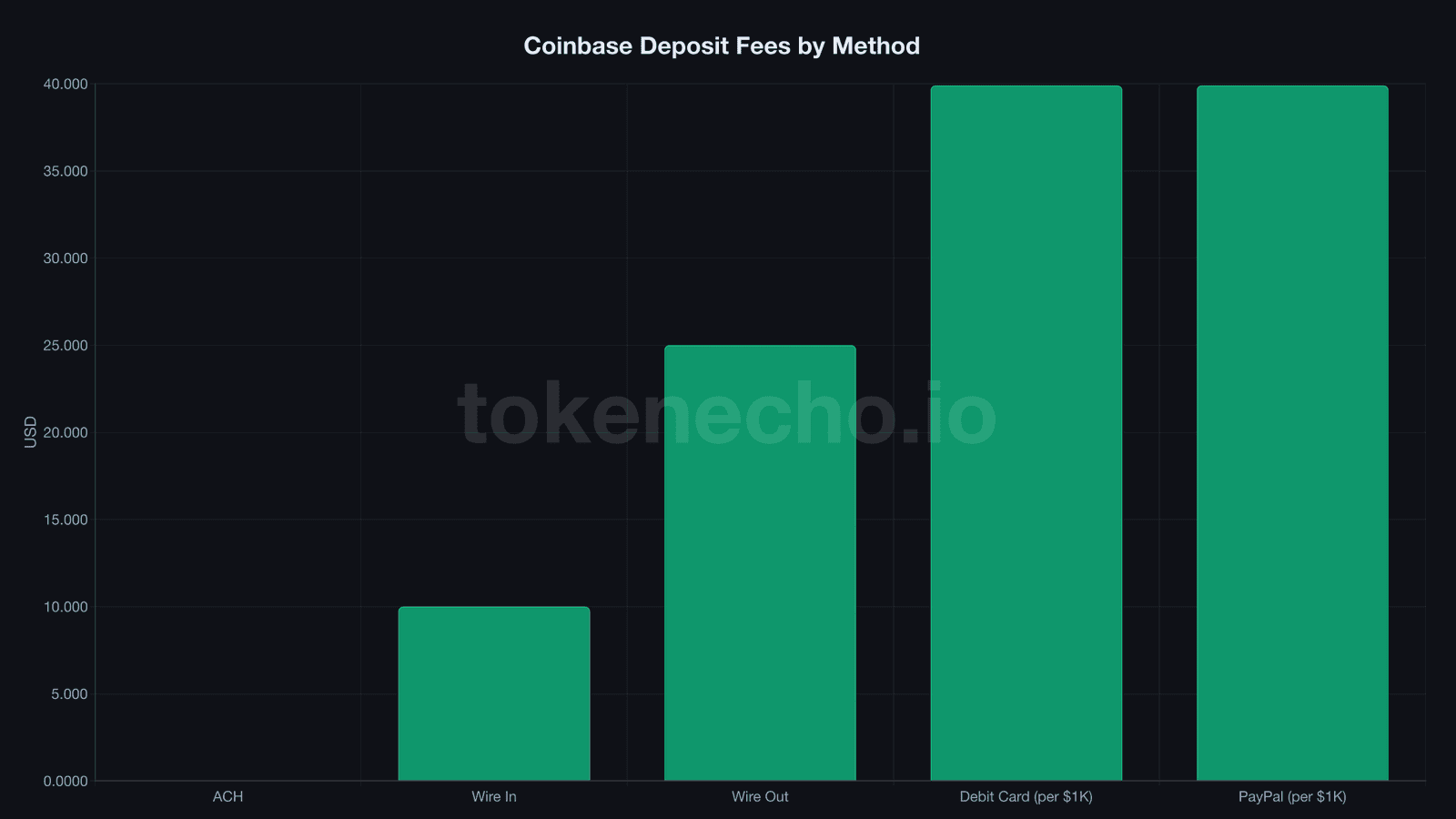
ACH bank transfers are free. They’re also slow – typically 3-5 business days before funds settle for withdrawal, though you can trade immediately. Wire transfers cost $10 incoming and $25 outgoing through Coinbase’s banking partner.
Debit card deposits? 3.99%. That’s not a fee schedule built for buying dips. Drop $1,000 via Visa and $39.90 vanishes before you own a single satoshi. PayPal deposits carry a similar surcharge.
Crypto withdrawals hit you with network fees, which Coinbase passes through at cost. During congestion spikes, an Ethereum withdrawal can run $5-15 in gas. Bitcoin withdrawals typically cost $1-3. Solana and other low-fee chains cost fractions of a cent.
The asymmetry matters. Getting dollars in is free (via ACH). Getting dollars out is free (via ACH). But getting crypto out costs network fees, and getting dollars in fast costs 3.99%. Speed has a price on Coinbase, and that price is steep.
The 35% staking cut and other fees Coinbase buries
Coinbase advertises “no hidden fees.” The fee schedule tells a different story.
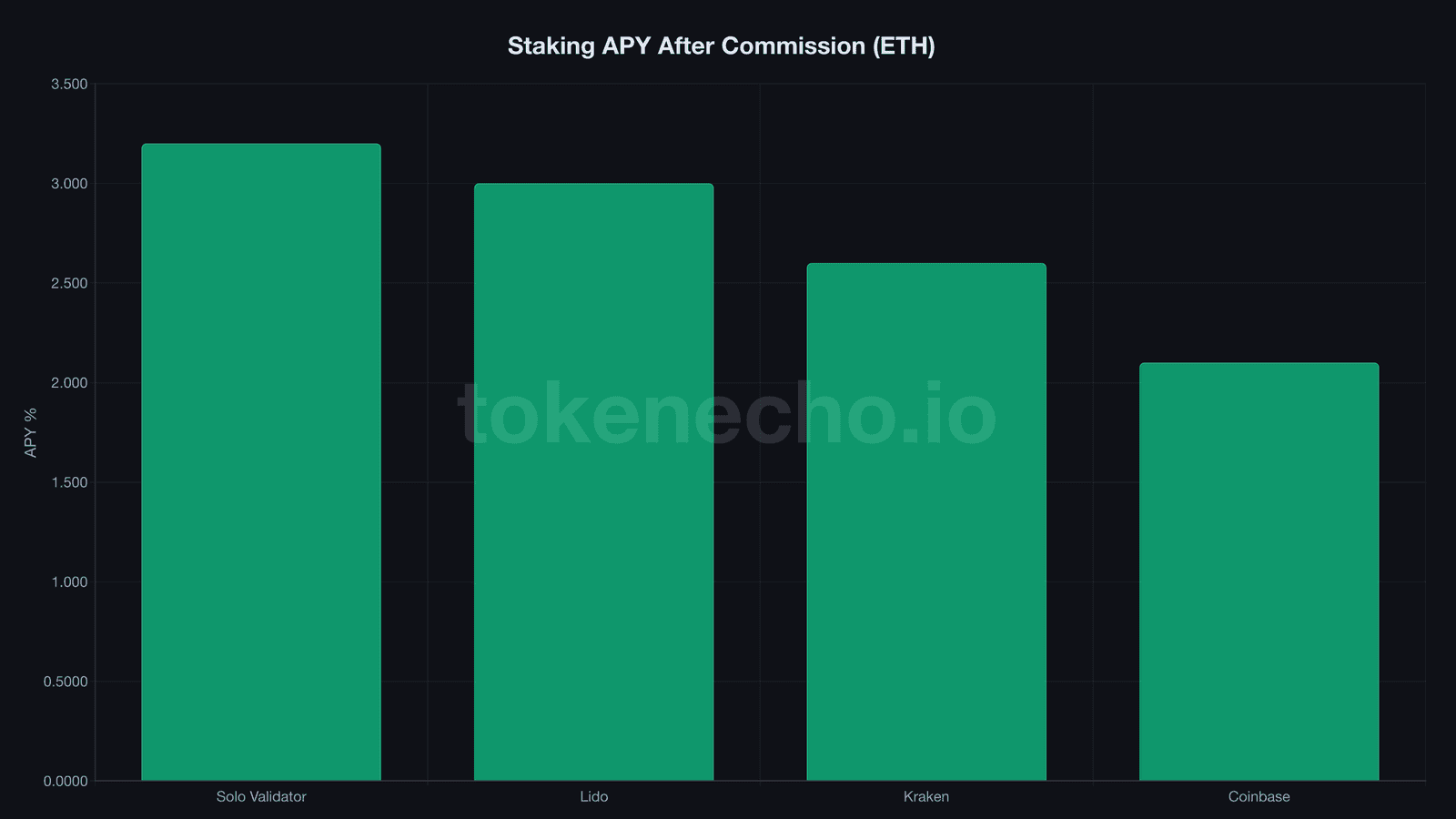
Staking is the biggest quiet earner. Coinbase supports staking for over 130 assets and takes a 35% commission on all rewards. Stake Ethereum through Coinbase and earn roughly 2.1% APY after their cut. Stake the same ETH through Lido and earn 3.0%. Through a solo validator? 3.2%.
That 35% commission means for every $1,000 in staking rewards you’d earn on a non-custodial platform, Coinbase keeps $350 and hands you $650. Over years of compounding, the difference isn’t trivial – it’s tens of thousands of dollars on a large enough position.
Then there’s the Coinbase Card, the exchange’s Visa debit card for spending crypto. It charges no transaction fee for USD-backed spending, but crypto-to-fiat conversions at point of sale carry a 2.49% liquidation fee. Cashback rewards (1-4% in crypto) partially offset the cost, but you’re spending down your portfolio at a 2.49% haircut each time.
Coinbase Wallet, the self-custody app, charges its own swap fee of 1% on in-app token swaps. That’s separate from DEX gas fees and trading fees on the exchange itself.
And Coinbase One? The $29.99/month subscription promises zero trading fees and boosted staking rewards. We’ll get to whether that math actually works in a moment.
Coinbase One: $29.99/month for zero fees – or is it?
Coinbase launched its subscription tier in 2022 and has steadily expanded benefits. For $29.99 per month (or $299/year on annual billing), subscribers get zero trading commissions, priority phone support, and a modest staking APY boost.
Zero trading fees sounds transformative. But Coinbase One doesn’t waive the spread. That 0.5-2% baked into Simple Trade prices? Still there. So “zero fees” is more like “zero visible fees” – you’re still paying through a wider bid-ask spread that’s invisible unless you’re comparing prices across exchanges.
The math only works if you’re a consistent, high-frequency trader. At 0.60% maker fees on a $5,000 monthly trading volume, you’d pay $30 in fees – roughly the subscription cost. Below that, you’re overpaying for a subscription. Above $10,000/month in volume and Coinbase One saves real money, assuming you ignore the spread.
In our Coinbase review, we noted that Coinbase One’s best feature isn’t trading – it’s the $1M account protection guarantee and phone support, which no other major exchange offers. The fee waiver is a marketing hook. The insurance is the product.
Four ways to cut your Coinbase fees by 80% or more
The easiest way to slash your Coinbase costs by 80% takes about thirty seconds. Switch from the Simple Trade interface to Advanced Trade. Same account. Same funds. Dramatically lower fees.
Use Advanced Trade with limit orders. A market buy on Simple Trade at the base tier costs 1.20% plus spread (potentially 1.7-3.2% total). A limit order on Advanced Trade costs 0.60% with no spread. That’s an instant 60-80% reduction on a single toggle. If you’re new to limit orders, our guide on how to buy Bitcoin walks through the mechanics.
Fund via ACH, never debit card. ACH deposits cost zero. Debit card costs 3.99%. On a $5,000 deposit, that’s the difference between $0 and $199.50. The only downside is settlement time – ACH takes 3-5 days for withdrawal, but you can trade instantly. Unless you’re panic-buying a crash at 2 AM, ACH wins every time.
Trade stablecoin pairs for 0% maker fees. Convert USDC to USD (or vice versa) with zero maker fees on Advanced Trade. If you’re moving between stablecoins and fiat regularly – say, taking profits or rebalancing – this route is effectively free.
Consider alternatives for large positions. For trades above $10,000, the fee differential between Coinbase and Kraken (0.26% taker) or Binance (0.10% taker for non-US users) becomes significant. A $50,000 BTC purchase costs $600 on Coinbase, $130 on Kraken, and $50 on Binance. Coinbase’s regulatory standing and FDIC-insured USD balances are worth something – but probably not $550 per trade.
Coinbase vs Kraken vs Binance – the fee gap is massive
Numbers don’t lie. And these numbers aren’t close.
| Fee type | Coinbase | Kraken | Binance |
|---|---|---|---|
| Taker fee (base tier) | 1.20% | 0.26% | 0.10% |
| Maker fee (base tier) | 0.60% | 0.16% | 0.10% |
| $10K trade cost (taker) | $120 | $26 | $10 |
| $50K trade cost (taker) | $300* | $130 | $50 |
| ACH deposit | Free | Free | N/A (US blocked) |
| Wire deposit | $10 | Free (domestic) | N/A |
| Wire withdrawal | $25 | $5 | N/A |
| Debit card deposit | 3.99% | 3.75% | 3.5% |
| Staking commission | 35% | 15-20% | 0-20% |
| Subscription (0% trades) | $29.99/mo | None | None |
*Coinbase’s $50K cost drops to $300 because the trade crosses into the $10K-$50K tier at 0.60% taker.
Binance charges a flat 0.10%/0.10% but isn’t available to US residents since the SEC lawsuit settlement. Kraken offers a middle ground – low fees, full US access, and a 14-year track record without a major security breach. We broke down the full matchup in our Coinbase vs Kraken vs Binance comparison.
Coinbase’s competitive edge isn’t pricing. It’s NASDAQ listing, FDIC-insured fiat balances, the Base L2 network, and a compliance record that institutional allocators actually trust. For a retirement account or a first-time buyer who values insurance over optimization, that premium might be worth paying.
But for anyone trading more than $5,000/month? The math gets harder to justify with each passing quarter.
Pros and cons
Why Coinbase wins despite the fees: FDIC insurance on USD balances up to $250,000. NASDAQ-listed public company (ticker: COIN). 98% cold storage. SOC 2 Type II audit. 382 supported cryptocurrencies. Base L2 for cheap on-chain transactions. Coinbase One insurance guarantee ($1M). Regulatory clarity that no competitor can match.
Why the fees sting: Base-tier taker fees are 4.6x Kraken and 12x Binance. Hidden spread on Simple Trade adds 0.5-2% on top. 35% staking commission is the highest among top-5 exchanges. 3.99% debit card fee punishes urgency. Coinbase One doesn’t waive the spread. Wire withdrawals cost 5x what Kraken charges.
Coinbase generated 59% of its 2025 revenue from transaction fees alone, according to S&P Global data. That’s not a company built to undercut competitors. It’s a company built to monetize trust – and as long as 110 million users keep paying, the fee schedule won’t budge.
For a detailed breakdown of Coinbase’s Advanced Trade tier system, see our Coinbase Advanced Trade fee guide.
Coinbase keeps raising fees while competitors keep cutting them. The question isn’t whether Coinbase is too expensive – it’s whether convenience alone can justify the gap forever.
This is not financial advice. DYOR. Data as of April 12, 2026.
Sources: Coinbase fee schedule, Kraken fee schedule, Binance fee schedule, S&P Global – Coinbase revenue analysis, CoinGecko exchange data, Coinbase Q4 2025 earnings report
Leave a Reply