

Updated on April 3, 2026
🕑 6 min read
Circle’s regulated dollar is outpacing Tether for the first time since 2019, fueled by the GENIUS Act and institutional demand.
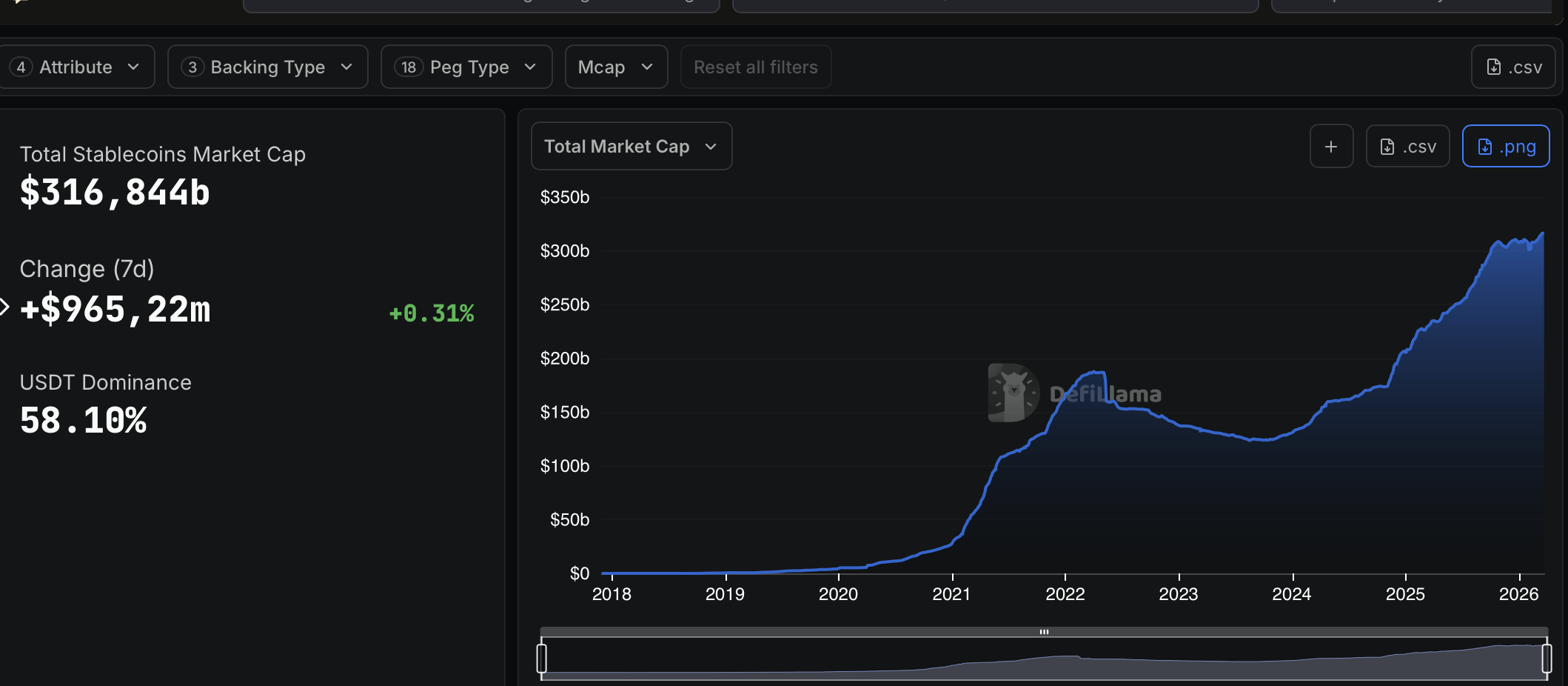
The stablecoin market has quietly crossed a historic threshold. Total market capitalization surged past $320 billion in March 2026, setting a new all-time record and signaling something far more consequential than another crypto milestone – the industrialization of digital dollars is underway, and the balance of power is shifting.
USDC Flips USDT in Transaction Volume – A Decade-Long First
The most striking development is not the headline number itself but what is happening beneath it. According to Mizuho Securities data published on March 13, USDC processed approximately $2.2 trillion in adjusted transaction volume year-to-date, compared with $1.3 trillion for USDT over the same period. This marks the first time USDC has overtaken Tether in adjusted stablecoin transaction volume since 2019.
As of March 15, USDC captured 64% of all adjusted stablecoin transaction volume – a seismic shift for a market long dominated by Tether’s USDT.
The divergence extends beyond volume. Through March 2026, USDC posted a net supply increase of $4.5 billion, while USDT recorded a net decline of approximately $2 billion. Circle minted $2.5 billion in new USDC in a single week leading up to mid-March, deploying primarily on Ethereum and Solana to meet surging institutional liquidity demand.
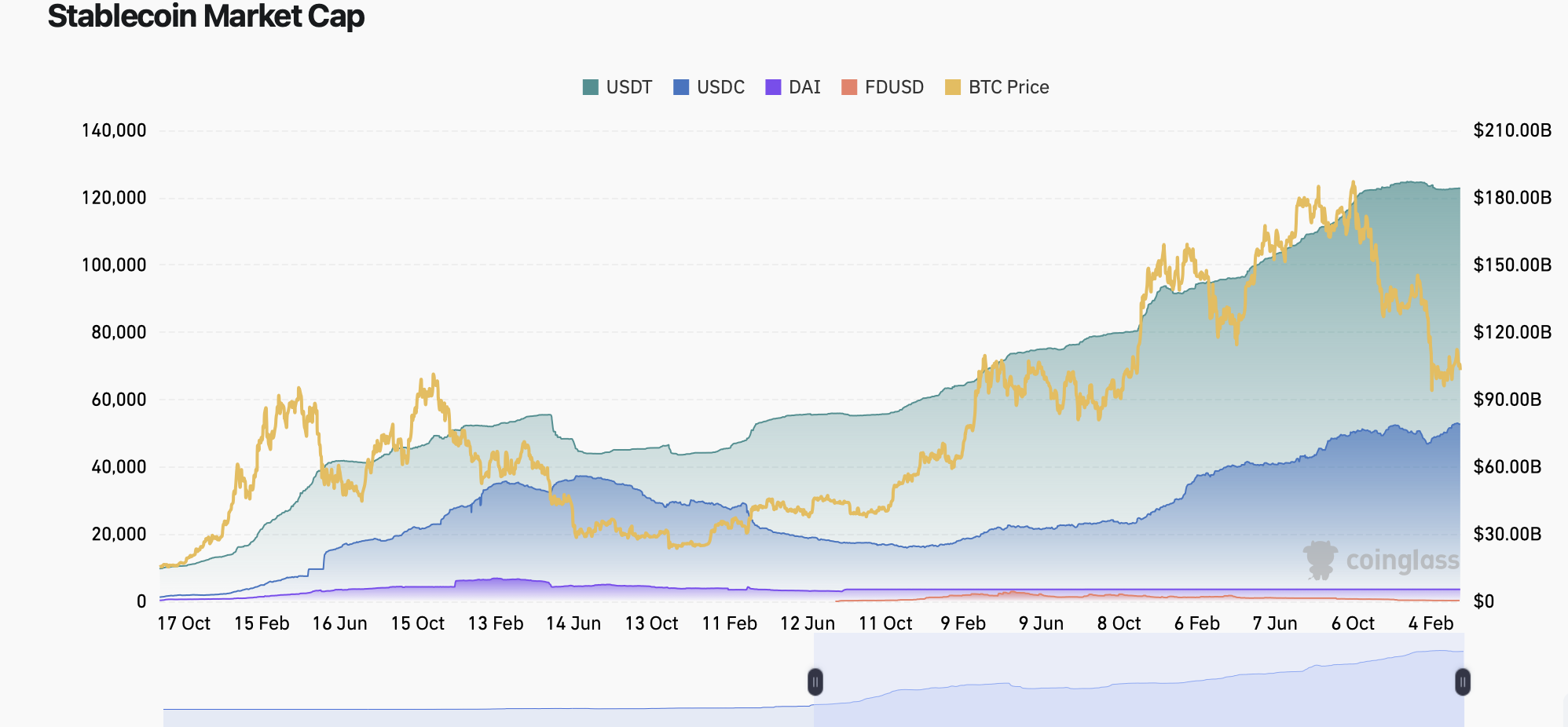
Yet Tether still commands the market cap crown by a wide margin – USDT holds roughly $184 billion in total value compared to USDC’s $79 billion. The gap between market cap dominance and transaction volume dominance tells a nuanced story – institutions are increasingly choosing USDC for settlement, while USDT remains the liquidity backbone across emerging markets and centralized exchanges.
The GENIUS Act Effect: From Regulatory Uncertainty to Federal Framework
Much of the institutional momentum traces back to a single piece of legislation. The Guiding and Establishing National Innovation for U.S. Stablecoins Act (GENIUS Act), signed into law on July 18, 2025, after passing the Senate 68-30 and the House 308-122, has fundamentally de-risked the stablecoin market for traditional finance.
The law mandates 100% reserve backing with U.S. dollars and short-term Treasuries, monthly public disclosure of reserve composition, and establishes three categories of permitted issuers: subsidiaries of insured depository institutions, federal-qualified nonbank issuers (regulated by the OCC), and state-qualified issuers. A critical $10 billion threshold determines whether nonbank issuers fall under federal or state oversight.
The result has been a flood of institutional adoption. Over 1,600 local banks have integrated stablecoin capabilities into their payment systems. BNY Mellon now serves as the primary custodian for USDC reserves and has launched a dedicated stablecoin reserves fund designed specifically for issuers operating under the GENIUS Act framework.
On March 9, 2026, Aon – the $86 billion insurance brokerage giant – announced the first known stablecoin insurance premium payment among major global brokers. Working with Coinbase and Paxos, Aon settled premium payments using USDC on Ethereum and PayPal USD (PYUSD) on Solana. This is not a crypto-native experiment. This is traditional finance infrastructure running on stablecoin rails.
Chain-Level Breakdown: Where the Stablecoins Live
The $320 billion in stablecoin supply is not evenly distributed across blockchains, and the chain-level data reveals distinct use cases.
Ethereum remains the dominant settlement layer, holding more stablecoin supply than all other chains combined. USDT accounts for approximately 50-53% of Ethereum’s stablecoin supply (around $80-85 billion), while USDC has reached a record $55 billion on the network alone.
Tron holds approximately $79 billion in stablecoins with $714 billion in 30-day transfer volume. USDT overwhelmingly dominates Tron’s ecosystem at over 95% of its stablecoin supply, reflecting its role as the primary rail for cross-border remittances and emerging market transactions.
Solana has become the fast-moving chain, handling around $10 billion in daily stablecoin transactions. Circle’s aggressive USDC minting on Solana aligns with the network’s position as a low-cost, high-throughput settlement layer – particularly attractive for institutional payment flows.
Circle’s Stock Tells the Institutional Story
The market’s verdict on the stablecoin shift is reflected in Circle’s stock price. Since its IPO at $31 on June 5, 2025, CRCL has been on a volatile but decisively upward trajectory. After collapsing from highs near $200 to a low of $49.90 in early 2026 during the broader crypto pullback, the stock has rallied sharply.
The stock price of CRCL has been on a tear lately, sitting at around $126 as of March 22 – that’s a whopping 49% jump since the start of the year, and a staggering 87% surge from its low point back in February.
Bernstein maintains an Outperform rating with a $190 price target, citing accelerating stablecoin adoption as a structural tailwind. The 11-to-1 buy-to-sell analyst ratio reflects broad conviction that USDC’s compliance-first positioning is a durable competitive advantage.
The ECB’s Warning: Growth Brings Systemic Risk
Not everyone is celebrating. The European Central Bank has issued increasingly pointed warnings about the systemic risks posed by stablecoin growth.
In a March 2026 paper, ECB analysts cautioned that widespread stablecoin adoption – particularly of U.S. dollar-denominated tokens – could cause retail deposit outflows from euro-area banks, weaken the ECB’s monetary sovereignty, and create conditions for dangerous fire sales. If a major stablecoin experienced a run, the forced liquidation of its reserve assets (primarily U.S. Treasuries) could disrupt the functioning of government bond markets.
The ECB’s concern echoes patterns observed in dollarized economies: as more economic activity settles in dollar stablecoins rather than euros, the central bank’s ability to influence monetary conditions could be progressively undermined.
This tension between U.S. regulatory embrace and European institutional anxiety will likely define the global stablecoin landscape for years to come.
What Comes Next: The Road to $1 Trillion
The forecasts from major institutions paint a consistent picture of continued exponential growth. JPMorgan projects the stablecoin market reaching $500-750 billion by the end of 2026 under its base case, with bull-case scenarios reaching $1-2 trillion. ECB analysts and market researchers suggest $1 trillion is achievable by 2027 if current trends hold, with $2 trillion possible by 2028.
The GENIUS Act’s regulatory deadline – July 18, 2026 – will be the next major catalyst. By that date, all implementing regulations must be finalized, creating full clarity for institutions still on the sidelines. As the framework matures and more banks integrate stablecoin capabilities, the market’s growth curve may steepen further.
The stablecoin market is no longer a crypto sideshow. At $320 billion and climbing, with major banks, insurers, and asset managers actively building on its rails, digital dollars have entered the phase of institutional industrialization. The question is no longer whether stablecoins will become core financial infrastructure – but how fast, and who will control the rails.
Please note that the information provided is not a recommendation to buy or sell anything. It’s essential to do your own research and make informed decisions. The data mentioned is current up to March 23, 2026.
Sources
- Mizuho Securities adjusted stablecoin volume data (March 13, 2026) – Analytics Insight
- DefiLlama stablecoin market cap and chain breakdown – defillama.com/stablecoins
- GENIUS Act full text – Congress.gov S.394
- Aon stablecoin premium payment announcement (March 9, 2026) – Aon Newsroom
- BNY Mellon stablecoin reserves fund – BNY Newsroom
- ECB Financial Stability Review – ECB stablecoin risks analysis
- Circle (CRCL) stock data – Yahoo Finance
- CoinGlass stablecoin market cap history – coinglass.com/pro/stablecoin
Leave a Reply