




Bitcoin’s Great Disconnect: Whales Stack 91,000 BTC as Fear Index Hits Rock Bottom at 10
🕑 5 min read
Exchange reserves plunge to a 7-year low while retail investors panic – on-chain data reveals who’s really buying the dip.
The crypto market is flashing one of its most extreme sentiment readings in years. On March 22, 2026, the Crypto Fear The fear and greed index has taken a big hit, dropping down to 10, which is way down in the “extreme fear” zone. This happened when Bitcoin’s price fell below $69,000. But if you look closer, there are some other things going on that might not be so obvious at first.
surface of panic selling and grim headlines, on-chain data tells a strikingly different story: whales are accumulating at a pace not seen since the 2022 bear market bottom.
What’s really standing out in the market right now is the difference between what the crowd thinks and what the smart money is actually doing – it could be the biggest signal we’re seeing today. Let’s break down what the data actually shows.
Exchange Reserves Hit a 7-Year Low
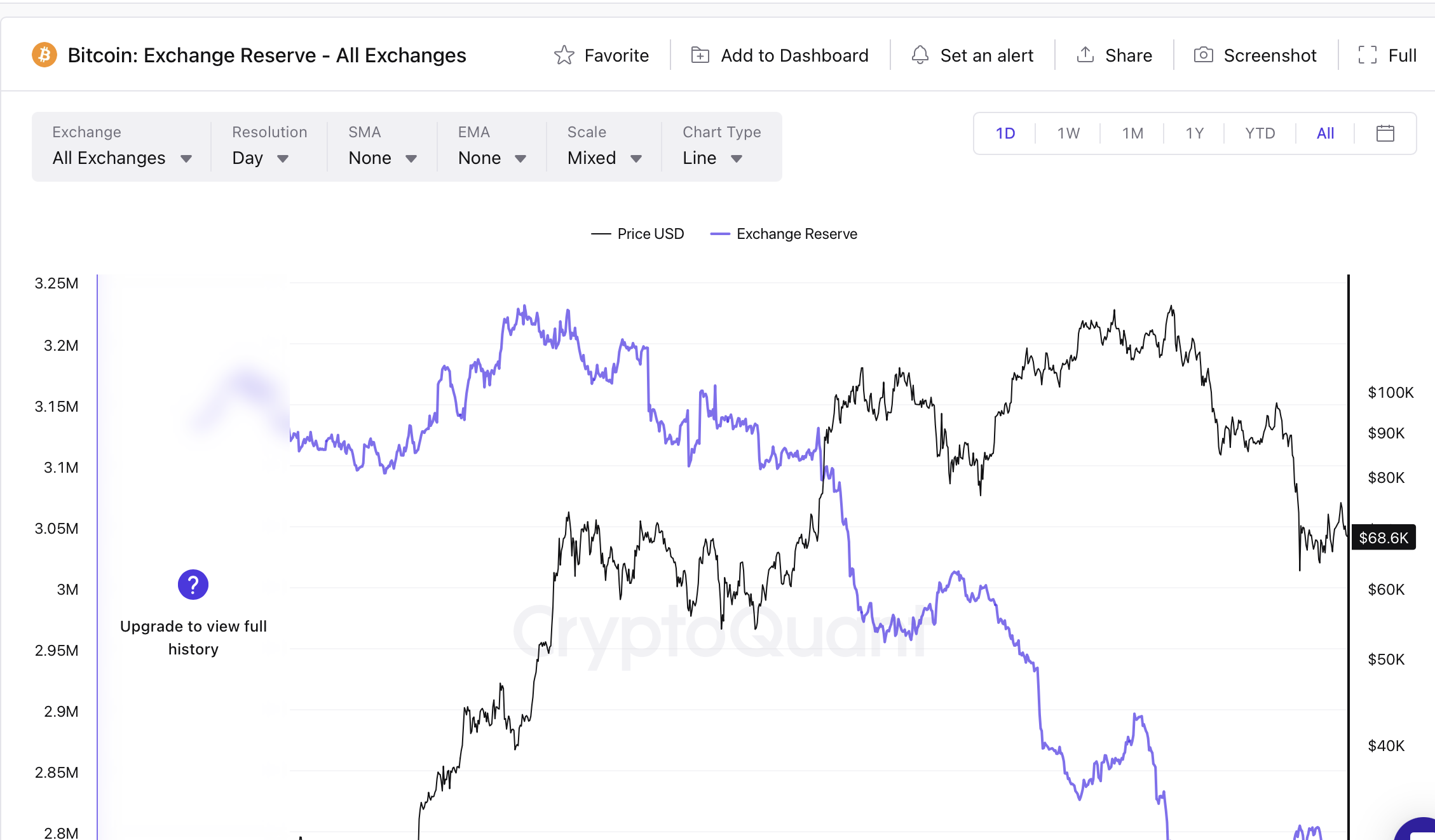
According to CryptoQuant, centralized exchanges now hold just 2.7 million BTC – the lowest level since November 2018. Over the past seven days alone, approximately 47,000 BTC worth $3.2 billion departed centralized platforms, with net outflows averaging 15,000 BTC per day.
This is not a subtle trend. Bitcoin has been steadily draining from exchanges throughout Q1 2026, and the acceleration in March suggests large holders are moving coins into cold storage with increasing urgency. When Bitcoin leaves exchanges, it typically signals reduced near-term selling pressure – holders are choosing to store, not sell.
Whale Wallets Are Growing, Not Shrinking
While the Fear & Greed Index screams panic, addresses holding 1,000+ BTC tell a completely different story. According to Glassnode data, these whale wallets have accumulated approximately 91,000 BTC over the past 90 days. The total number of addresses with over 1,000 Bitcoins is going up. Now, there are 2,140 addresses with over 1,000 Bitcoins – that’s 58 more than in December 2025.
Even more telling is CryptoQuant’s Exchange Whale Ratio, which surged to 0.64 in early March – its highest reading since October 2015. This means 64% of all Bitcoin flowing into exchanges now originates from whale-sized wallets. When whales dominate exchange flows at this ratio, it historically signals either distribution or strategic repositioning. Given the simultaneous drop in total exchange reserves, the current pattern points firmly toward accumulation rather than selling.
Long-Term Holders Tighten Their Grip
The conviction isn’t limited to whales. Long-term holders – defined as addresses holding BTC for more than 155 days – now control around 78.3% of all the Bitcoin that’s out there, which is a big jump from 74.1% back in October 2025 – that’s a 4.2 percentage point increase over five months, representing one of the most aggressive accumulation phases in Bitcoin’s history.
When long-term holder supply percentage rises during a period of falling prices and extreme fear, it has historically preceded significant price recoveries. The pattern mirrors what occurred in late 2022, when long-term holders accumulated aggressively before Bitcoin’s move from $16,000 to new record highs.
ETF Inflows Provide an Institutional Floor
Spot Bitcoin ETFs have added another layer to this dynamic. As of March 17, capital poured into spot Bitcoin funds for the seventh day in a row, adding to a two-week stretch where we’ve seen around $1.47 billion in new investments. BlackRock’s IBIT led with $169.3 million in daily inflows, followed by Fidelity’s FBTC at $24.4 million.
This institutional buying creates what analysts call a “price floor” – even as retail sentiment deteriorates, a steady stream of ETF capital prevents the kind of capitulation-driven crashes that characterized pre-ETF market cycles. The price of Bitcoin is currently stuck in a tight range, bouncing between $69,000 and $72,500, where institutional demand meets on-chain weakness from short-term holders taking losses.
DeFi Resilience Adds to the Bullish Undercurrent
The divergence extends beyond Bitcoin. Total DeFi TVL reached $97.6 billion as of March 10, marking a 4.44% weekly increase – all while the Fear & Greed Index sat at 13. Ethereum DeFi deposits hit an all-time high of 25.3 million ETH, and on-chain liquidation risk dropped 84% year-over-year to just $53 million.
Aave commands $26.46 billion in TVL, a staggering $8.5 billion ahead of second-place Lido at $17.96 billion. Capital isn’t fleeing DeFi – it’s consolidating into proven protocols, suggesting sophisticated investors are positioning for the next leg up rather than heading for the exits.
What Does This Divergence Mean?
History offers clear guidance. Every previous instance where the Fear & Greed Index fell below 15 while whale accumulation accelerated has marked a significant market bottom – or at the very least, a zone of asymmetric upside risk:
- June 2022: Fear & Greed at 6, whales accumulated – BTC bottomed at $17,600
- March 2020: Fear & Greed at 8 during COVID crash – BTC recovered from $3,800 to $60,000 within 13 months
- December 2018: Fear & Greed at 10 – BTC bottomed near $3,100
The current setup in March 2026 shares key characteristics with each of these periods: extreme retail pessimism, aggressive institutional accumulation, and declining exchange reserves.
The Risk Factor
This doesn’t mean an immediate reversal is guaranteed. The macro environment remains uncertain following the Federal Reserve’s recent decision that triggered a 5% drop from $74,700. Short-term holder cost basis sits above current prices, meaning any bounce could face selling pressure from underwater positions. The on-chain data shows conviction among large holders, but not yet the broad-based demand that fuels sustained rallies.
The most likely near-term scenario: continued consolidation in the $67,000-$73,000 range, with institutional ETF flows and whale accumulation gradually absorbing remaining sell pressure from retail and short-term holders.
The Bottom Line
The data is unambiguous: while the crowd panics at Fear & Greed levels of 10, the largest and most sophisticated market participants are buying aggressively. Exchange reserves at a 7-year low, 91,000 BTC accumulated by whales in 90 days, long-term holders controlling 78.3% of supply, and $1.47 billion in ETF inflows over two weeks – these are not the hallmarks of a market preparing to collapse.
Whether this marks the definitive bottom of the current correction remains to be seen. But on-chain data has been far more reliable than sentiment surveys at identifying major turning points, and right now, the data says smart money is loading up.
Disclaimer: This is not financial advice. DYOR. Data as of March 22, 2026.