

🕑 7 min read
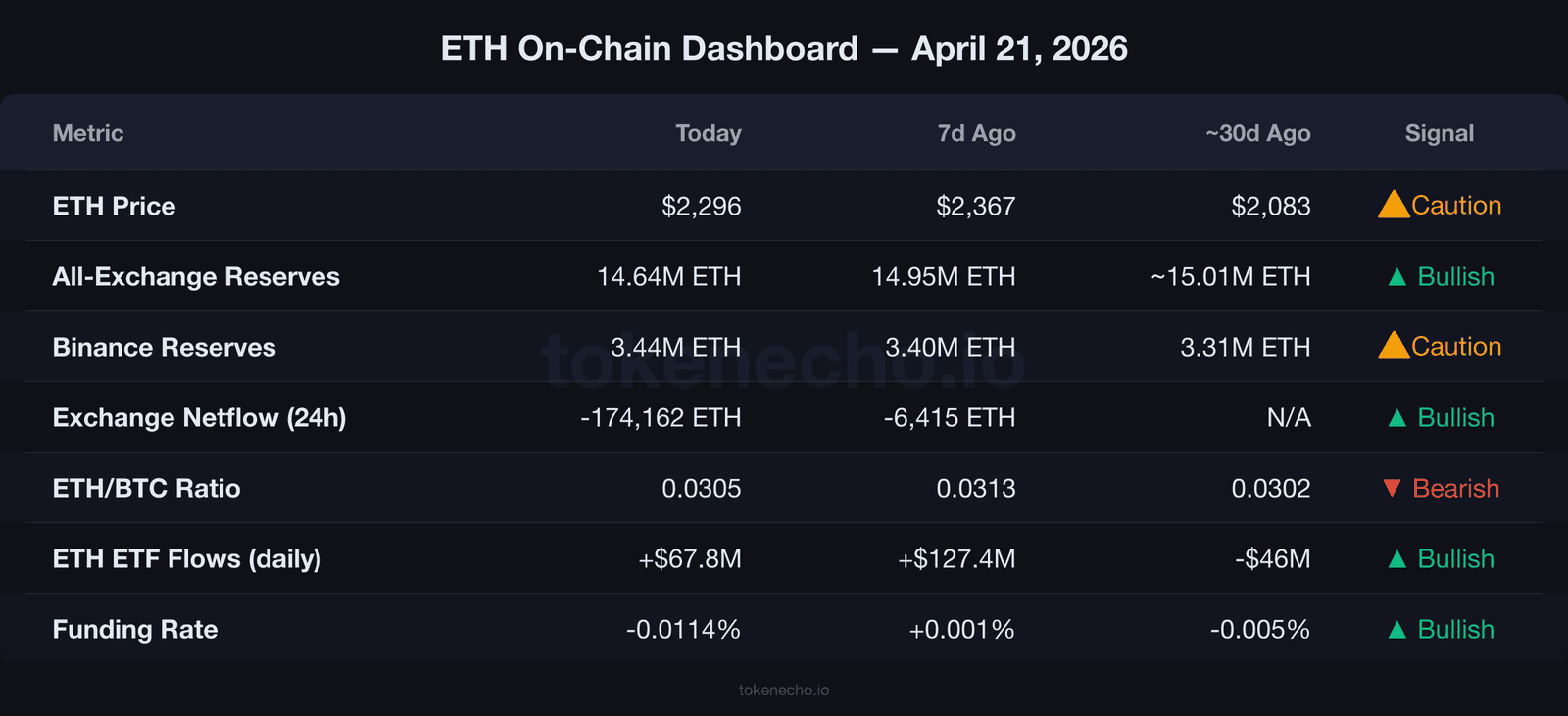
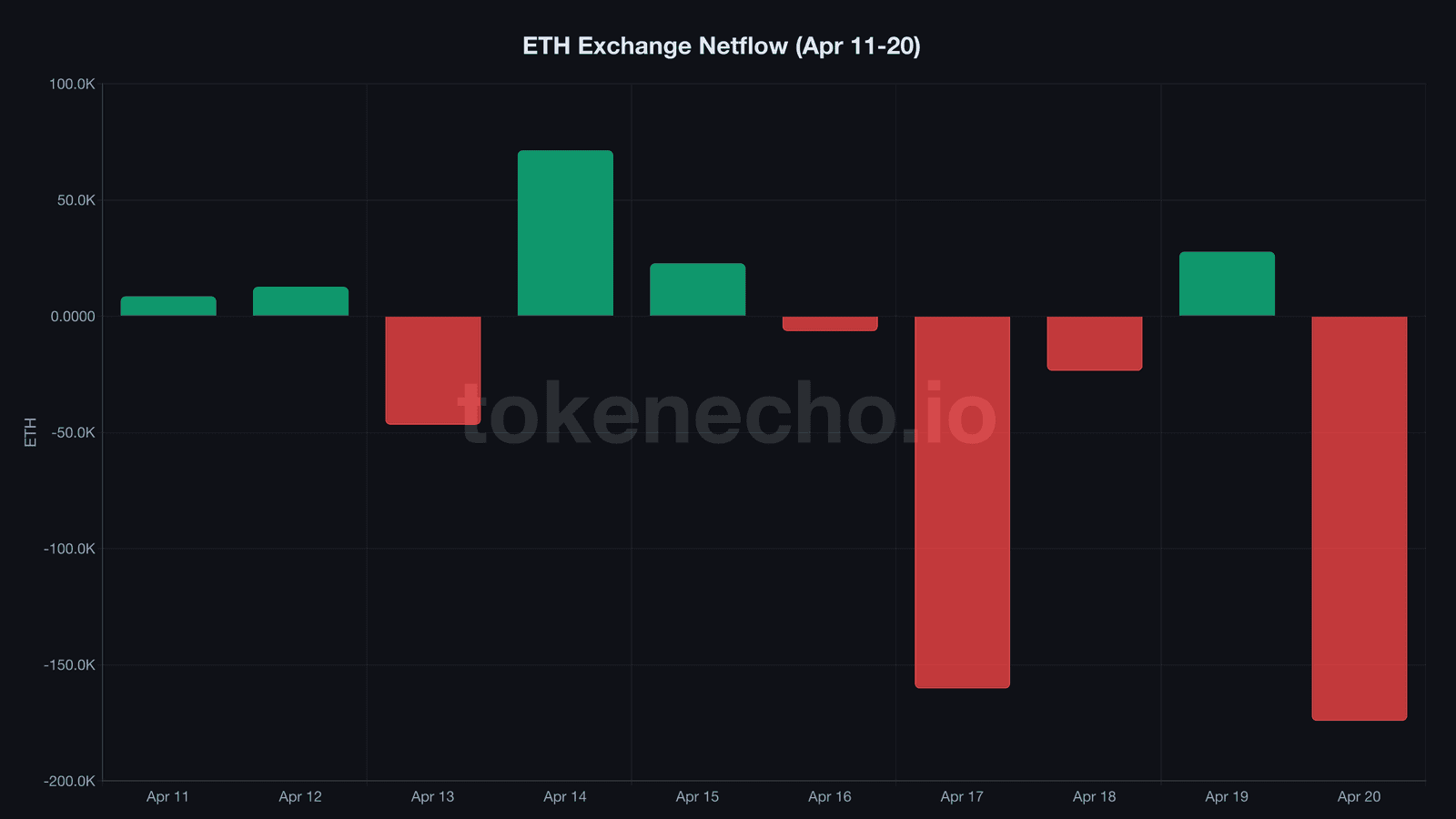
Some 174,162 ETH left exchanges on April 20. That’s roughly $400 million – gone in a single Sunday, making it the second-largest outflow we’ve tracked in 10 days.
And Binance, the exchange that handles more Ethereum volume than anyone else, didn’t lose a single token. It gained them.
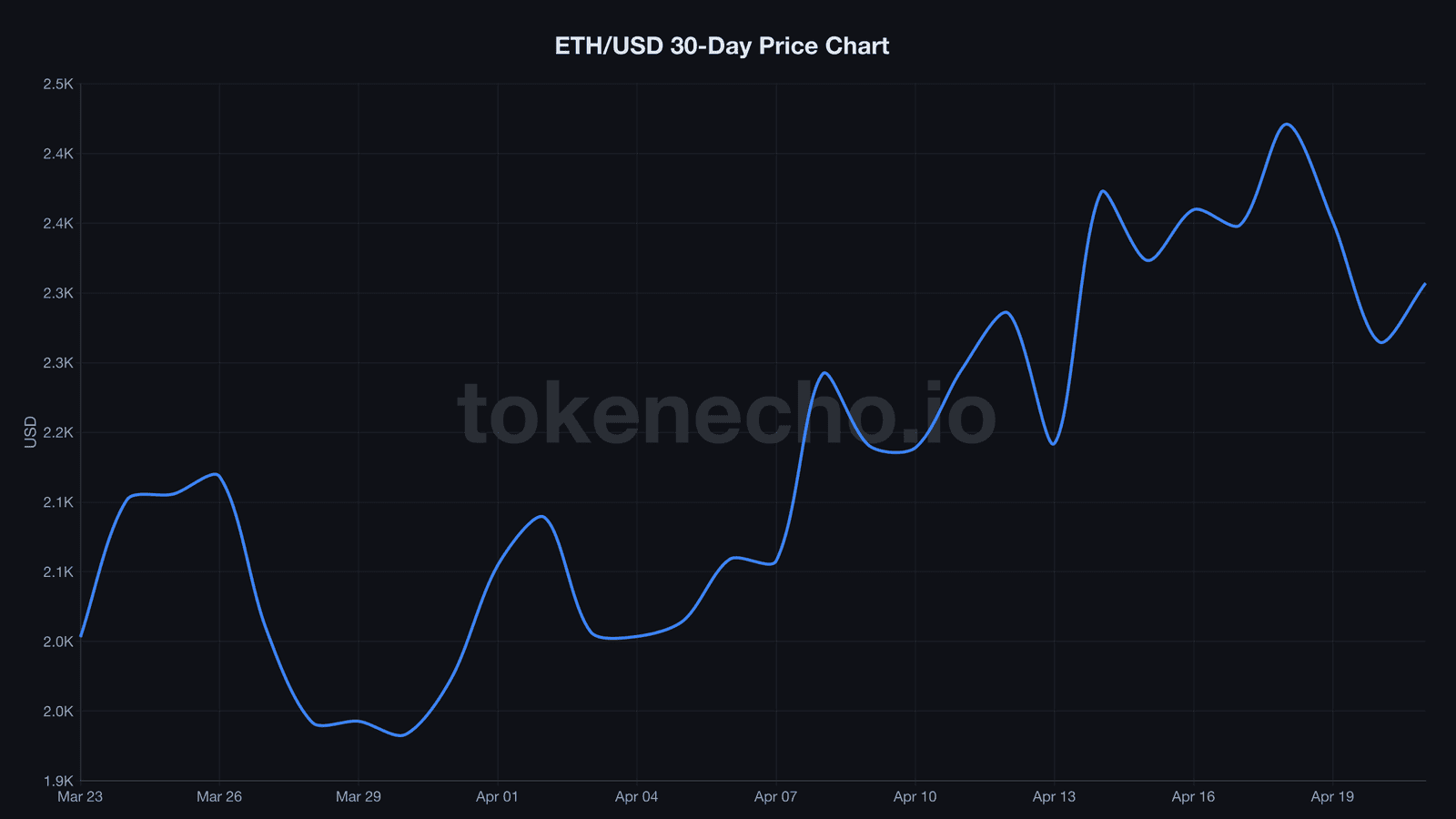
Ethereum trades at $2,296 as of Monday, down 0.6% in 24 hours and 3% on the week. The 14-day picture looks better – up 10.4% – but today’s Ethereum price picture starts with a question nobody’s answering: where did all that ETH actually go?
Key Takeaways
- Exchange reserves crashed to 14.64 million ETH, a 30-day low, with 337,000 ETH ($773M) drained in 5 days. April 20’s outflow of 174,162 ETH was the second-largest single-day exit since April 11.
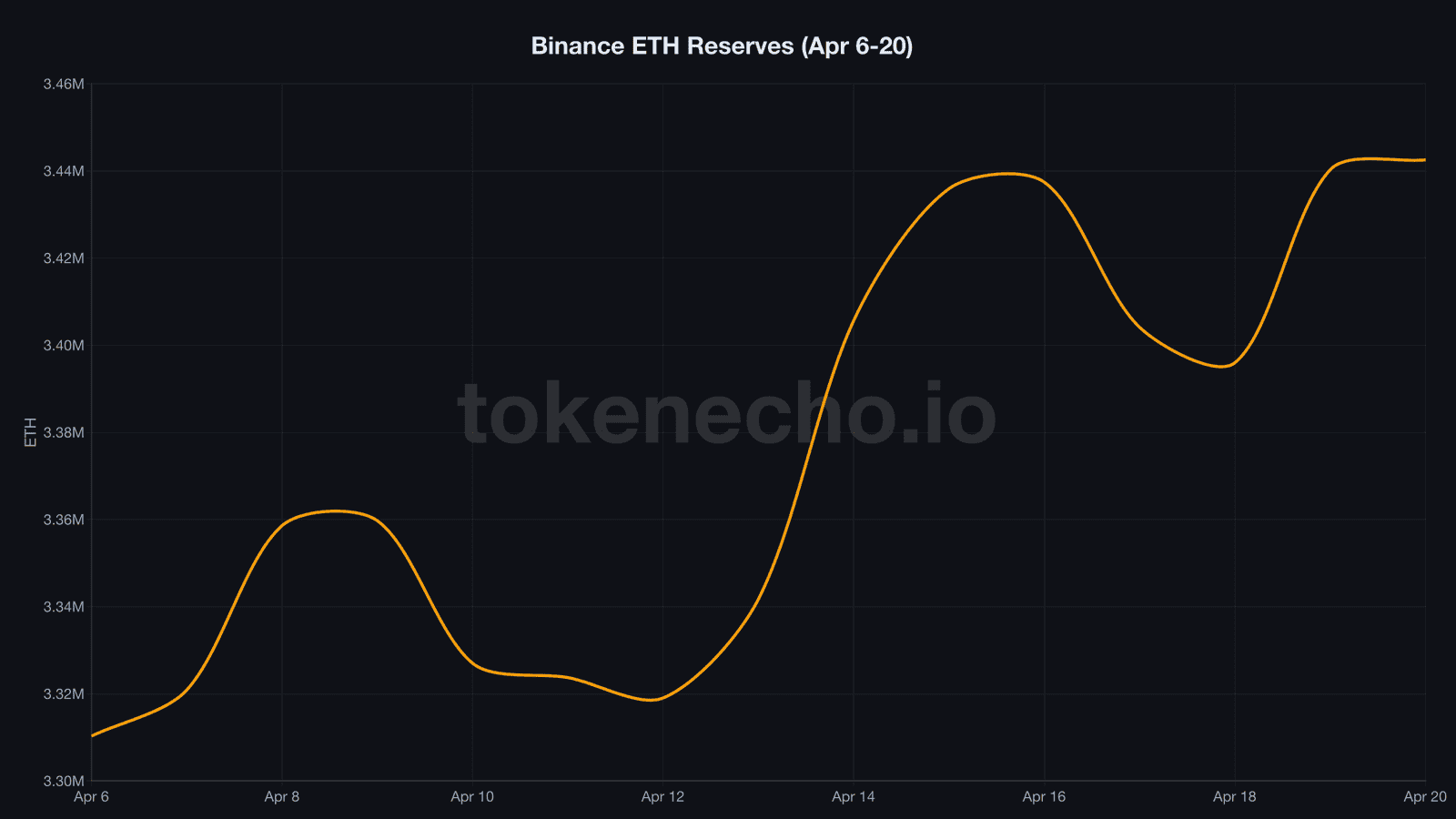
- Binance is the lone exception – gaining 132,000 ETH ($303M) over 15 days while non-Binance exchanges lost roughly 460,000 ETH ($1.05B). KelpDAO’s $292M hack likely triggered a DeFi-to-CEX rotation.
- Funding rates flipped negative to -0.0114%, meaning shorts are paying longs to hold positions – a setup that historically precedes violent squeezes. Iran’s ceasefire expires April 22.
Exchange reserves hit a 30-day low – the drain keeps accelerating
Everyone expected KelpDAO’s $292M hack to push ETH back onto centralized exchanges. The $13.2 billion DeFi TVL wipeout should’ve meant panic deposits and a flood of sell orders.
The opposite happened.
All-exchange reserves, the total Ethereum sitting on trading platforms, dropped to 14,637,576 on April 20. That’s the lowest reading in over 30 days, down from a local peak of 14,974,168 on April 15.
The math: 336,592 ETH drained in five days. At current prices, that’s $773 million worth of Ethereum moved off exchanges and into cold storage, staking contracts, or institutional custody.
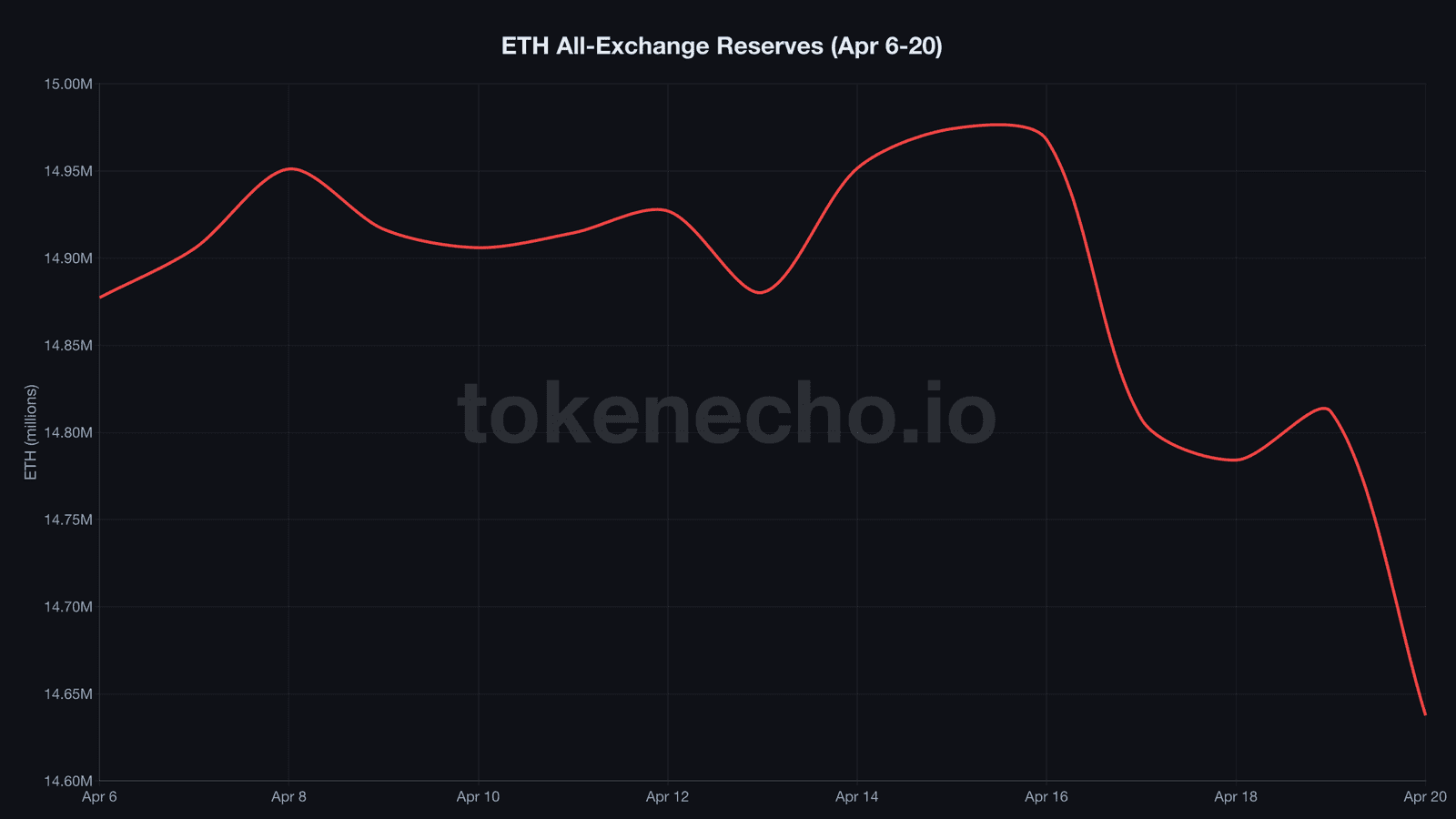
Two days tell most of the story. April 17, when the Strait of Hormuz briefly reopened, saw 160,188 ETH leave exchanges. April 20 nearly matched it with 174,162 – while most of the Western hemisphere was sleeping.
The top-10 withdrawals on April 20 totaled 215,000 ETH. These aren’t retail moves.
Non-Binance exchanges have lost approximately 460,000 ETH over 15 days. That’s $1.05 billion in supply removed from every major platform except one. It should feel bullish.
It doesn’t – not completely – because of where some of that ETH ended up.
The exchange landscape right now looks like a shopping district where every store is closing – except one that somehow has a line around the block.
Binance absorbs 132,000 ETH while every other exchange bleeds
One number breaks the pattern.
Binance’s ETH reserves climbed from 3,310,289 on April 6 to 3,442,529 on April 20 – a gain of 132,240 ETH worth roughly $303 million. That’s a 4% increase in two weeks while the rest of the market hemorrhaged.
Why?
The most likely explanation starts with KelpDAO. When $292 million in restaked ETH got drained through a forged bridge message, it didn’t just crater Aave’s TVL by $6.6 billion. It shattered confidence in the entire restaking ecosystem.
Scared DeFi users pulled tokens out of lending protocols and sent them somewhere they considered safe. They chose Binance.
Bitmine reinforces the trend. The institutional ETH accumulator bought 101,627 ETH ($235 million) this week – their largest weekly haul of 2026. Total holdings now stand at 4.976 million tokens, or 4.12% of all Ethereum in existence. Some of that volume almost certainly routes through Binance’s OTC desk.
But there’s a less comforting read. Rising reserves on the world’s largest exchange can also signal pre-distribution – whales move tokens TO exchanges before selling, not after. And with average deposit sizes on April 20 running 1.7 times the weekly average, the inflows weren’t coming from small fish.
We’ve tracked this Binance divergence for over a week. It hasn’t broken one direction yet – and that ambiguity is itself a signal worth watching.
Negative funding, one whale’s $91M bet, and the Iran clock
The last time funding rates on ETH perpetuals, the recurring fee traders pay to hold leveraged positions, turned this negative was January 2023. ETH sat at $1,200. Shorts were crowded, confident, paying premiums to stay in their positions.
Within 90 days, ETH hit $2,100. A 75% rally that liquidated most of them.
Today funding sits at -0.0114%. Shorts are paying longs again. And someone isn’t just noticing – they’re acting on it. An unidentified whale opened a 40,000 ETH position on HyperLiquid with 20x leverage, worth $90.8 million, at an average entry of $2,289. Liquidation price: $1,392.
That’s a bet ETH won’t fall another 39% from here. Given it’s already 53% below its all-time high of $4,946, the whale is essentially saying the capitulation is behind us.
ETH ETFs back the thesis – partially. BlackRock’s ETHA pulled in $76.1 million on April 20 alone, offset by Grayscale’s ETHE bleeding $17.1 million. Net daily inflow: $67.8 million.
Cumulative ETH ETF inflows have now crossed $11 billion. And Schwab’s spot ETH trading went live for early-access clients last week, opening a pipeline from 38.9 million brokerage accounts into the asset.
But the ceasefire expires tomorrow.
“I expect to be bombing because I think that’s a better attitude to go in with,” said Trump on Monday, referring to the Iran conflict ahead of the April 22 deadline. Iran hasn’t confirmed attendance at Pakistan-mediated peace talks. VP Vance landed in Islamabad for a second round of negotiations that may not happen.
If the ceasefire extends, negative funding becomes a coiled spring. If it collapses, even $773 million in exchange outflows won’t provide a short-term floor.
When this setup last appeared, ETH rallied 75%
In January 2023, two months after FTX collapsed, the picture looked remarkably similar: ETH exchange reserves were declining at roughly 6-7% monthly, the token traded at $1,200 – down 75% from its $4,946 all-time high – and funding rates were negative. Nobody wanted to touch it.
ETH rallied from $1,200 to $2,100 over the next 90 days.
Today’s setup rhymes. Reserves are draining at 6.5% monthly – approximately 1.03 million ETH over 30 days. ETH trades 53% below ATH. Funding is negative. But open interest now sits between $25 billion and $34 billion, roughly 4-5 times the $6-8 billion during January 2023. More leverage means more potential forced liquidations if the path up comes with hiccups.
The rally – if it materializes – won’t be clean. Our previous analysis showed leverage dropping 8% in 48 hours only to start rebuilding immediately. That pattern of flush-and-rebuild creates violent, choppy recoveries rather than smooth trends.
On-chain scorecard (4 of 7 bullish)
- ✅ Exchange reserves: 14.64M ETH, 30-day low, accelerating drain (bullish supply squeeze)
- ✅ Netflow: -174,162 ETH single-day outflow Apr 20 (bullish accumulation signal)
- ✅ Funding rates: -0.0114%, shorts paying longs (bullish short squeeze setup)
- ✅ ETH ETF flows: +$67.8M daily, $400M+ weekly, $11B+ cumulative (bullish institutional demand)
- ⚠️ Binance reserves: +132K ETH in 15 days – accumulation or pre-distribution? (caution)
- ⚠️ ETH/BTC ratio: 0.0305, pinned at 5-year floor (relative weakness vs Bitcoin)
- ❌ Iran ceasefire: expires April 22, Trump signals military escalation (geopolitical risk)
TokenEcho verdict: cautiously bullish
Direction: Cautiously bullish
Key level: $2,400 – a sustained close above this level triggers the next leg toward $2,500-$2,600
Risk factor: Iran ceasefire collapse on April 22 combined with Binance’s rising reserves could flip the supply narrative if large holders begin distributing into strength
This is an analytical assessment, not financial advice.
What to watch in the next 48-72 hours
- Iran ceasefire outcome (April 22 evening ET): Extension → likely ETH push toward $2,400 as shorts scramble to cover. Collapse → test of $2,200 support with potential cascade below $2,100.
- Binance reserve direction: If Binance’s ETH stash starts declining after accumulating 132K tokens, that’s a bullish breakout signal – tokens moving to cold storage. Continued inflows while price stalls means distribution.
- Funding rate flip: A reversal from -0.0114% to positive confirms the short squeeze is underway. Liquidation cascades above $2,350 would accelerate the move.
This analysis is part of our daily Ethereum price tracking. See all previous analyses and key metrics on our hub page.
Exchange reserves say one thing. Binance says the opposite. Tomorrow’s Iran deadline will force a resolution – and somebody’s going to be wrong.
This is not financial advice. DYOR. Data as of April 21, 2026.
Sources:
- CoinGecko – ETH price, market cap, supply, ATH data
- CryptoQuant – exchange reserves, netflow, inflow/outflow (all exchanges + Binance)
- CoinDesk – Bitmine 101,627 ETH acquisition
- TradingView – Whale 40,000 ETH HyperLiquid position
- Blockchain.news – ETH ETF flow data
- CNN, NPR – Iran ceasefire status, Trump comments
Leave a Reply