
🕑 6 min read
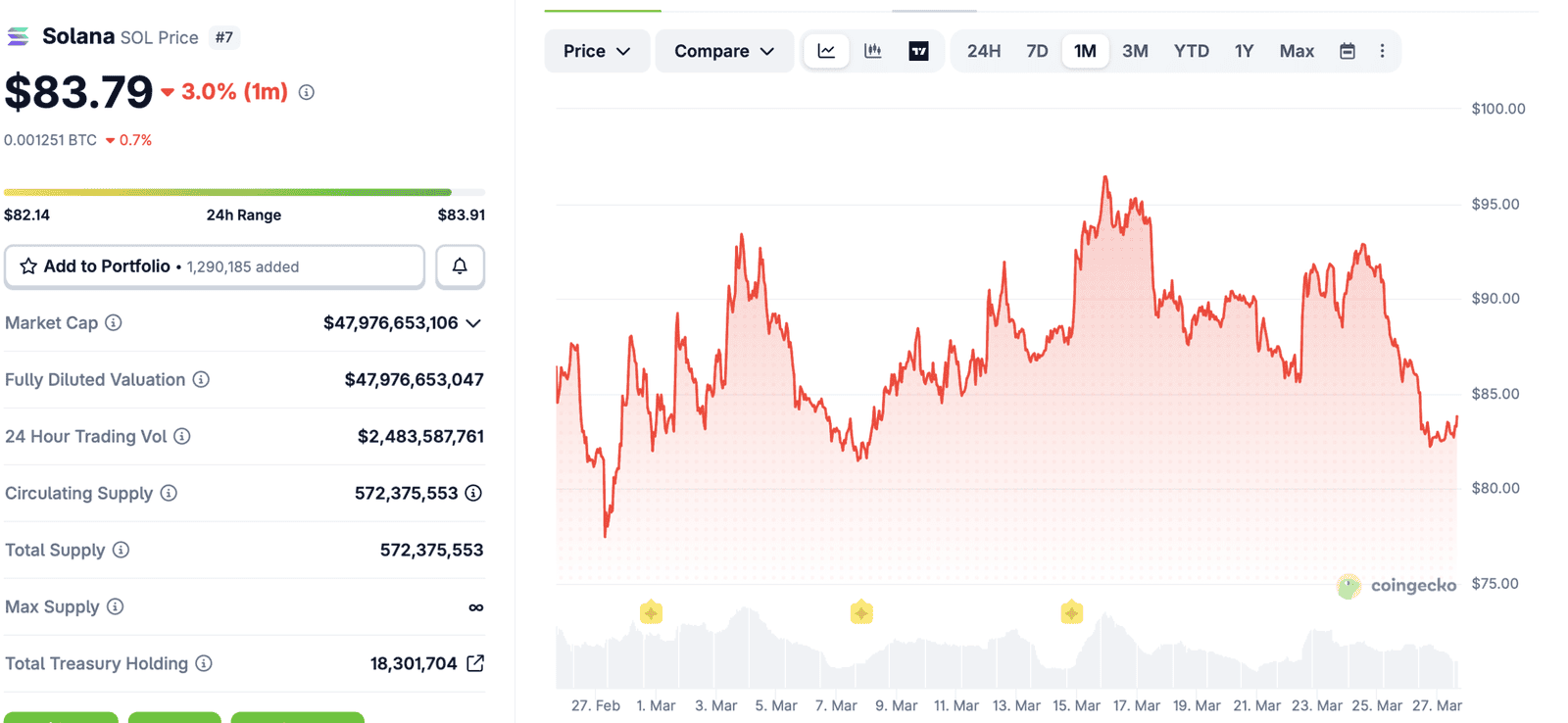
You’ve probably heard of Solana. Maybe a friend mentioned it. Maybe you saw a headline about it processing more stablecoin volume than Ethereum. Maybe you just watched SOL drop from $293 to $83 and thought: “Is this thing on sale?”
Good instinct. But buying crypto for the first time can feel like walking into a casino where everyone speaks a different language. This guide strips away the jargon and walks you through the entire process – from opening an account to earning staking rewards on your SOL.
No prior crypto experience required. Just a phone, an ID, and about 15 minutes.
Your SOL Shopping List (Before You Start)
You’ll need three things, and only three things:
A crypto exchange account – that’s where you’ll buy SOL with dollars, euros, or your local currency. Think of it as a stock brokerage, except it’s open 24/7 and nobody wears a suit.
A wallet – optional but recommended. Exchanges can hold your SOL, but moving it to your own wallet is like taking cash out of the bank and putting it in your own safe. You control it.
Government-issued ID – every reputable exchange requires identity verification. That’s called KYC (Know Your Customer). It takes 5-10 minutes and usually just means snapping a selfie with your passport.
Pick Your Exchange – Fees Matter More Than You Think
Not all exchanges charge the same. On a $1,000 SOL purchase, the fee difference between platforms is staggering.
Coinbase charges 0.40% maker and 0.60% taker fees. That’s $6-14.90 on a $1,000 buy depending on the order type. It’s the most beginner-friendly option – clean interface, FDIC-insured USD balances, and it’s publicly traded on Nasdaq. If you’ve never bought crypto before, Coinbase is the training wheels option. Nothing wrong with that.
Binance starts at 0.10% for both sides. That’s $1 on a $1,000 trade. Deeper liquidity, more trading pairs, lower fees – but the interface can overwhelm new users. It looks like an airplane cockpit.
Kraken offers a solid middle ground: competitive fees, built-in staking, and a reputation for security that goes back to 2011. They’ve never been hacked. In crypto, that’s practically a superpower.
The Actual Buying Part (It’s Easier Than You Think)
Once your account is verified and funded:
Log into your exchange. Search for “SOL” or “Solana.” Hit “Buy.” Choose how much – you don’t need a full SOL. You can buy $10 worth, $50, whatever fits your budget. SOL at $83.28 per coin is already much more accessible than Bitcoin’s $66,000.
For your first purchase, use a simple market order – it buys SOL immediately at the current price. Limit orders let you set a target price, but that’s an optimization for later.
One strategy worth knowing: DCA (Dollar-Cost Averaging). Instead of throwing $500 at SOL today, you invest $100 per week for five weeks. If the price drops, you buy more coins cheaper. If it rises, you already own some. DCA removes the stress of timing the market – and historically, it’s outperformed lump-sum buying in volatile assets like crypto.
Coinbase and Kraken both offer automatic recurring buys. Set it and forget it.
Move Your SOL to a Wallet (Yes, You Should)
Exchanges are convenient. They’re also giant targets for hackers. The crypto graveyard is littered with exchange collapses – Mt. Gox, FTX, Celsius. “Not your keys, not your coins” isn’t just a slogan. It’s a survival rule.
Phantom is the go-to Solana wallet for beginners. Free, browser extension and mobile app, beautiful interface. Install it from phantom.app (never download wallets from random links – phishing scams are everywhere). Write down your 12-word recovery phrase on paper. Not in your Notes app. Not in a screenshot. Paper, stored somewhere safe.
Solflare is better for power users – more granular staking controls, hardware wallet integration, and transaction simulations that preview what a transaction does before you sign it.
Ledger (hardware wallet, ~$79) is the vault option. Your private keys never touch the internet. If you’re holding more than $1,000 in SOL, a Ledger is worth the investment. It works with both Phantom and Solflare.
To transfer SOL from your exchange to Phantom: copy your Phantom wallet address (starts with a long string of letters and numbers), go to your exchange, hit “Withdraw,” paste the address, enter the amount. Solana transactions cost about $0.001 and confirm in under a second. That’s not a typo – one-tenth of a penny.
Stake Your SOL and Earn 6-8% APY
This is where Solana gets interesting. Once your SOL is in a wallet, you can stake it – locking it to help secure the network in exchange for rewards. It’s like earning interest on a savings account, except the rates are actually worth talking about.
Three options, ranked by simplicity:
Exchange staking (easiest) – Coinbase and Kraken offer one-click staking. Lower rewards (4-5% after their cut), but zero effort. Good if you’re keeping SOL on the exchange anyway.
Phantom liquid staking (easy) – Hit “Stake” inside Phantom, receive pSOL tokens. You earn rewards AND can still use your staked SOL in DeFi. Phantom uses Jupiter routing under the hood but charges a small premium.
Jito (best rewards) – Stake directly at jito.network and receive JitoSOL. Current APY: approximately 7.46%, which includes traditional staking rewards plus MEV tips, the revenue extracted from transaction ordering. Jito is the largest liquid staking platform on Solana.
Marinade – The OG Solana liquid staking protocol. Stake, receive mSOL, and deploy it as collateral across DeFi. Slightly lower APY than Jito but distributes stake across 400+ validators, which is better for network decentralization.
With liquid staking, you don’t have to choose between earning yield and having access to your funds. Your JitoSOL or mSOL tokens represent your staked position and can be swapped back to SOL anytime.
The Security Stuff (Read This Even if You Hate It)
Five rules. Non-negotiable.
Never share your recovery phrase. No legitimate service will ever ask for it. If someone does, it’s a scam. Always.
Bookmark your exchange and wallet URLs. Don’t Google “Phantom wallet” and click the first result – phishing sites buy ads that look identical to the real thing.
Enable 2FA (two-factor authentication) everywhere. Use an authenticator app (Google Authenticator, Authy), not SMS. SIM-swap attacks can hijack your phone number.
Start small. Buy $50 of SOL first. Transfer it to your wallet. Stake it. Make sure the whole flow works before committing larger amounts.
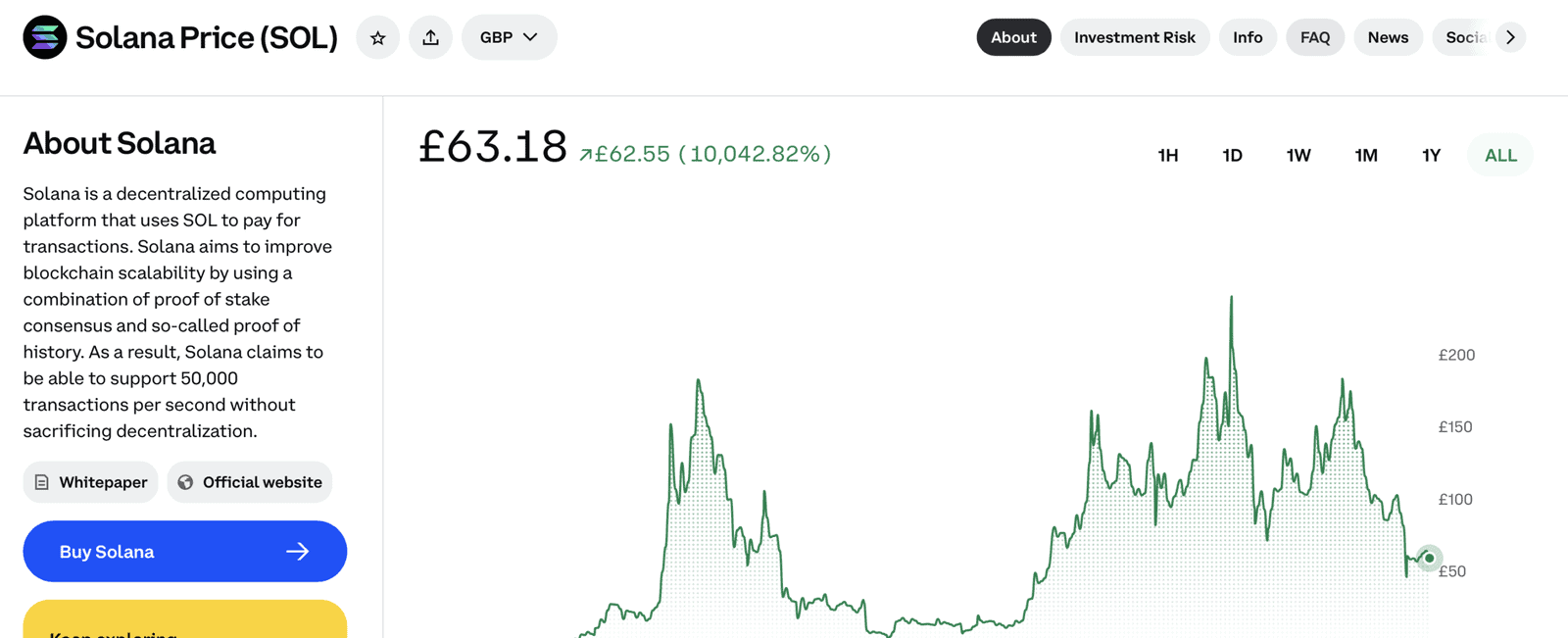
Don’t invest money you can’t afford to lose. SOL dropped 72% from its all-time high. It could drop further. Crypto is volatile by nature – even sophisticated whale wallets get timing wrong.
What Makes Solana Different From Bitcoin and Ethereum
Solana processes transactions in under a second for fractions of a penny. Bitcoin takes 10 minutes and costs $2-5. Ethereum takes 12 seconds and costs $0.50-10 depending on congestion.
That speed makes Solana the preferred chain for DeFi, NFTs, and payments. Visa and Western Union have both partnered with Solana for stablecoin settlements. Over $650 billion in stablecoins flow through Solana monthly – more than Ethereum.
The tradeoff? Solana has had multiple network outages in its history. It’s faster but less battle-tested. Think of it as a sports car versus a tank – one is quicker, the other is harder to break.
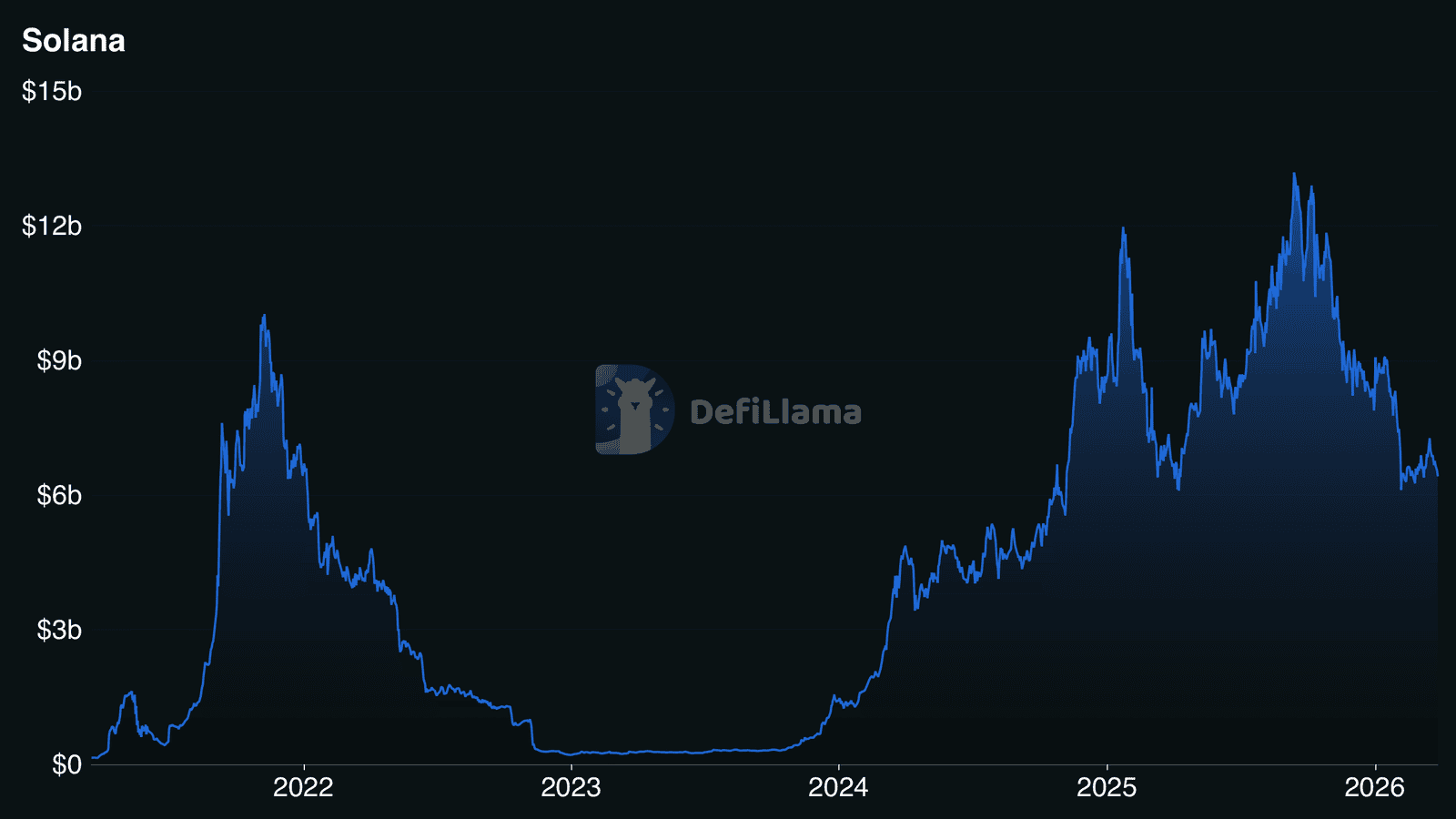
At $83.28 with a $47.67 billion market cap, SOL sits at #7 globally. Whether it climbs back toward its $293 high depends on adoption, competition from Ethereum’s layer-2 networks, and the broader macro environment.
This is not financial advice. DYOR. Data as of March 28, 2026.
Sources
- CoinGecko API – SOL price $83.28, market cap $47.67B, rank #7, ATH $293.31 (accessed March 28, 2026)
- Phantom Wallet – liquid staking, pSOL documentation
- Jito Network – JitoSOL APY ~7.46%
- Marinade Finance – mSOL liquid staking, 400+ validators
- DefiLlama – Solana ecosystem TVL
Leave a Reply