
🕑 6 min read
AVAX trades at $9.56. That’s 93% below its November 2021 peak of $144.96.
Most people have moved on. The institutions haven’t.
VanEck launched a spot AVAX ETF in January 2026. Bitwise followed with a staked version in April – one that pays roughly 5.4% APY while you hold shares. FIFA chose Avalanche for its 2026 World Cup digital ticketing. And BlackRock runs its BUIDL tokenized Treasury fund on the network.
This guide covers how to buy Avalanche, where to store it, and how to earn 5-7% annual yield by staking. No fluff, no “what is blockchain” – just the practical steps.
What you’ll learn
- Which exchange gives you the cheapest AVAX (spoiler: Coinbase charges 12x more than Binance)
- The official Avalanche wallet that most buyers haven’t heard of
- How to stake for up to 7.6% APY, or use liquid staking to keep your AVAX working in DeFi simultaneously
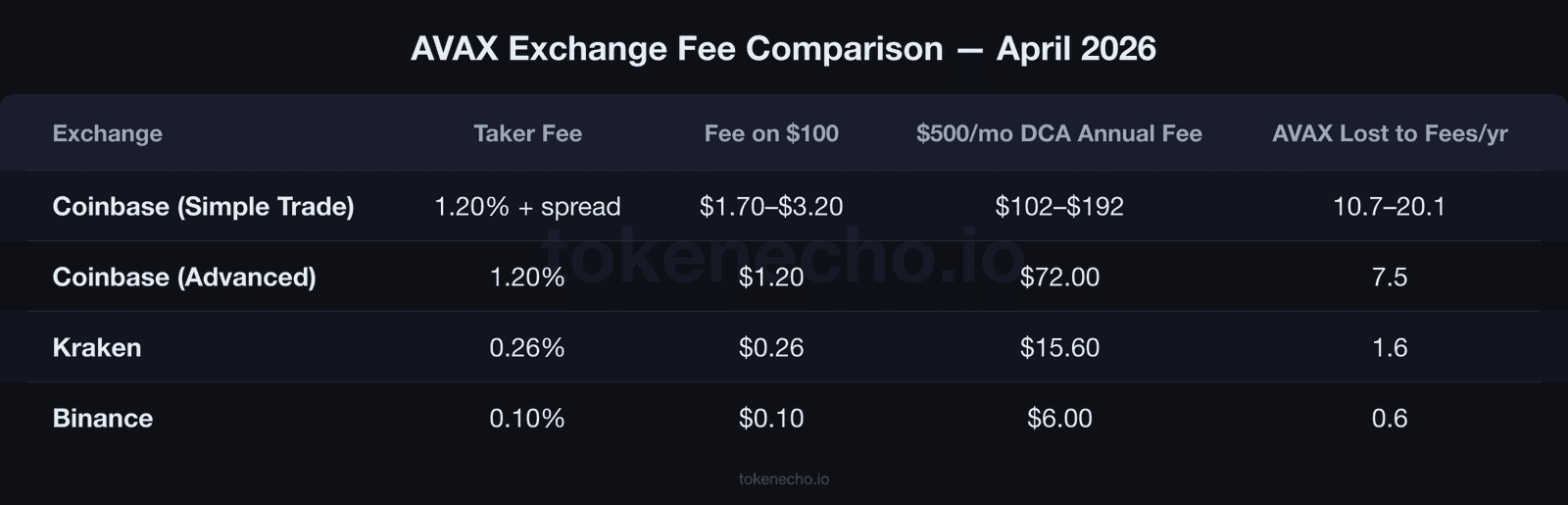
Coinbase charges 12x more than Binance – fees compared
$100 of AVAX costs $1.20 in fees on Coinbase Advanced. That same $100 costs $0.10 on Binance.
Why would you pay 12x more for the same asset?
Convenience, mostly. Coinbase is the default for US buyers – simple interface, FDIC insurance on cash, NASDAQ-listed. But the default screen (Simple Trade) hides a 0.5-2% spread on top of the posted fee. On a $500 AVAX purchase, that’s $2.50-$10 in invisible costs before the 1.20% commission even kicks in.
“Four to five times more expensive than the competitors – that’s outrageous,” Alex Svanevik, CEO of blockchain analytics firm Nansen, said about Coinbase’s fee structure. He wasn’t wrong. Our full Coinbase fee breakdown has the details.
Kraken charges 0.26% – the best deal for US residents. No hidden spread, no surprises. Fourteen years without a security breach, which in crypto is roughly equivalent to a bank surviving since the Great Depression.
Binance at 0.10% is cheapest overall but blocked in the US. If you’re outside America, it’s the obvious choice.
Quick math for DCA buyers: $500/month in AVAX through Coinbase Advanced costs $72/year in fees. Through Kraken, $15.60. That $56 gap buys you 5.9 AVAX at current prices – almost a full month of staking rewards, eaten by fees before you earn a cent.
The buying process itself takes about 10 minutes on any exchange. Sign up, verify your identity (selfie + ID, usually approved within hours), deposit USD via bank transfer, search for AVAX, buy. If you’ve bought any crypto before, nothing here will surprise you. Our cryptocurrency for beginners guide covers the basics if this is your first time.
Core Wallet exists and most people don’t know about it
MetaMask gets all the attention. For AVAX specifically, it’s the wrong choice.
Core Wallet, built by Ava Labs (the team behind Avalanche), supports all three Avalanche chains: C-Chain for DeFi and smart contracts, and the X-Chain and P-Chain for transfers and staking. MetaMask only handles C-Chain. If you want to stake natively or interact with subnets, MetaMask literally can’t do it.
Core runs as a browser extension and mobile app. It connects to Ledger for cold storage. The team claims 10x faster transaction processing on Avalanche than MetaMask, though real-world performance depends on network conditions.
For DeFi users who operate across chains, Rabby deserves a look. Its pre-transaction simulation shows you exactly what a smart contract will do before you sign. That feature alone has saved users from phishing attacks.
If you’re holding more than $1,000 in AVAX long-term, add a Ledger Nano X ($149). Think of it like renters insurance – you hope you never need it, but the one time you do, it pays for itself a thousand times over. Hardware wallets aren’t optional above that threshold.
$500 in AVAX earns $35 a year – staking options compared
The price recovery thesis is one reason to buy AVAX. The yield is the other.
Native staking pays 6.9-7.6% APY. The minimum for delegating to a validator is 25 AVAX (~$239), with a 14-day lock-up period. No separate unbonding queue – when your term ends, tokens unlock immediately. Compare that to Polkadot’s 28-day unbonding or Ethereum’s variable exit queue, and Avalanche looks almost flexible.
But native staking locks your tokens. Can’t touch them for at least two weeks.
Benqi solves this through liquid staking. Deposit AVAX, receive sAVAX (a liquid token representing your staked position), and use that sAVAX as collateral on Aave or Trader Joe. You earn ~5% staking yield AND whatever DeFi returns you generate on top.
Choosing between native staking and liquid staking is like choosing between a bank CD and a savings account. The CD pays more but locks your money. The savings account pays less but you can spend it tomorrow.
Exchange staking is the low-effort option. Coinbase pays ~4.5% after taking a 25% cut off the top. Binance offers 5.5-6.5% on locked terms (30-120 days). Kraken doesn’t currently offer AVAX staking.
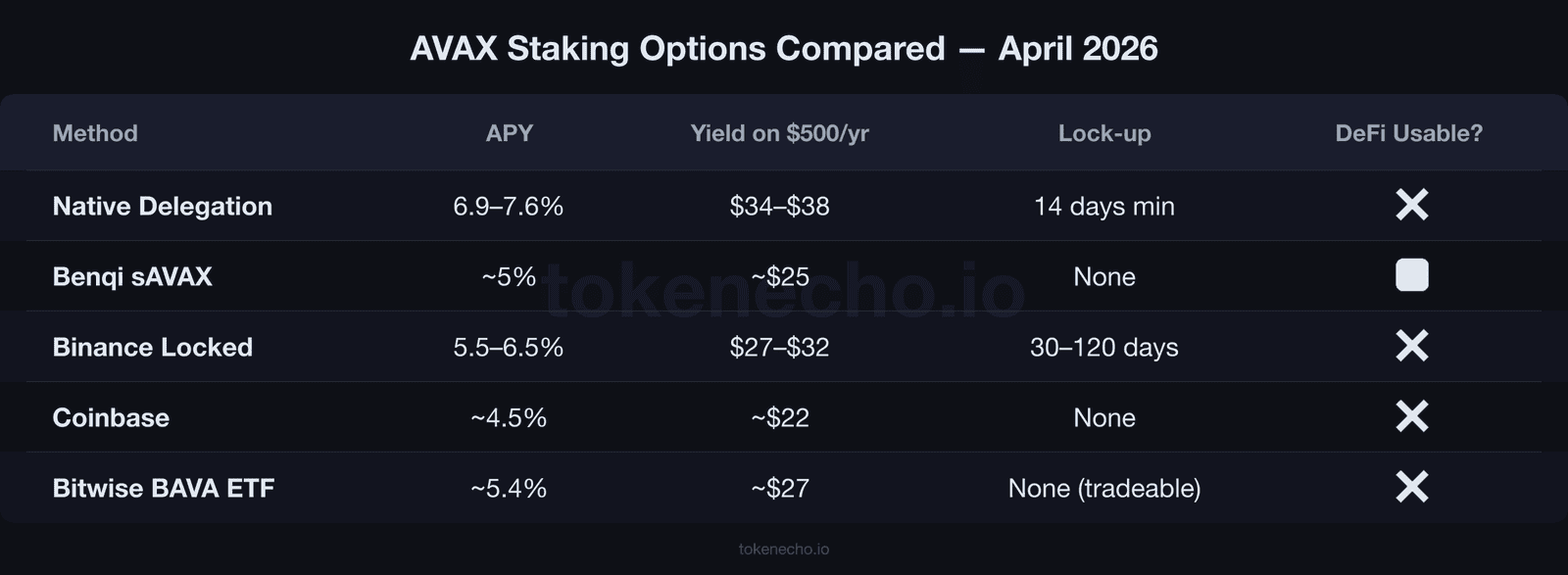
The $13/year gap between native staking ($35) and Coinbase ($22) on a $500 position doesn’t sound dramatic. Compound it over 3-5 years with a larger position and the math gets real.
What you’re actually buying when you buy AVAX
Most guides open with this section. We put it last because most people have already decided to buy before they read a guide – they just need the how.
Avalanche is a Layer 1 blockchain built on a unique three-chain architecture. The C-Chain handles smart contracts and DeFi (where your tokens live after you buy them). The X-Chain processes fast transfers. The P-Chain coordinates validators and staking. This isn’t marketing – it’s why Avalanche can handle 4,500+ transactions per second while Ethereum mainnet manages roughly 22.
The December 2024 Avalanche9000 upgrade changed the economics. It cut the cost of launching a subnet (now called an L1) by 99.9% and removed the 2,000 AVAX validator requirement for new L1s.
Institutions noticed. BlackRock, Apollo, and KKR now run tokenized funds on Avalanche. Total DeFi TVL sits at $1.74B, with Aave ($563M) and Benqi ($521M) holding 62% of the pie.
AVAX ranks #27 by market cap at $4.13B. Circulating supply: 431.8M out of 720M max. About 60% is already in circulation.
For more context on where this fits in the broader crypto landscape, our cryptocurrency for beginners guide covers the fundamentals.
The risks nobody puts in the guide
AVAX is 93% below its ATH for a reason. Don’t skip this section.
The L1 competition is brutal. Solana processes more transactions daily. Ethereum has 10x the DeFi TVL. Base is eating into Avalanche’s EVM market share without needing its own token.
40% of max supply (288M AVAX) hasn’t been released yet. That future dilution creates sell pressure for years. Compare that to Bitcoin (95.3% circulating) or Solana (77%).
And the staking yield? It comes partly from inflation – new AVAX minted and distributed to stakers. If demand doesn’t keep up with emissions, the yield just offsets price decline.
Don’t put rent money here. DCA ($25-$100/month) into a position you can forget about for 2-3 years. Honestly, that’s the advice for any altcoin at -93% – not just AVAX.
Looking for more ways to get into crypto? See our step-by-step guides for Bitcoin, Ethereum, and Solana.
This is not financial advice. AVAX is down 93% from its all-time high – do your own research before buying. Data as of April 22, 2026.
Sources: CoinGecko AVAX, Avalanche Docs – Staking, Bitwise BAVA ETF, DefiLlama – Avalanche
Leave a Reply