

🕑 6 min read
Grayscale filed an S-1 registration statement with the SEC on March 20 for a spot Hyperliquid ETF, proposing to list HYPE shares on Nasdaq under the ticker GHYP. The filing names Coinbase Custody as custodian and CoinDesk Benchmark as pricing provider, with staking explicitly prohibited at launch. At $40.86 per token, Hyperliquid carries a fully diluted valuation of $39.3 billion, making it the largest decentralized exchange ever targeted for an ETF wrapper, according to CoinGecko data. The registration does not address several structural risks that have drawn repeated criticism from security researchers, validators, and competing exchange operators since late 2024.
Key Takeaways
- Five Hyper Foundation validators control 81.4% of staked HYPE, exceeding the 67% threshold required to unilaterally control the network under Byzantine Fault Tolerance, while Grayscale’s S-1 filing omits this concentration.
- Hyperliquid validators settled JELLY perpetual contracts at $0.0095 in March 2025 while oracle prices showed approximately $0.50, prompting Bitget CEO Gracy Chen to warn the protocol risked becoming “FTX 2.0.”
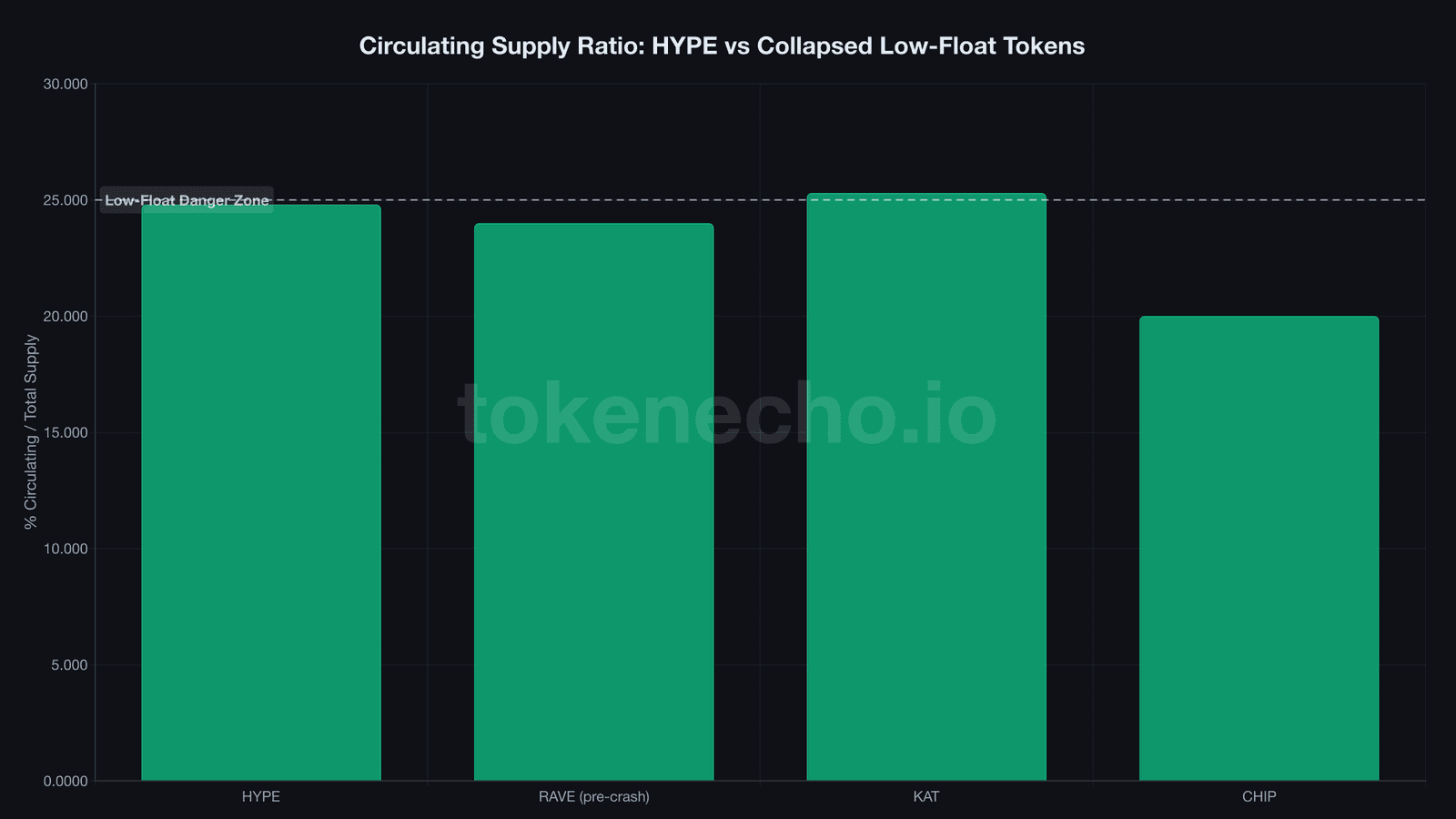
- 57.5% of HYPE supply remains locked, with a $407 million Core Contributors unlock on May 6. The circulating supply ratio of 24.8% is nearly identical to RaveDAO’s before its 96% collapse on April 19.
Grayscale filed for a spot HYPE ETF on March 20
Grayscale’s filing followed the SEC’s September 2025 decision to approve general listing standards for crypto exchange-traded products, which eliminated the need for individual Section 19(b) submissions. The GHYP fund would be a Delaware Statutory Trust holding actual HYPE tokens, giving retail investors spot exposure through a traditional brokerage account.
Grayscale also increased its allocation to Hyperliquid’s native token within its DeFi Fund in early April, raising the HYPE weighting from 31% to 43%, according to fund rebalancing data published on April 7. Three days later, the token’s price dropped 28% after a key developer departed the ecosystem.
Jeff Yan, CEO of Hyperliquid, has built the protocol’s brand on rejecting venture capital. “If we are going to build something that is really going to be a credibly neutral platform on which everyone else can build, then a really important principle is to sort of not have insiders,” Yan said in a January 2026 interview with Fortune. The team has 11 employees and generated $844 million in revenue during 2025, outearning Ethereum’s mainnet over the same period, according to data from DefiLlama. The absence of venture investors, however, does not mean the absence of concentrated ownership.
Five foundation nodes control 81% of staked HYPE
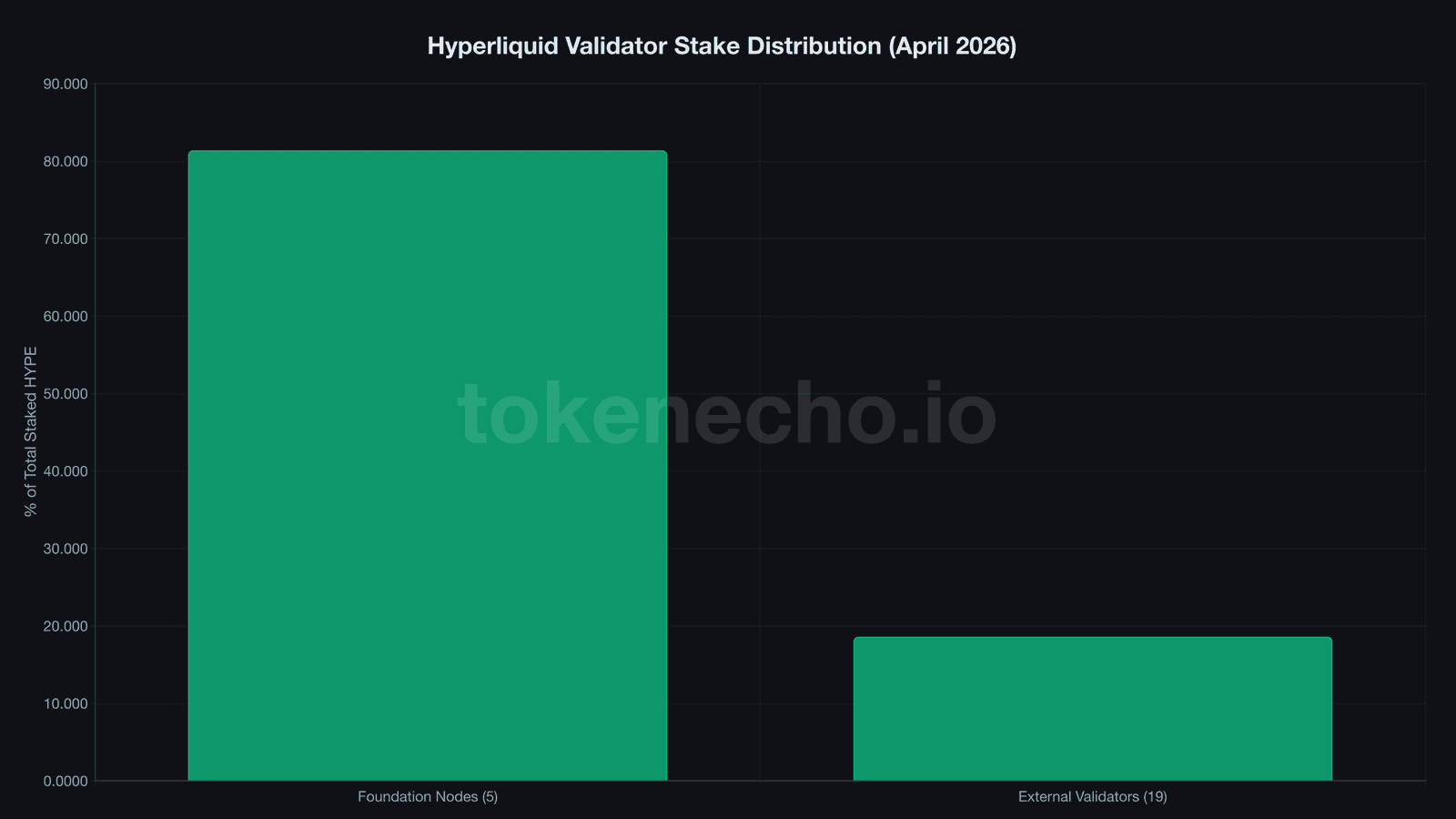
Of the 404,495,250 HYPE tokens staked across Hyperliquid’s 24 validators, approximately 329.6 million sit on five Hyper Foundation nodes, according to staking data from the protocol’s validator dashboard. That 81.4% share exceeds the 67% supermajority threshold under Byzantine Fault Tolerance, a consensus mechanism that gives any entity above two-thirds of the stake full control over network governance.
“If a single entity controls one-third of the stake, they can halt the chain,” said Kam Benbrik, an employee at node operator Chorus One, in an open letter posted on X in January 2025. “If they control two-thirds of the stake, they control the network entirely.” Benbrik’s letter also raised concerns about closed-source node code and reliance on a single API endpoint. Hyperliquid responded by outlining plans for a Foundation Delegation Program to distribute stake more broadly, though the foundation’s share has remained above 80% through April 2026.
Taylor Monahan, a security researcher at MetaMask, added a separate dimension to the criticism in December 2024 after wallet addresses linked to North Korea’s Lazarus Group deposited and withdrew ETH from the platform. “That is a lot of Single Points of Failure,” Monahan said on X, adding that she had reason to believe the validator nodes operated on the same devices that founders used for social media and video calls. Hyperliquid experienced its largest single-day net outflow on record that day, with $211 million in USDC leaving the protocol.
Validators settled JELLY at $0.0095 in two minutes
The clearest test of Hyperliquid’s governance came in March 2025, when a trader opened a $6 million short position on JELLYJELLY perpetual futures and then manipulated the token’s spot price upward to force a self-liquidation. The Hyperliquidity Provider vault, a shared pool that absorbs liquidated positions, faced approximately $12 million in unrealized losses.
Hyperliquid’s validators voted to delist the JELLY contract and settle all positions at $0.0095 per token. Oracle prices at the time showed JELLY trading at approximately $0.50, a 98% discount to the market rate. Consensus was reached in roughly two minutes.
“Immature, unethical, and unprofessional,” said Gracy Chen, CEO of Bitget, in a post following the incident. Chen warned that Hyperliquid “operates more like an offshore CEX with no KYC/AML” and risked becoming “FTX 2.0.” The Foundation reimbursed most users except flagged addresses, but the precedent remains: an exchange marketed as decentralized froze a market mid-trade, overrode oracle pricing, and settled contracts at a level that protected its own vault.
Hyperliquid rebuilt HLP vault deposits to $380 million by early 2026. Its 73% share of the decentralized perpetuals market and $2.95 trillion in 2025 trading volume are not in dispute.
57% of HYPE tokens remain locked through 2029
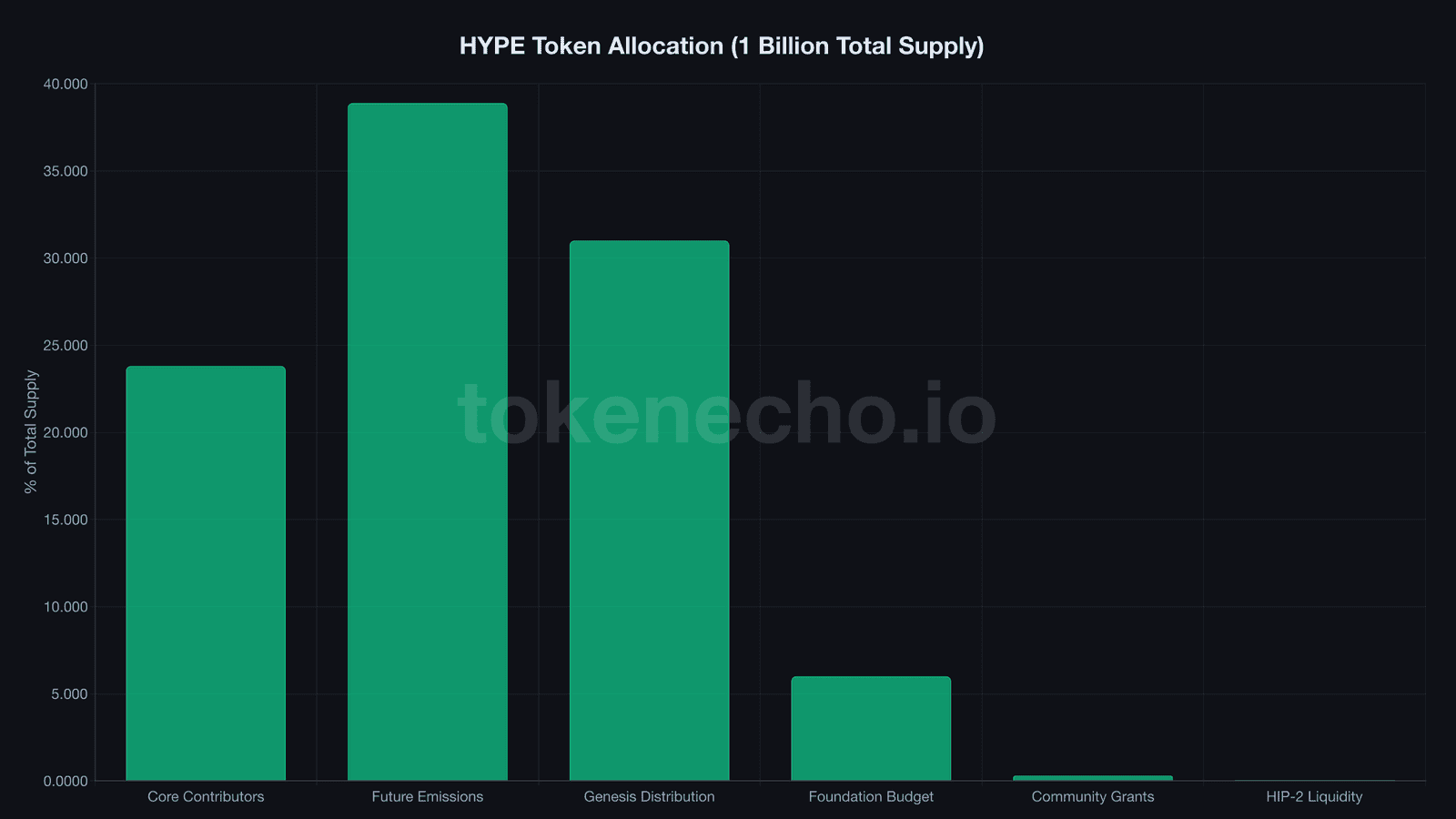
Of the 1 billion maximum HYPE supply, 574,755,520 tokens remain locked as of April 24, according to Tokenomist data. Core Contributors hold 23.8% of total supply, valued at $9.4 billion at the current fully diluted valuation.
The Hyper Foundation Budget accounts for another 6%. Future Emissions, controlled by the Foundation, represent 38.89%, bringing the total Foundation-aligned share to roughly 69% of all tokens.
The next major unlock is scheduled for May 6: 9,916,667 HYPE tokens, worth approximately $407 million, will be released to Core Contributors. The vesting schedule uses cliff-based distribution, releasing tokens in large blocks rather than gradual streams, and extends through November 2029.
At 24.8%, Hyperliquid’s circulating supply ratio is nearly identical to that of RaveDAO before its 96% collapse. RAVE traded with 24% of supply in circulation and a 4.2x FDV-to-market-cap gap when TokenEcho flagged the unlock risk on April 11. Eight days later, ZachXBT exposed that three Gnosis Safe wallets controlled 90% of RAVE’s supply, and the token crashed from $27.88 to $1.13 in 18 hours.
Zach Rynes, community ambassador at Chainlink Labs, has described the recurring low-float structure as “predatory tokenomics” in posts on X, pointing to RAVE and CHIP as examples of how concentrated ownership creates asymmetric risk for retail buyers. The same pattern appeared in Katana’s debunked “no VC” claim, where Polygon Labs and GSR operated behind a community-first narrative while 75% of supply remained locked.
Hyperliquid earned $844 million in 2025
The comparison to RAVE, a project with $3 million in projected 2026 revenue, has an obvious limit. Hyperliquid is the highest-revenue decentralized application in crypto, and its Assistance Fund directs 97% of trading fees toward open-market HYPE buybacks. Through 2025, the Fund spent $645 million repurchasing tokens, and the protocol burned 37.51 million HYPE worth $912 million following an 85% governance vote.
Hyperliquid processed $2.95 trillion in volume during 2025, according to DefiLlama. It added over 609,000 users during the year.
If the Foundation reduces its validator stake below the 67% BFT control threshold while buyback-driven demand continues to offset unlock supply, the structural risks in this filing gap would narrow. The May 6 unlock will provide the first test of whether Core Contributors sell into a market already priced at $39.3 billion on a fully diluted basis, or whether the $9.2 million in weekly HYPE burns absorb the new supply before it reaches exchanges.
What to watch
- May 6, 2026: 9.9 million HYPE ($407 million) unlocks for Core Contributors, the first major post-genesis insider supply event.
- Foundation stake ratio: Whether delegation reduces foundation control below the 67% BFT threshold that would prevent unilateral network decisions.
- SEC review of GHYP S-1: Any comment letters requesting additional risk disclosures around validator concentration or token supply overhang.
For more on low-float token risks, see TokenEcho’s coverage of CHIP’s 80% locked supply and the $6.6 billion RaveDAO collapse.
This is not financial advice. Data as of April 24, 2026.
Sources: Grayscale GHYP S-1 (SEC), Hyperliquid Validator Dashboard, Tokenomist HYPE Vesting, CoinGecko HYPE Data, DefiLlama Hyperliquid
Leave a Reply