
🕑 5 min read
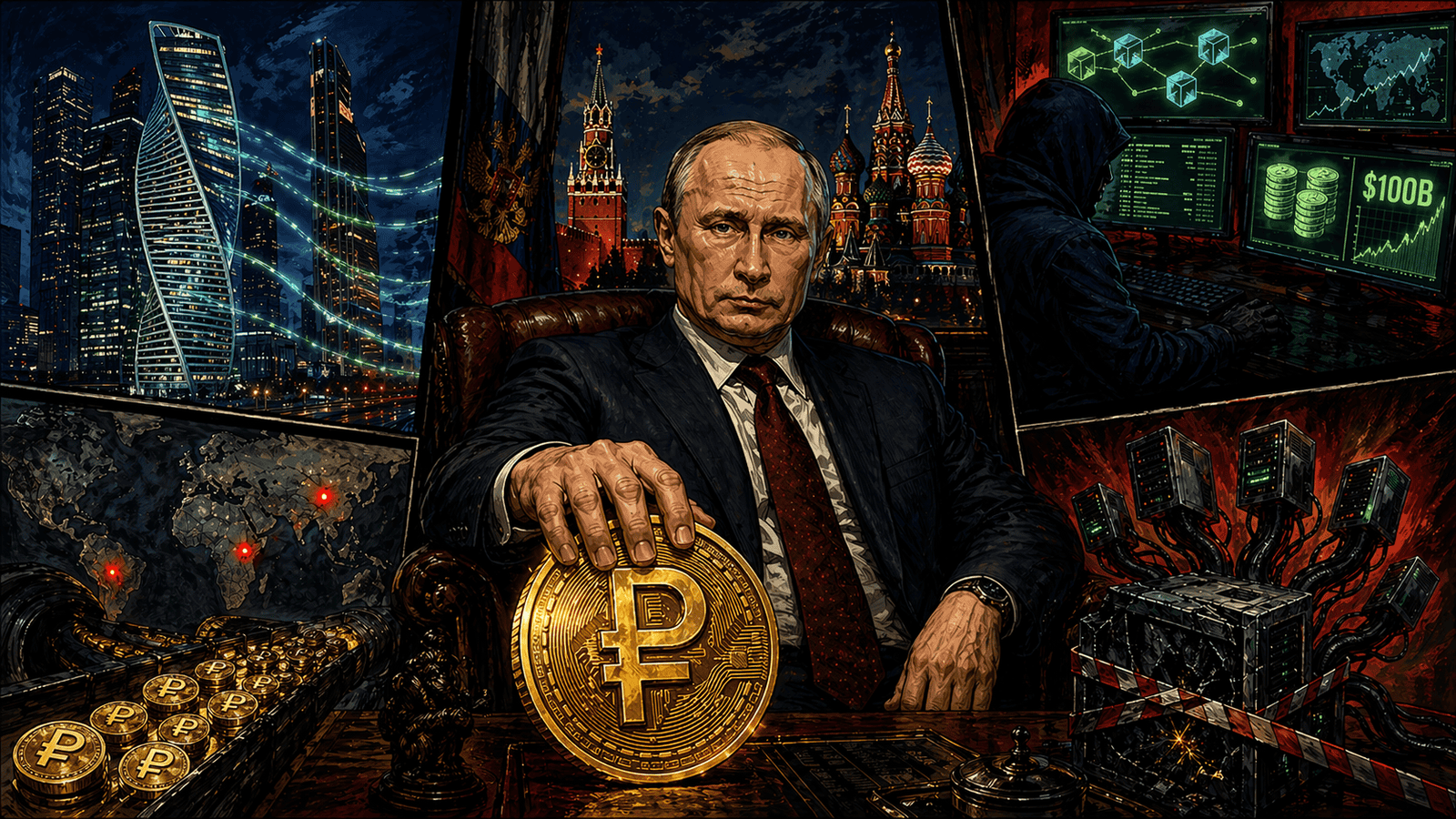
A ruble-backed stablecoin co-owned by a sanctioned Russian state defense bank and a convicted Moldovan oligarch processed more than $100 billion in transactions in under 12 months, according to a report by blockchain analytics firm Elliptic. On April 23, the European Council adopted its 20th sanctions package against Russia, imposing a complete ban on cryptocurrency transactions with Russian and Belarusian providers, a measure that explicitly targets that stablecoin.
Key takeaways
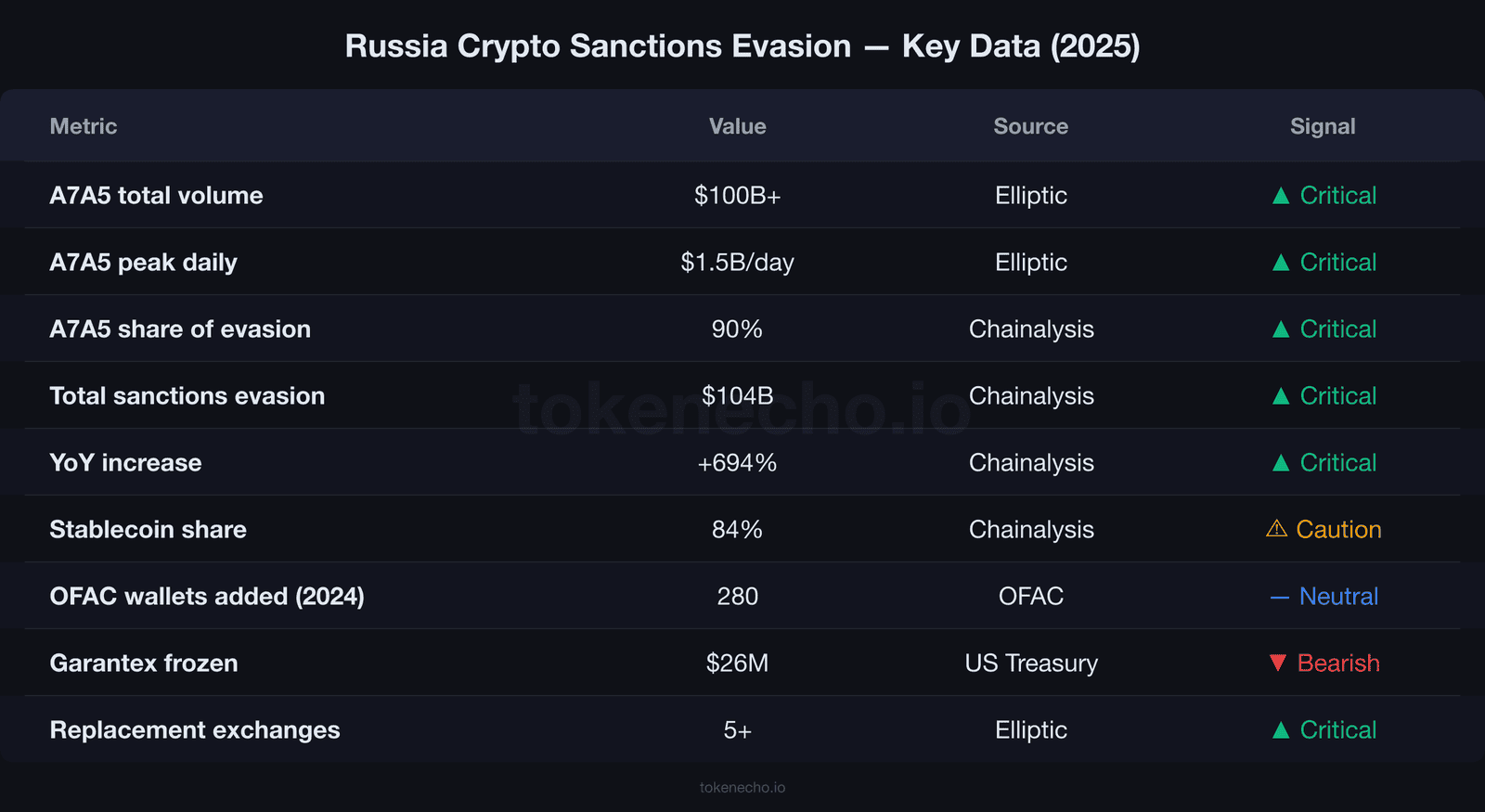
- A7A5, a ruble-pegged stablecoin on the Tron blockchain, processed over $100 billion since its January 2025 launch, peaking at $1.5 billion per day. Ownership is split between convicted oligarch Ilan Shor (51%) and sanctioned defense bank Promsvyazbank (49%).
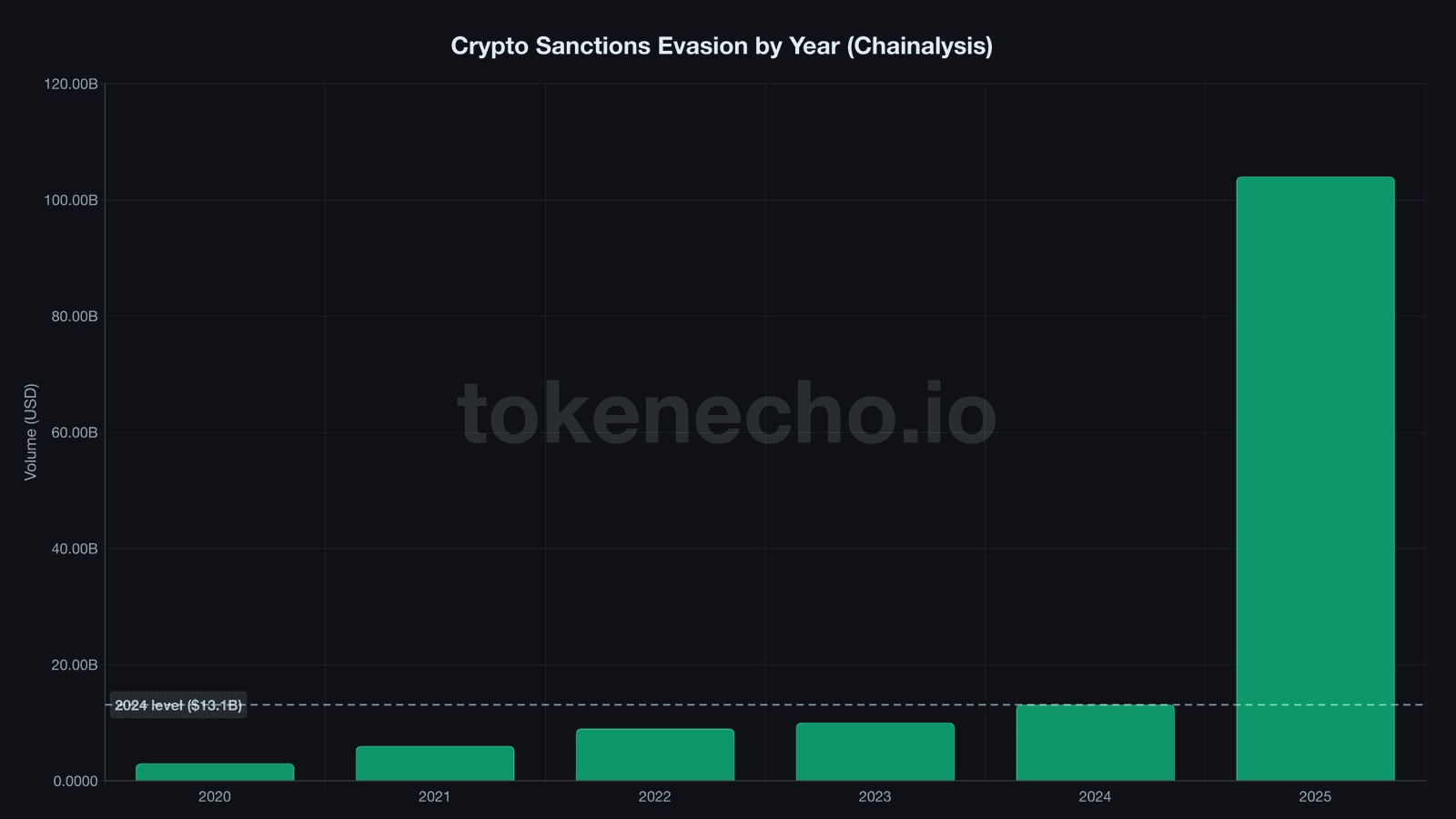
- Chainalysis data shows crypto-based sanctions evasion surged 694% year-over-year to $104 billion in 2025. A7A5 alone accounted for $93.3 billion, or roughly 90% of the total.
- The EU’s new sanctions ban all crypto transactions with Russian providers effective May 24, 2026, targeting A7A5, RUBx, and the digital ruble ahead of Russia’s planned CBDC rollout in September.
State bank and convicted oligarch built $100 billion stablecoin
A7A5 launched on January 28, 2025, as a ruble-pegged stablecoin operating primarily on the Tron blockchain. Ilan Shor, a Moldovan oligarch convicted of orchestrating a $1 billion bank fraud who later received Russian citizenship, controls 51% of the issuing entity A7 LLC.
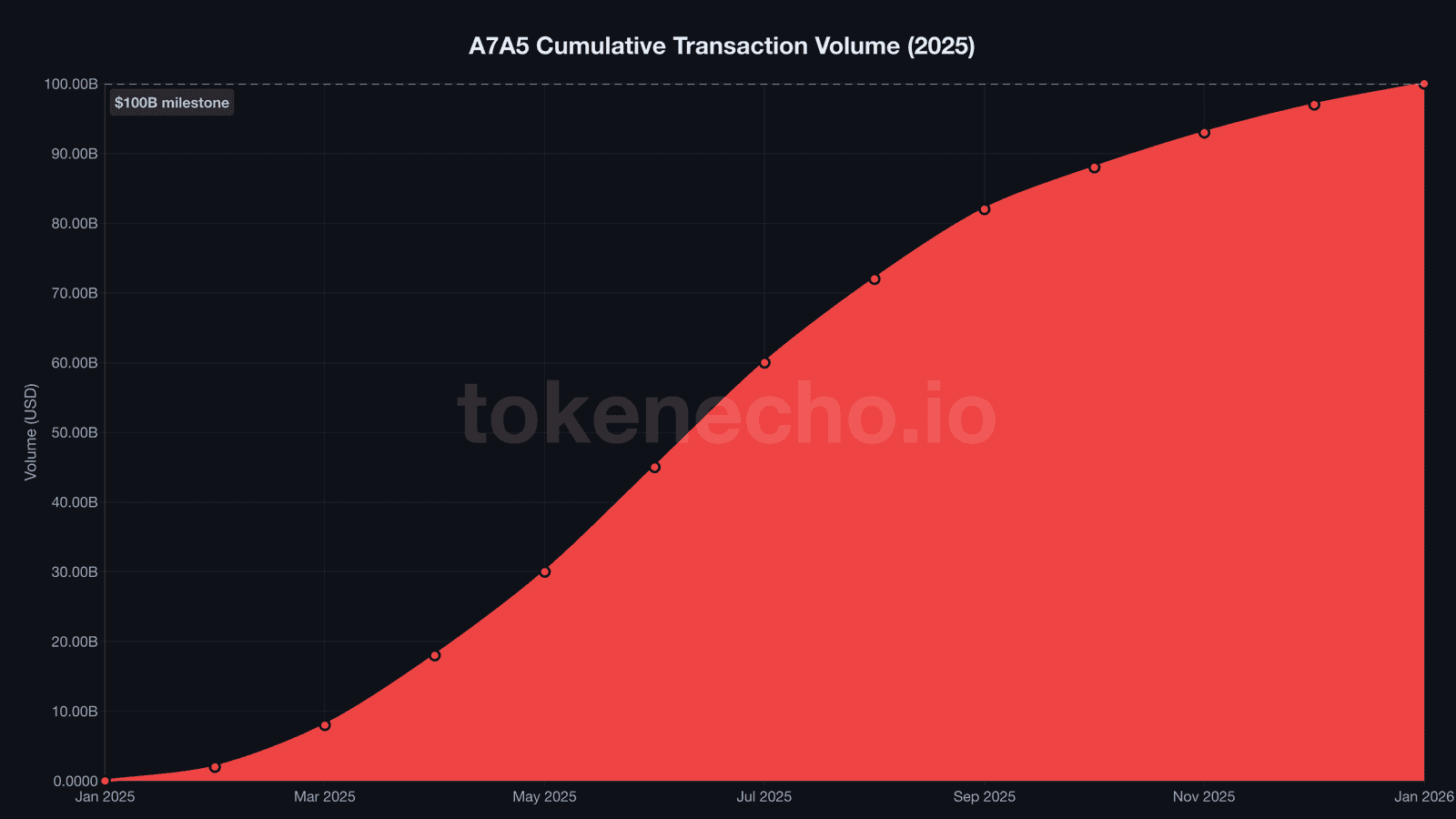
Promsvyazbank, sanctioned by Washington and Brussels for financing Russia’s defense sector, holds the remaining 49%. Within seven months of launch, A7A5 was processing $1.5 billion per day in transfers, Elliptic reported.
By January 2026, cumulative transaction volume had crossed $100 billion, with approximately 42.5 billion tokens in circulation. Russian President Vladimir Putin attended a virtual ribbon-cutting for A7’s Vladivostok branch in September 2025. OFAC and the United Kingdom’s Office of Financial Sanctions Implementation had sanctioned A7A5-related entities the previous month.
A September 2025 leak of internal A7 documents allowed Elliptic to identify cryptocurrency addresses tied to sanctions evasion and election interference operations in Moldova. TRM Labs separately linked A7-associated addresses to procurement networks serving Iran’s Islamic Revolutionary Guard Corps and Hamas, according to research published later that year.
Chainalysis estimated that A7A5 accounted for $93.3 billion in sanctions evasion during 2025. Before A7A5, annual crypto-based sanctions circumvention measured in the single-digit billions.
Five replacement exchanges emerged from the same Moscow building
A7A5 was not the only evasion channel. On March 6, 2025, the US Secret Service and German and Finnish law enforcement seized infrastructure belonging to Garantex, a Moscow-based crypto exchange that OFAC had designated in April 2022 for processing over $100 million in illicit transactions. Authorities froze approximately $26 million in the operation.
Both sides had anticipated the enforcement action. Garantex’s operators had incorporated its successor, Grinex, in Kyrgyzstan in December 2024, three months before the seizure. Customer deposits transferred to the new platform within days.
OFAC sanctioned Grinex, three of its executives, and six associated companies in August 2025. Elliptic identified five additional replacement exchanges filling the void, with ABCeX processing more than $11 billion from Moscow’s Federation Tower, the same building where Garantex had operated.
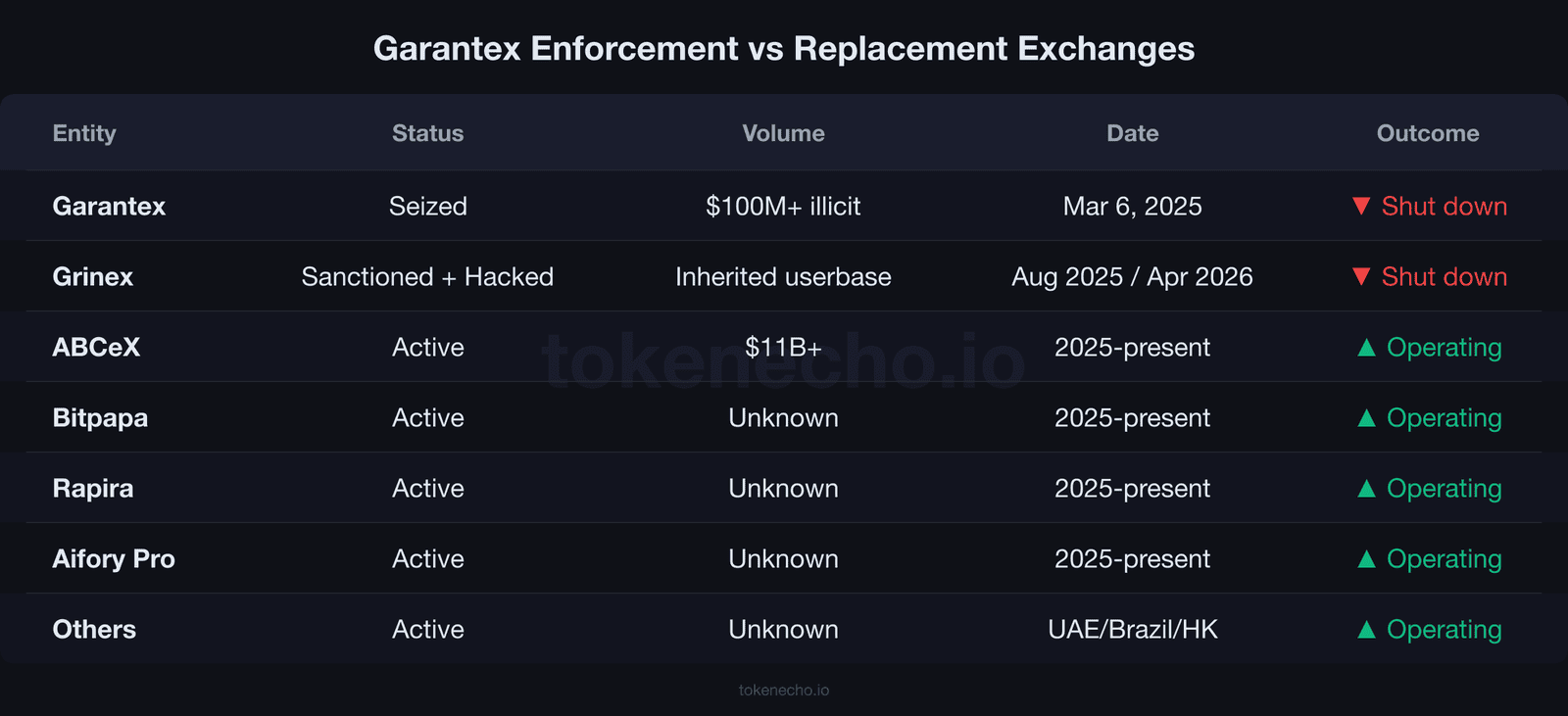
Grinex itself suspended operations on April 15, 2026, after a hack drained approximately $14 million, according to TRM Labs. The shutdown did not reduce the number of active successor services. Elliptic documented a network of replacement exchanges spanning the United Arab Emirates, Brazil, Kyrgyzstan, Spain, Thailand, Georgia, and Hong Kong.
Sanctions evasion through crypto surged 694% in one year
Chainalysis reported in its 2026 Crypto Crime Report that sanctioned entities received $104 billion in cryptocurrency in 2025, a 694% increase from the prior year. Stablecoins accounted for 84% of all illicit transaction volume, with the Tron blockchain processing the majority of these flows.
The European Council’s response came on April 23. Its 20th sanctions package imposed a complete sectoral ban on all cryptocurrency transactions with Russian and Belarusian providers, effective May 24, 2026, and explicitly named A7A5, RUBx, and the digital ruble, Russia’s planned central bank digital currency scheduled for mass rollout in September 2026.
Russia’s domestic crypto infrastructure has expanded in parallel. Putin signed Law 221-FZ in August 2024, legalizing cryptocurrency mining. The country’s hash rate has tripled since 2022, with an estimated 136,600 mining farms now operating across the country.
Ivan Chebeskov, Russia’s deputy finance minister, said only 30 percent of active miners had registered with authorities as of mid-2025, with full regulatory compliance required by July 1, 2026. Russia’s digital financial assets market reached $13 billion that year.
“Now is the time for the industry to demonstrate that blockchains’ inherent transparency make cryptocurrency a powerful deterrent to sanctions evasion,” said Michael Gronager, CEO of Chainalysis, in the company’s 2026 report.
The transparency argument provides a counterpoint. North Korea’s Lazarus Group stole approximately $2 billion in cryptocurrency during 2025, according to Chainalysis, including a $285 million attack on Drift Protocol attributed to the group in April 2026, yet investigators traced and partially recovered funds in several cases because every blockchain transaction is permanently recorded. Russia’s A7A5 processed 50 times that volume, but the same transparency applies to every transfer on the Tron ledger.
The enforcement challenge is one of speed. When OFAC designated Garantex in 2022, the exchange operated for three more years before physical seizure. When authorities finally shut it down, five successors launched within months from the same building.
One stablecoin moved $93 billion, 50 times North Korea’s total
North Korean state hackers have stolen a cumulative $3 billion or more in cryptocurrency since 2017, primarily through exchange hacks and DeFi exploits. Russia, through A7A5 alone, moved $93.3 billion in under 12 months.
The difference between the two models is one of design. North Korea steals and launders existing cryptocurrency. Russia created a state-backed stablecoin with institutional co-ownership, presidential endorsement, and documented connections to sanctioned procurement networks spanning multiple conflict zones.
What to watch
- The EU crypto ban takes effect May 24, 2026. Global exchanges will need to screen for A7A5, RUBx, and digital ruble transactions or face sanctions exposure.
- Russia’s digital ruble mass rollout is scheduled for September 2026. The EU ban preemptively targets it, creating a potential enforcement collision before the CBDC launches at scale.
- OFAC added 280 Russian crypto wallets to its Specially Designated Nationals list in 2024 alone. The pace of new designations in 2026 will signal whether enforcement keeps up with the replacement exchange cycle.
For a broader view of how geopolitical conflict is reshaping cryptocurrency markets, see TokenEcho’s analysis of five forces shaping crypto through 2031. For background on stablecoin safety and the USDT vs USDC comparison, see the full guide.
This is not financial advice. Data as of April 24, 2026.
Sources: Elliptic, Chainalysis 2026 Crypto Crime Report, TRM Labs, US Treasury/OFAC, European Council, Arkham Intelligence.
Leave a Reply