

🕑 5 min read
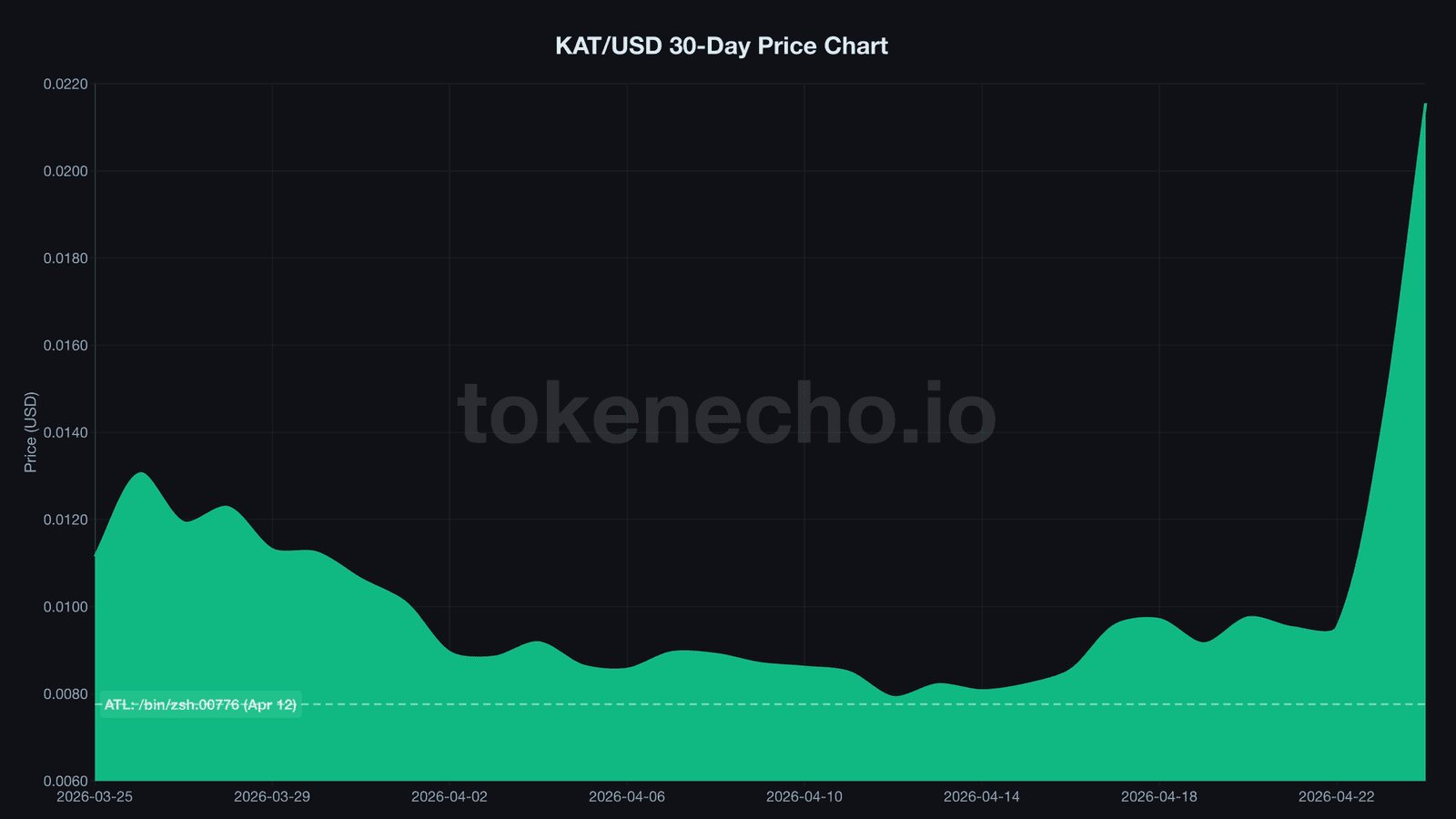
Katana’s KAT token hit an all-time high of $0.0193 on Thursday, rallying 155% from its April 12 low of $0.00776 in 12 days. Daily trading volume reached $590 million according to CoinGecko data, a figure 13.8 times the token’s $42.7 million market capitalization and larger than the 24-hour turnover of several top-50 cryptocurrencies. The Katana Foundation launched KAT on March 18 with “no venture capital investment, listing directly on Binance,” according to a PR Newswire release issued the same day, but Polygon Labs and GSR, two of the industry’s most prominent institutional players, built the project before the token reached public markets.
Key Takeaways
- KAT rallied 155% from its April 12 all-time low to a new ATH of $0.0193, with $590 million in daily volume on a $42.7 million market cap.
- Katana marketed itself as having “no VC investment,” but Polygon Labs incubated the chain and GSR, one of crypto’s largest market makers, co-developed it and provides ongoing liquidity.
- 74.7% of KAT supply remains locked until 2030, with the first core contributor unlock on May 18. The FDV-to-market-cap gap of 4.3x mirrors RaveDAO before its 96% collapse.
Polygon Labs and GSR built Katana before KAT existed
Katana Foundation described the March 18 token generation event as a departure from the low-float launches that have drawn criticism across the crypto industry since 2024. “No hidden wallets with 20% of supply unlocking at month 6,” the foundation said in its launch announcement, positioning KAT against the venture-backed distributions that dominated the previous cycle.
Polygon Labs provided the CDK development kit and AggLayer integration for Katana’s layer-2 architecture. GSR, a market maker involved in dozens of crypto project launches, co-developed the network and provides ongoing liquidity, according to The Block’s reporting from June 2025 when the private mainnet went live. Governance operates through multisig wallets shared among Polygon Labs, GSR, and the Katana Foundation.
The “no VC” label is technically accurate since neither Polygon Labs nor GSR made a traditional equity investment in the Katana Foundation. Both entities designed the chain’s architecture from inception and retain governance control through the multisig structure.
“The low-float, high-FDV model allows early participants to capture most of the early-stage gains, leaving little upside for public investors,” said Haseeb Qureshi, managing partner at Dragonfly Capital, in a May 2024 analysis of token distribution dynamics. Katana’s structure substituted equity stakes for infrastructure development and multisig governance participation.
Zero public commits and a Stage 0 rating from L2BEAT
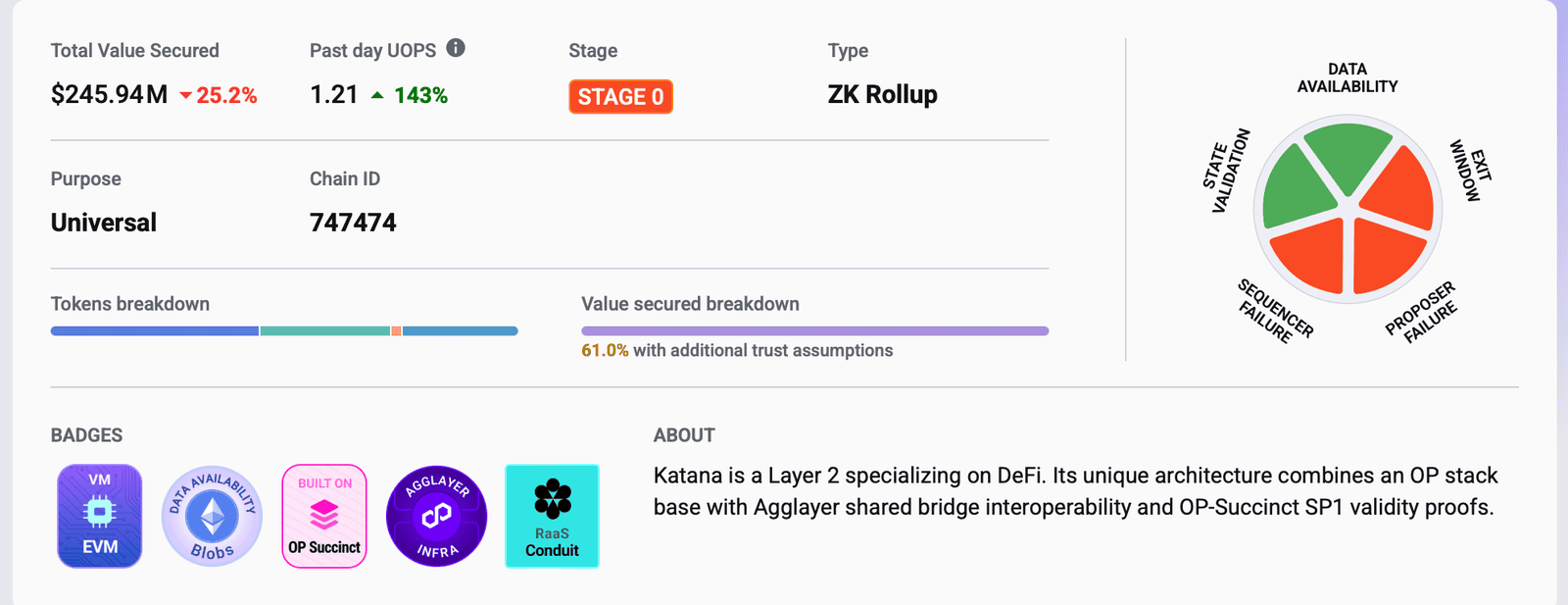
L2BEAT, the independent layer-2 analytics platform, classifies Katana as Stage 0, the lowest tier in its decentralization framework. The sequencer can censor transactions with no fallback mechanism, only whitelisted proposers can publish state roots, and the Security Council can remove upgrade delays entirely, according to the assessment.
Katana’s public GitHub repository shows zero commits, zero stars, zero forks, and zero pull requests over the four-week window ending April 24, according to CoinGecko developer data. For a layer-2 reporting $245.9 million in total value locked, the absence of visible public development activity is unusual among comparable networks.
That TVL figure has dropped 51% from the $500 million Katana reported before the March token launch, according to L2BEAT. On-chain activity averages 1.22 user operations per second, though the figure rose 43% week over week.
“Restricting the movement of tokens distorts the market signal and misleads both actual and potential network participants,” said Christopher Goes, co-creator of Anoma and Namada, in a March 2026 analysis of locked-supply token structures published on CoinDesk.
Volume distribution skews heavily toward South Korea. Upbit reported $11 billion in KAT volume on Thursday according to CoinGecko ticker data, on a token with a $42.7 million market cap. That ratio is characteristic of zero-fee exchange environments where automated trading generates inflated turnover. Bithumb added $2.33 billion, bringing Korean exchanges past 60% of all KAT trading.
Bitcoin’s SOPR, a metric tracking whether sellers are in profit or loss, sat at 0.9997 on Wednesday according to CryptoQuant data, still below the 1.0 break-even line that has defined most of 2026. BTC exchange reserves fell to 2,669,397 on Thursday at a new cycle low, the data shows.
74.7% of KAT supply remains locked until 2030
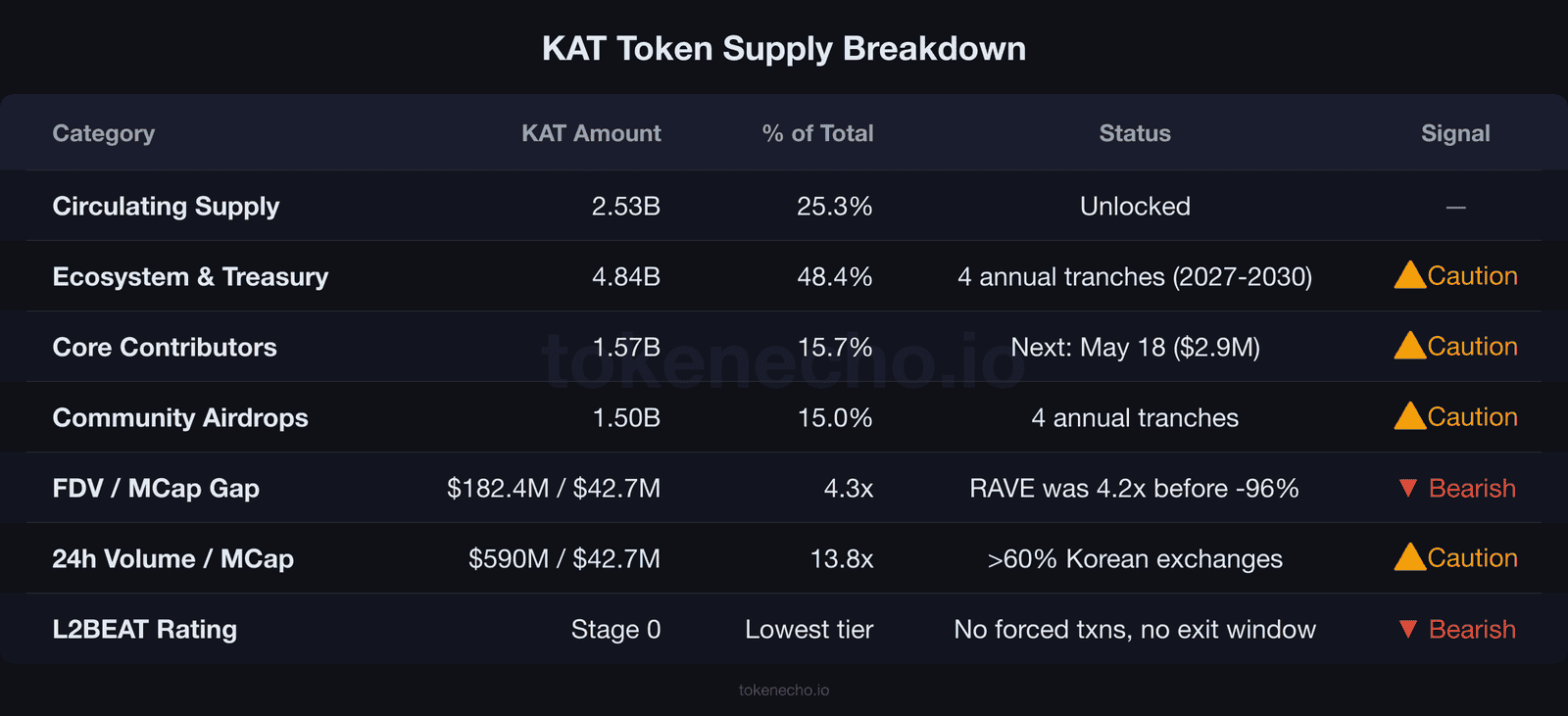
Only 2.53 billion of 10 billion total KAT supply circulates, leaving 74.7% locked. The fully diluted valuation of $182.4 million sits 4.3 times above the $42.7 million circulating market cap, according to CoinGecko.
The next scheduled unlock arrives on May 18, when 176.8 million KAT, worth $2.9 million at current prices, vests to core contributors, according to Tokenomist data. That tranche represents 7% of currently released supply. The full unlock schedule extends through 2031, with 3.748 billion KAT (37.5% of total supply) in ecosystem and treasury vesting across four annual tranches.
“Low-float tokens with predatory tokenomics create a structural disadvantage for retail participants who buy after listing,” said Zach Rynes, Chainlink community ambassador, in an April 2026 post on X.
RaveDAO provides the most direct precedent. RAVE launched with 24% circulating supply and a 4.2x FDV gap in March 2026, rallied 879%, then crashed 96% in 18 hours on April 19 after blockchain investigator ZachXBT exposed three wallets controlling 90% of supply. TokenEcho flagged RAVE’s unlock risk eight days before the collapse. CHIP, another low-float token with 20% circulating supply, generated $700 million in day-one volume two days ago with a 5x FDV gap.
Katana differs from RAVE in one structural respect. Polygon Labs and GSR are established institutional entities with public track records, unlike RAVE’s anonymous founding team. The four-year anniversary-based vesting is more gradual than the 6-to-12-month cliff schedules typical of VC-backed launches. Katana Foundation said the structure eliminates “preferential unlock schedules for insiders.”
If trading volume normalizes from its Korean-exchange-driven spike while the May 18 unlock approaches without TVL recovery, the 177 million KAT entering circulation would add 7% to released supply against potentially lower demand. RAVE’s 96% collapse followed a structurally identical setup.
What to watch
- May 18 core contributor unlock: 177 million KAT ($2.9 million), representing 7% of released supply
- Whether Upbit and Bithumb volume normalizes from $11 billion and $2.33 billion daily toward levels consistent with the $42.7 million market cap
- TVL trajectory: $245.9 million and declining from $500 million pre-launch, with on-chain activity at just 1.22 operations per second
This is not financial advice. Data as of April 24, 2026.
Sources: CoinGecko API, CryptoQuant API, L2BEAT, Tokenomist, PR Newswire, The Block, CoinDesk
Leave a Reply