
🕑 5 min read
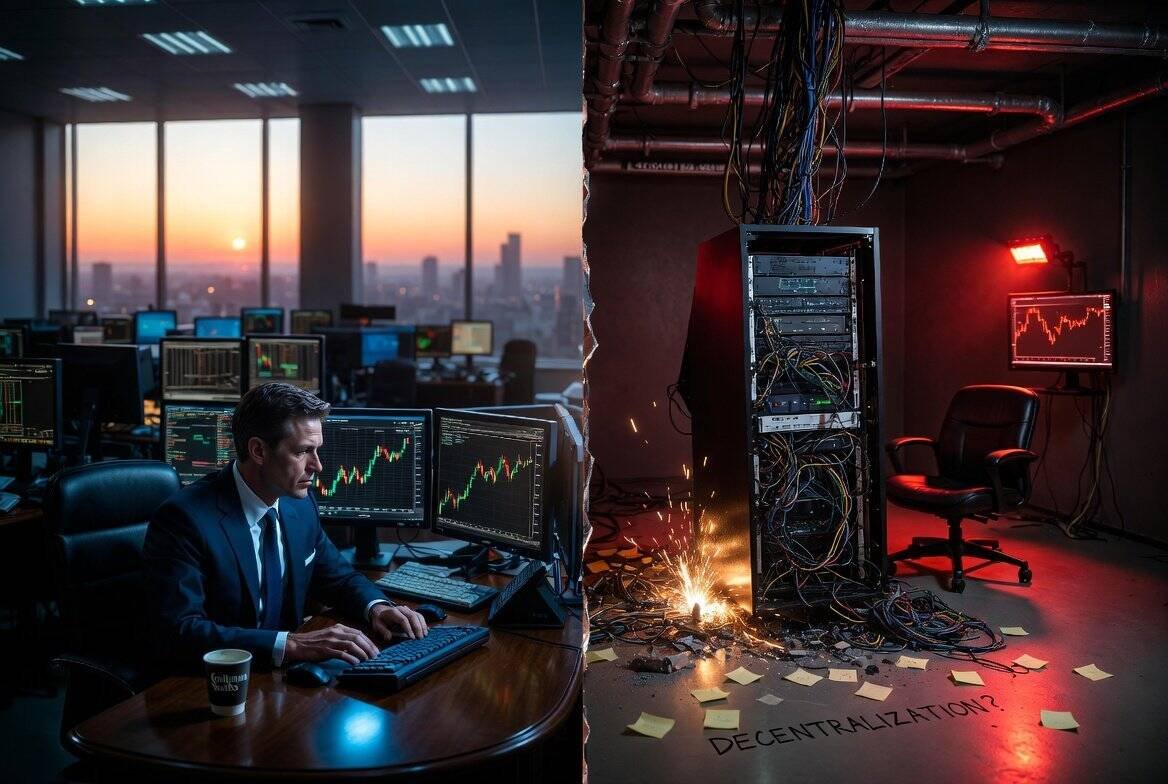
Covenant AI’s founder dumped 37,000 TAO, called the project “decentralization theatre,” and split the community in half.
Grayscale just made Bittensor its single biggest AI bet. Three days later, the project’s most prolific subnet builder called the whole thing a fraud and dumped $10 million in tokens on the open market.
Bittensor’s TAO crashed 28% in a single week – one of the steepest drops for any top-50 token this quarter – after a governance crisis that nobody at Grayscale’s office apparently saw coming.
Key Takeaways
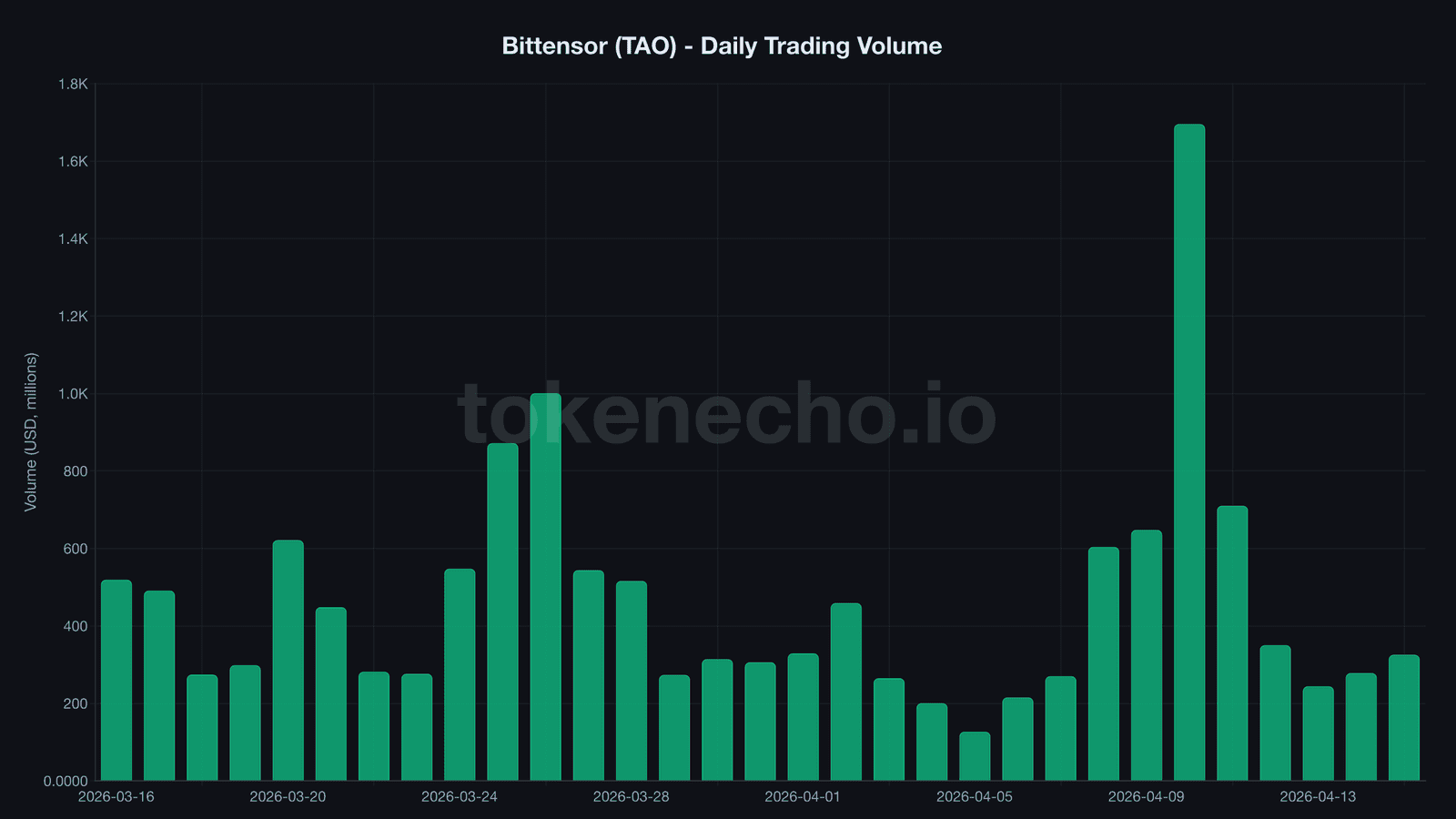
- Covenant AI’s founder sold 37,000 TAO ($10M+) and accused Bittensor of faking decentralization – wiping $900M from the token’s market cap in under six hours on April 10
- Grayscale increased its TAO allocation from 31% to 43% on April 7, just three days before the crash, and its spot TAO ETF filing remains active with the SEC
- All 128 Bittensor subnets continue operating normally – the governance drama hasn’t touched the network’s actual infrastructure
37,000 TAO, one accusation, and $900M gone
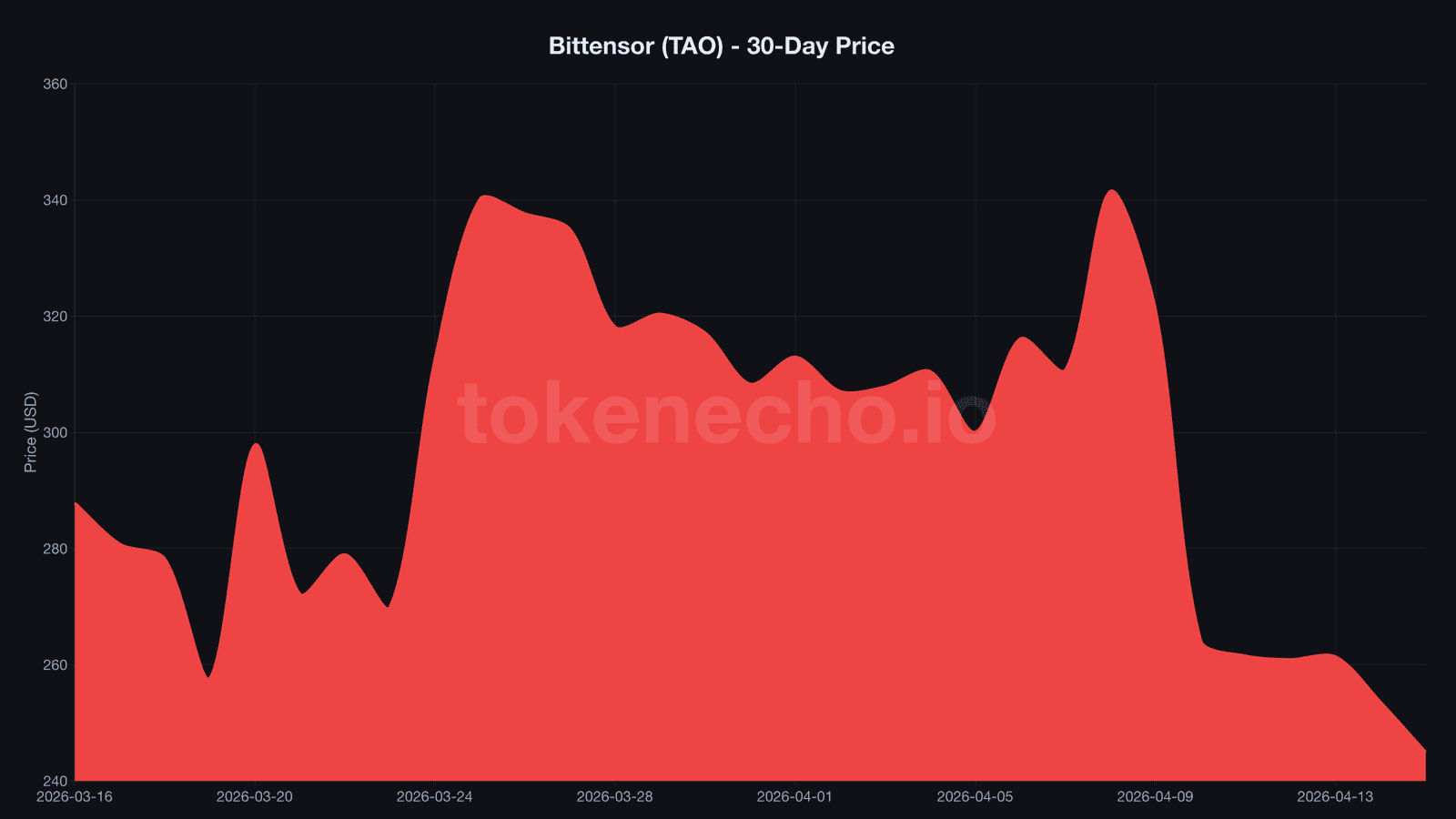
$900 million. That’s what vanished from Bittensor’s market cap in six hours on April 10.
Sam Dare – founder of Covenant AI, one of the network’s largest subnet operators – published a scorched-earth exit statement and then dumped his entire position.
“The entire premise of Bittensor, the promise that drew builders, miners, validators, and investors into this ecosystem, is that no single entity controls it. That promise is a lie,” said Dare.
The target? Bittensor co-founder Jacob Steeves, whom Dare accused of maintaining centralized control while marketing the network as decentralized – what he labeled “decentralization theatre.”
He alleged that Steeves suspended emissions to Covenant’s subnets without warning, stripped their moderation rights over community communication channels, deprecated key subnet infrastructure, and pushed through governance changes without anything resembling consensus from the network’s validators.
Then came the dump.
Dare unloaded 37,000 TAO into an already spooked market. For a token with just 9.6 million coins in circulation, that’s like a board member liquidating their entire stake during a shareholder revolt.
The selling triggered $9-11 million in long liquidations across derivatives venues.
TAO cratered from $344 to $253 within hours. It hasn’t recovered – trading at $247 as of Tuesday morning, down 67% from the March 2024 all-time high of $757.
Steeves fired back, calling the exit a “deep betrayal” and denying any ability to suspend subnet emissions. He also announced a “Locked Stake” mechanism – essentially a vesting lock designed to prevent future sudden exits of this scale.
Buying a house three days before the foundation inspector condemns the building. That’s roughly where Grayscale found itself.
Grayscale raised its Bittensor bet to 43% – three days too early
Nobody told Grayscale. Or if they did, the asset manager didn’t care.
On April 2, Grayscale filed an S-1 amendment with the SEC to advance its spot TAO ETF – adding to its expanding crypto ETF pipeline.
Five days later, the firm rebalanced its AI fund and bumped Bittensor’s weighting from 31% to 43%. TAO became the single largest holding in the portfolio.
Three days after that, $900 million evaporated.
The timing is almost comical – but what happened next is more telling. Grayscale didn’t flinch. No public statement. No panic rebalance. No downsizing.
And they weren’t alone. As we tracked during crypto’s great AI rotation in March, institutional appetite for AI tokens had been building for weeks.
So does Covenant’s exit crack that thesis? Or does Wall Street view governance drama as noise it can afford to ignore?
Bittensor’s fully diluted valuation, the theoretical market cap if all 21 million tokens were circulating, still sits at $5.19 billion. That’s a 2.19x premium over the current $2.37 billion actual market cap – a similar low-float dynamic to what drove RaveDAO’s explosive rally.
Institutional buyers price in a network that grows into its supply schedule. One angry subnet operator – no matter how legitimate the complaints – may not shift that calculus.
But protocols aren’t people. And that distinction matters more than most traders realize right now.
128 subnets don’t care about governance drama
Does Covenant’s exit actually threaten the network?
On paper, no. All 128 active subnets, the independent task-specific networks that form Bittensor’s decentralized AI backbone, kept running through the crash.
Bittensor generated roughly $43 million in Q1 2026 revenue. Not a single subnet went offline when Dare hit the sell button. A new Subnet Ideathon attracted over 150 submissions, and the Teutonic subnet is pushing toward training a one-trillion parameter language model.
But the community fracture is real. Some called Dare’s exit an ego-driven rugpull. Others saw it as a necessary alarm – a legitimate warning that Bittensor’s governance concentrates too much power in too few hands. Both camps are loud. Neither has backed down.
CoinGecko’s sentiment data tells a stranger story: 70% of voters remain bullish on TAO despite the crash. That’s an unusually lopsided reading for a token that just shed a quarter of its value.
The Solana parallel sticks, loosely. The last time a dominant ecosystem player vanished was FTX’s collapse in November 2022 – Solana’s biggest financial backer gone overnight, SOL crashing 77% from $35 to $8, every analyst from Bloomberg to Messari writing obituaries for a chain that kept producing blocks through the entire meltdown.
Eighteen months later, SOL hit $260. A 32x recovery.
But FTX was an external bankruptcy, not an internal accusation of fraud from a top builder. The structural rhyme is imperfect – but the lesson holds: distributed networks don’t die because one participant leaves.
What to watch
- Grayscale’s next rebalance – if TAO drops below 43% in the next monthly update, the institutional conviction thesis weakens considerably
- The “Locked Stake” vote – Steeves’ proposed governance mechanism will either address the centralization concerns or validate them, depending on how much community input actually shapes the final design
- $230 support – a break below this level reopens the path to $200, territory TAO hasn’t visited since early 2025; a reclaim of $300 would confirm the crash was a shakeout, not the start of something worse
Covenant AI called Bittensor “decentralization theatre.” Grayscale called it a $5 billion opportunity. One of them is dead wrong – and the next monthly rebalance might tell us which.
This is not financial advice. DYOR. Data as of April 15, 2026.
Sources: CoinGecko TAO data, The Block: Covenant AI exits Bittensor, AMBCrypto: Grayscale raises TAO exposure
Leave a Reply